
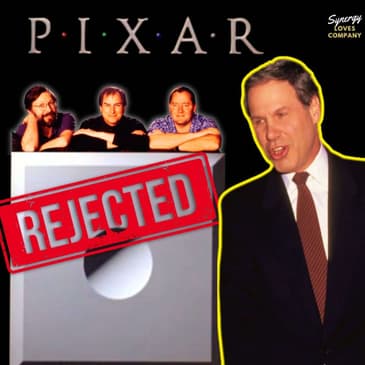
In 1984, Disney had the chance to own the future of animation for just $15 million. They said no.
Today, Pixar is a multi-billion dollar cornerstone of the Disney empire, but the journey from a Lucasfilm basement to the top of the box office was a decade-long corporate war. In this episode of Synergy Loves Company, we’re diving deep into the three specific inventions Disney rejected, the firing of John Lasseter, and the "worst deal" Steve Jobs ever signed.
How did the king of animation miss the paradigm shift happening right under their nose? And how did they end up paying $7 billion for a team they could have owned for a fraction of the price?
In this video, we explore:
-
The Lucasfilm "Graphics Group": The rebel engineering outfit that built the future in a basement.
-
The 3 Key Inventions: How the Pixar Image Computer, CAPS, and RenderMan changed cinema forever.
-
The Exile of John Lasseter: Why Disney fired the man who would eventually save their animation department.
-
The Jobs vs. Eisner Showdown: The high-stakes corporate battle that led to the creation of Toy Story.
QUESTION: Have you seen those early Pixar shorts like Luxo Jr., Red's Dream, or Tin Toy? Which one is your favorite? Let me know in the comments!
If you love exploring how Disney connects to the broader world of history, business, and pop culture, make sure to SUBSCRIBE
https://www.youtube.com/@synergylovescompany?sub_confirmation=1
Podcast: Listen to Synergy Loves Company → https://synergylovescompany.com
Support the Show: Shop official Synergy Loves Company merch → https://shop.synergylovescompany.com
Affiliate Disclosure: Some links above may be affiliate links. If you click and purchase, I may receive a small commission at no extra cost to you.
Thank you for supporting the channel!
Connect with Me:
Instagram → https://www.instagram.com/synergylovescompany
Bluesky → https://bsky.app/profile/erichsynergy.bsky.social
Facebook → https://www.facebook.com/synergylovescompany
Credits / Resources: •
Synergy Loves Company is not affiliated with The Walt Disney Company or any of its subsidiaries. • Images and clips are used under fair use for commentary, criticism, and education.
Until next time, keep discovering the magic in everything!
This podcast is powered by Pinecast.
00:00 --> 26:48 In November of 1995, the El Capitan Theater in Hollywood was packed. The red carpet was out, the lights were blinding. It was the premiere of Toy Story, the first fully computer animated feature film. The audience, full of Hollywood royalty, watched a cowboy doll named Woody and a space ranger named Buzz Lightyear come to life in a way animation had never seen before. It was a triumph, a new era. And the man hosting the premiere, the one basking in all the glory, was Michael Eisner, the CEO of the Walt Disney Company. But here's the thing. That moment, that crown, that future, it didn't belong to Disney. Not really. The company that made Toy Story was Pixar. And just 12 years earlier, Disney could have bought the entire Pixar team, the whole operation, the technology and the future you just saw, for a price tag of just $15 million. But they said no. This is the story of the technical dream team. Disney didn't want the three key inventions they built from scratch and the corporate skepticism that kept Disney, the king of animation, at arm's length from its own future until it was far, far too late. Hey, this is Synergy Loves Company, where we explore how Disney connects to everything. I'm Eric, and let's take a look at how Disney missed out on the chance to make Pixar their own, long before it was even called Pixar. To understand how Disney missed this, you have to go back to the place where Pixar was invented. And it wasn't a glitzy studio. It was in the basement. We're talking about Lucasfilm. In the 1970s, right after Star wars changed cinema forever, George Lucas, flush with success, did something unusual. He started bankrolling a computer graphics research and development division to complement Industrial Light and Magic. This wasn't about making the next movie. This was pure blue sky creative experimentation. He hired a computer scientist named Ed Catmull to run it. Catmull had a lifelong, almost obsessive dream to make the world's first computer animated feature film. In fact, he had been working toward that goal since his graduate school days in 1972, when he created one of the very first 3D computer animations. It was a digital model of his own left hand. That animated hand was more than a technical demo, and it was a statement of intent. It proved that computers could model and animate complex organic forms with realistic detail. For Catmull, it was the first step towards a full length movie. He brought over his partner from the New York Institute of Technology, a graphics pioneer named Alvy Ray Smith, and together they Started assembling a team of the smartest engineers and programmers they could find. This was the graphics group. Their mission statement was simple and wildly ambitious. Don't make the movies. At least not yet. First build the tools that could make the movies. They were a rebel engineering outfit, living inside a film company, Lucasfilm. Their culture wasn't Hollywood. It was pure Silicon Valley. Long haired programmers in T shirts solving impossible programs with code. They were building the future, one algorithm at a time in the Lucasfilm basement. But they had a problem. They could imagine the art, but they were scientists. They needed someone who could see the art in the code. And in 1984, he showed up. A young animator, recently fired from the Walt Disney Company, walked through their doors. His name was John Lasseter. And his arrival created the most ironic triangle. So let's rewind a little bit back a year to 1983, inside the Disney Animation building. John Lasseter was a young, passionate Disney animator. He had worked on the Fox and the Hound and he was a true believer in Walt Disney animation tradition. But then he saw something that broke his brain. The 1982 film, Tron. Now, I personally love Tron. I think it's a great movie, even if it does have flaws. I know I can see the flaws. But it wasn't the success that Disney was hoping for. Lasseter, however, saw it as the beginning of what could be. It was those brief, glowing, computer generated sequences, the light cycles, the tanks. That's what captivated him. He saw something nobody else at Disney did. He saw depth. He saw a new dimension of storytelling, not just special effects. Disney had a history of pioneering so much animation technology. Adding synchronized sound to Mickey, the multiplane camera to get more depth into hand drawn animation. To Lasseter, the computer was the ultimate multiplane camera. So he got to work. He wanted to test that this style of animation could enhance the work that Disney was already doing. Lasseter produced some animation tests based on Maurice Sendak's classic picture book, where the Wild Things Are, to keep it in Disney's comfort zone. The tests included computer animated backgrounds and hand drawn characters. And the results looked great. So he teamed up with other young artists and pitched a project, a hybrid short film that would combine traditional Disney character animation with CGI backgrounds. The project was an adaptation of the Thomas M. Dish novella, the Brave Little Toaster. Lasseter took it to Ron Miller's Disney manager management team and they shut him down hard. The official line was that computers have no place in animation. The real reason was more practical and more shortsighted. Disney was in the midst of what fans sometimes consider the Dark Age, films like the Black Cauldron were bleeding money. The last thing management wanted was a young animator tinking with expensive, unproven technology. They saw it as a distraction from the real work, which was struggling to replicate the past glories. Ironically, the Black Cauldron was the first Disney animated film to feature some computer generated effects. But maybe that's more of a reason they took a pass on it. But they didn't just take a pass on it, they fired him. They let John Lasseter go for championing the very technology that would one day save Disney animation. Disney would later in 1987, release a 2D hand drawn animated Brave Little Toaster without John Lasseter. But it wouldn't be a full Disney release. It had a limited theatrical release by Hyperion Pictures, but became a cult classic on VHS and its re airings on the Disney Channel. Lasseter, with nowhere else to go, heard about the crazy graphics experiment up north at Lucasfilm. He called Ed Catmull. Catmull asked him what he thought about making animated characters with a computer. And Lasseter's response was perfect. Well, I just got fired by Disney. I got nothing else to lose, so let's go. He packed his bags and moved to Marin County. The animator Disney exiled for his faith in computer animation became the creative heart of the very company Disney was about to reject. His role was clear. Use the engineer's tools to create art, to direct short films that would sell the technology to build new animation language from the ground up. With Lasseter now part of the team, the dream had its storyteller. But to bring his ideas to life, they first had to invent the machine powerful enough to render them. To create the complex, beautiful imagery they dreamed of, they first had to build the computer powerful enough to even render it. You have to remember this is the early 1980s. The personal computer revolution was just starting with machines like the Apple ii. What the graphics group needed didn't exist. So they had to invent it. They called it the Pixar Image Computer, or the PIC pic. This wasn't a general purpose machine. It was a specialized, incredibly expensive graphics supercomputer. Its sole job was to process and display high resolution 3D color images. It was a beast. And it cost a staggering 135 per unit. That's over 400 in today's money. Their initial business plan was to sell this machine to make money. Then they could make movies. But they marketed it to scientific and medical fields. Places that needed to Visualize complex data like MRI scans. But it was a tough sell. They were trying to create a market for a product that nobody knew that they needed. This commercial struggle is what Steve Jobs saw when he first met ed catmull in 1985. George Lucas, needing cash to pay for his divorce, had put the entire computer division, including the graphics group, up for sale. Jobs was initially interested, but he was skeptical. He saw a company losing money on a fancy computer that nobody was buying. But Catmull and Smith had a new plan to sell the hardware. To demonstrate the pic's power, you needed killer software. And to them, the ultimate software demo was animation. This led to the first real glimpse of what this team could do when they put it all together while still at Lucasfilm. They created a short film to showcase the pic's real time animation capabilities. It was called the Adventures of Andre and Wally B. And it debuted at the Siggraph Computer graphics conference in 1984. It was a simple story. It's basically a baby chasing a guy. But the revolution was in the motion. The characters had a squash and stretch quality that felt organic. And the backgrounds had a depth that hand drawn animation couldn't match. For the first time, the industry saw that computer graphics could be about character and personality, not just shiny geometric shapes. The short was a sensation at the conference. It proved the hardware could be do something magical. And that magic opened a door. A door that led right to the one company that should have been the most interested. Disney. All right, let's get down to business. Let's set the scene. It's 1983. George Lucas needs money, and the computer division is officially on the block for $30 million. And it doesn't sell right away. Meanwhile, down in Burbank, Disney is in chaos. 1984 is one of the most tumultuous years in the company's history. Corporate raider Saul Steinberg is trying to stage a hostile takeover and CEO Ron Miller is ousted. And in September of that year, a new management team takes over. Michael Eisner as CEO and Frank Wells as president. And then of course, Jeffrey Katzenberg to run the studio. This is the Disney that Ed Catmull and Alvy Ray Smith walk into with their proposal. But it wasn't a cold call. They had even been keeping up with Disney over the years. And they even had a fan on the inside with Disney's chief technologist, Stan Kinsey, who had for years championed the Lucas computer graphics division and pushed for Disney to work with them. Seemed like they had a pretty good in. And the Offer wasn't even asking Disney to buy the whole division. They were proposing a partnership. Disney buys half of the Lucasfilm computer division for $15 million. For Disney, it's a bargain. They get the team, the revolutionary Pixar Image computer. In all the research and development, Disney takes that meeting and gives a flat no. And the veto came from Jeffrey Katzenberg. His reasoning, according to those in the room in later reports, was a combination of cost and profound skepticism. Disney was in the midst of that animation dark age. With the Black Cauldron to be an expensive flop. Katzenberg even thought about closing animation altogether. The last thing Katzenberg wanted to do was to pour millions into an unproven computer graphics division run by engineers, not filmmakers. He saw it as a science project, not a production studio. Think about the irony here. Disney's own animation crisis, their struggle to find creative direction blinded them to the technological solution being literally sold to them. They were so focused on fixing the old way or just getting rid of it, that they couldn't see the new way being invented in a basement up the road. With Disney out, the door was wide open for someone else to buy the graphics group. That someone else was Steve Jobs. After the deal with Disney fell apart, Jobs continued negotiating with Lucas and the asking price dropped. And In February of 1980, Steve Jobs bought the computer division from Lucasfilm for $10 million. He spun it off as an independent company and named it Pixar. Jobs became the chairman and the primary investor. Ed Catmull was the president and John Lasseter was the creative lead. The dream team was now officially on its own. So Pixar was independent. But their financial reality was brutally precarious. Steve Jobs was writing checks every month just to keep the lights. The Pixar Image computer remained a tough sell. They were doing TV commercials and they were making short films, but they were still hemorrhaging money. The lifeline, ironically, came from the very company that had just refused to buy them. Disney had its own desperate problem. Its animation process was stuck in the past and it was killing them financially. I'm talking about the actual physical process of making a cartoon. After the animators drew the characters on paper, an army of artists had to hand paint every single frame onto clear plastic sheets called cells. Then the photographers had to photograph those cells one by one onto film. It was labor intensive, slow and wildly expensive. A single feature film could require over a million hand painted cells. And after all that work, you had to hope and pray it would be a success if Disney could streamline, maybe even digitize their Pipeline, they could save time and money. And who had the only computer graphics technology advanced enough to attempt it? The guys. They had just said no to Pixar. So in the late 1980s, Disney hired Pixar as a vendor. Their contract billed us the Computer Animated production system, or CAPS. This wasn't about 3D animation. This was about taking Disney's existing 2D hand drawn process and bringing it into the digital age. Pixar's job was to create a digital ink and paint system that could replace the armies of painters and photographers. And they did. CAPS was a revelation. It allowed animators to scan their drawings into a computer, color them digitally and then composite them with backgrounds, all without ever touching a physical cell. The first feature film to use it was 1989's the Little Mermaid. You can see it in film one scene, the final one with the rainbow. That's all caps. But that's all that used caps in the movie. But then in 1990, they went all in on CAPS and all in on feature sequels. With the rescuers down under, it was the first fully caps produced Disney film. Caps didn't just save money, it enabled the Disney renaissance. The complexity and the speed of films like Beauty and the Beast, Aladdin and the Lion King would have been impossible with the old sell method. Disney's greatest modern creative run was powered under the hood by Pixar's technology. But the relationship dynamic was crystal clear. Disney was the client and Pixar was the vendor. A hired tech shop. They were improving Disney's process, not replacing it. In Disney's eyes, they were toolsmiths, not peers. And Pixar knew it too. To change the perception, they had to keep proving that they were storytellers too. And that's where the short films came back in. While developing CAPS, they released Luxo Jr. In 1986. That film wasn't for Disney, it was for the world. A tiny lamp hops around, plays with the ball, and shows more personality in two minutes than most characters show in a whole feature. It got an Oscar nomination and proved they could do character and emotion, even with inanimate objects. But a lamp is one thing. To sell a feature film, you need to prove that you can create an entire believable world. And for that, they needed to invent one final crucial piece of software. All right, let's break down the core problem. You've built the computer, you can model a 3D character, but how do you make it look real? How do you make a metallic toy look shiny and scuffed? Or a baby's skin look soft and translucent. In the early days of cgi, everything looked like shiny plastic. It was cold, it lacked texture. It couldn't support the warmth that a feature film story needs. The answer wasn't in the modeling. It was in the final step, the rendering. This is where Pixar made their masterstroke. They invented a software called Renderman. Renderman wasn't a tool for artists to draw with. Think of it as the dark digital equivalent of the camera, a lighting studio and a physics lab all rolled into one. Its job was to take all the 3D data, the models, the lights, the camera angles, and calculate the final photorealistic image. But its secret weapon was something called the shading language. This was the game changer. Shading language let artists and programmers define how a surface reacts to light. They could write a little program that said, this is metal, so it should be very reflective or with sharp highlights. Or this is denim, so it should be slightly fuzzy and absorb most of the light. Or this is skin, so it should scatter the light slightly beneath the surface to give it a soft, subsurface glow. This moved CGI out of the realm of basic colors and into a world of visual richness. It could make water look wet, dust look dusty, and hair look. Well, they were still working on hair, but you get the idea. Renderman was the software that could make you believe that a world existed. The proof was in the short film that fully realized its power. 1988's Tin Toy. This was the story of a one man band toy terrified of a chaotic drooling baby. And it's a visual leap from anything before it. The metallic sheen of the tin toy, the slightly grimy plastic of the other toys and the baby. Audiences couldn't believe their eyes. It was the first realistic humanoid character done in cgi. Its skin had a believable softness. Its movements were clunky and organic, like a baby. Tin toy didn't just win the Academy Award for best Animated short. It was the absolute undeniable proof of concept for Toy Story. It proved Renderman could make a world you could believe in, populated by characters you could imagine actually care about. Have you seen any of these early pixar shorts? Luxo Jr. Red's Dream Tin toy. I didn't even talk about Red's dream, but which one of these is your favorite? Drop a comment below. I'd love to know which one you remember the most. Or maybe you watched them more recently on Disney. Which one's your favorite? While the Pixar image computer hardware Business ultimately failed. Renderman became a quiet massive success. It became the industry standard for high end visual effects. The dinosaurs in Jurassic park rendered with Renderman, the liquid metal in Terminator 2, Judgment Day, RenderMan, Industrial Light and Magic, the company Pixar was born from, was now their best customer. So by the early 1990s, Pixar had survived. They had kept the lights on with with Caps, Money and Renderman licenses. And they had the hardware legacy and the industry standard software and a string of award winning short films that proved their artistic chops. They had built all the pieces. The stage was finally set. All they needed was a partner willing to bet everything on a full length film. And Disney, after a decade of saying no, was finally ready to say yes, but only if the terms cemented their total control. So in 1991, Pixar has credibility from Tin Toys, Oscar and the trust of the Capps partnership. And they finally have enough leverage to pitch the big dream, a feature film. John Lasseter takes the idea to Jeffrey Katzenberg at Disney. And the pitch is simple. A buddy movie about toys. The toys come alive when the humans aren't around. It's a premise that plays perfectly to the strengths of Tin Toy. Katzenberg loves it. The project gets the green light and becomes Toy Story. Here's where the deal gets brutal. Disney agreed to finance and distribute. But the terms of this three picture contract were overwhelmingly, deliberately in Disney's favor. They'd own the rights to the characters, Woody and Buzz, all of them. They'd control the merchandise rights and any sequels. And they'd take the vast majority of the profits. Pixar's role, they were a production contractor, a hired gun studio using the tools they invented, Renderman, their pipeline, all to make a film for the client. They were still not a peer in Disney's eyes. They were a vendor being paid a fee to deliver a product. Steve Jobs later called it the worst deal he'd ever made. But he also knew it was the only deal. It was this or no movie at all. The stakes were existential. If Toy Story failed, Pixar was finished. Steve Jobs was prepared to sell the company everything. Catmull's lifelong dream. Lasseter's creative vision. A decade of invention came down to this one film. But we're in the future. We all know what happened next. Toy Story wasn't just a hit, it was a cultural earthquake. It became the highest grossing film of 1995. It changed the entire power dynamic. Overnight, Pixar was no longer a struggling tech shop. They were the new gold standard. And the tables had turned. Disney, the king, was suddenly in a position of playing catch up. Let's rewind for a second. Disney had three clear chances to own this future. To listen to John Lasseter and invest in computer animation. In 1983, they could have bought bought a piece of George Lucas's team. In 1984, for 15 million, they could have been more than just a client for the cap system. Each time they saw a cost, a risk, a distraction. They never saw the paradigm shift that was happening, the consequence. By 1995, they were trapped in a perfect corporate catch 22. Disney owned the rights to the characters and controlled the distribution and the keys to the theaters. But Pixar owned the creative future. Every Pixar hit like Toy Story didn't just make money for Disney. It made Disney's own traditional animation look more outdated. It was a brutal feedback loop. Disney needed Pixar's hits to stay relevant. But those same hits were systematically undermining Disney's own animation division, their historic bread and butter. Pixar needed Disney's marketing machine to reach audiences, but Disney needed Pixar's innovation to avoid becoming obsolete. Each company held the other's fate in their hands and neither could succeed without damaging the other. And that impossible tension created a volatile decade long corporate showdown between the most stubborn CEO in Tech, Steve Jobs, and the most stubborn CEO in Hollywood, Michael Eisner. A brutal battle for control, for credit, for survival and relevance in the new animation landscape. That war, the clash of egos between Jobs and Eisner, the renegotiations, the near breakup in the ultimate acquisition of Pixar by Disney. That's a story for the next time, so subscribe so that you don't miss it. You can also check out the other Pixar related videos I've been doing about Tom Hanks and Tim Allen. And until next time, keep discovering the magic in everything. Sam.