
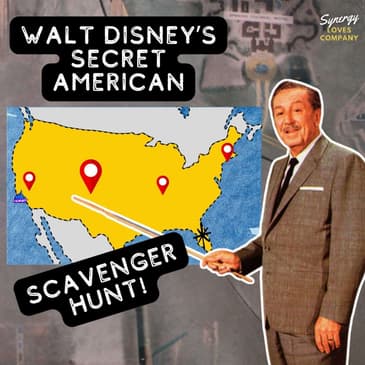
Before Walt Disney bought a single acre of swampland in Florida, he spent years on a secret "scavenger hunt" across America. We often hear that Disney World was a "Plan B" after Disneyland, but the truth is much more calculated. From a luxury bowling alley in Denver to a 5-story indoor theme park in St. Louis and a controversial ski resort in the Sierras, Walt was secretly testing the pieces he needed for his "Florida Project."
In today’s episode of Synergy Loves Company, we’re connecting the dots between Walt’s biggest "failures" and the ultimate success of Walt Disney World. We explore:
- How a Denver bowling alley became the training ground for Disney’s world-class service.
- The real reason the St. Louis "Riverfront Square" project was cancelled (it wasn't just about the beer!).
- Why a mountain ski resort in the Sierras taught Walt the most expensive lesson of his life.
- How the 1964 New York World’s Fair acted as a multi-million dollar R\&D lab funded by corporate sponsors.
Every stop on this scavenger hunt provided a piece of the puzzle: Operations, Control, Land, Technology, and Market Proof. By the time Walt looked at Florida, he didn't just have a dream—he had a proven blueprint for perfection.
Join the Conversation: Which of these "failed" projects do you think had the most fascinating ripple effect on the Disney parks we know today? Let me know in the comments
!Subscribe for more Disney connections:
https://www.youtube.com/@synergylovescompany?sub_confirmation=1
Podcast:
Listen to Synergy Loves Company → https://synergylovescompany.com
Support the Show:
Shop official Synergy Loves Company merch → https://shop.synergylovescompany.com
Affiliate Disclosure: Some links above may be affiliate links. If you click and purchase, I may receive a small commission at no extra cost to you. Thank you for supporting the channel!
Connect with Me:
Instagram → https://www.instagram.com/synergylovescompany
Bluesky → https://bsky.app/profile/erichsynergy.bsky.social
Facebook → https://www.facebook.com/synergylovescompany
This podcast is powered by Pinecast.
00:00 --> 18:49 July 17, 1955. Disneyland opens. And opening day is kind of a mess. The asphalt is still soft. The water fountains don't work. Tickets are counterfeited. And then Mark Twain Riverboat nearly capsizes. But past the chaos of opening day, something undeniable happened. The public showed up. And they never stopped. Disneyland wasn't just a park, it was a phenomenon. It redefined what family fun could be. And that success created a problem for Walt, a personal one. You see, Walt Disney loved his park because it was, in his words, alive. He said, it's something that will never be finished. Something that he could keep developing and pushing and adding to a movie once it's done is done. But Disneyland could grow. The trees would grow, the ideas would grow. It would get more beautiful as time went on. But there was a catch. Disneyland was in Anaheim. And by the late 1950s, Anaheim was changing. Because of Disneyland. Cheap motels and tourist traps were popping up right outside the park's berm. Walt's perfect little world was getting boxed in by the very commercialism he wanted to escape. At the same time, the public wanted more. And they started asking a question. A simple one. When will there be another Disneyland? Walt had famously said there would never be another Disneyland. But you know, he always kind of wanted to build something like it, but maybe bigger, maybe on a more grand scale. And his mind was already looking beyond Anaheim's borders. He was restless. The success trapped him. But his imagination wouldn't stay trapped. The question wasn't if he would expand, but how? And more importantly, where? Hey, this is Synergy Loves Company, where we explore how Disney connects to everything. I, Eric. I'm Eric. And today we're taking a look at Walt Disney's scavenger hunt all around the United States for where to build his next dream and avoid those downsides he discovered in Disneyland. So, of course, Walt went looking. And his first stop wasn't a theme park at all. It was a bowling alley. A really, really fancy bowling alley just outside Denver, Colorado. Get this. By 1959, bowling was a national craze. Automatic pin setters had turned it into a massive Walt. Always looking for where families wanted to spend their time. Saw an opportunity. Along with his brother Roy and a bunch of celebrity friends, Jack Benny, Bing Crosby, George Burns, they backed a new venture just outside of Denver, Colorado, and they called it Celebrity Lanes. But this wasn't just your local alley. When it opened in phases Starting in 1960, it was a $6 million indoor entertainment complex. It had 80 bowling lanes, an Olympic sized swimming pool, slot Car racing tracks in the basement, bumper cars, an English pub, a fine dining restaurant, even a barber shop. At this point, it was more than just a bowling alley. It was the Celebrity Sports Center. And it could be a prototype, A test to see if the Disney standard of operations, service and cleanliness could work outside of Disneyland in California. And it did. Families loved it. Disney characters even showed up for photo ops. But here's where it gets interesting. By 1962, Walt and Roy bought out all the other celebrity investors and they took full control. And this is key. It stopped being a celebrity backed side project and became a Disney operation. They brought in the full playbook. Employees got those strict Disney appearance rules. Short hair, polished shoes. They watched training films narrated by Walt himself. And it became a real world training ground for the service culture that defined the Disney parks experience. Celebrity Sports center proved something crucial to Walt. It proved that his brand and his operational model could travel. It could work in a different city with a different climate. It was also profitable, but it also showed the limit. This was a successful business, but it wasn't storytelling. It wasn't the expansion of his narrative dream. It was a lesson in operations. But Walt was after something bigger. Walt Disney had proven the operations could work. Now he wanted to test the art, the show. And for that he looked to a place that felt like home. Walt Disney grew up in Missouri and he always said he considered it his home state. So in 1963, when the city of St. Louis approached him to make a Circle Vision film for their bicentennial, he listened. But Walt being Walt, he didn't just want to make a film. He saw a bigger opportunity. What started as one film snowballed. And By November of 1963, Walt was announcing plans for Riverfront Square. This wasn't another Celebrity Sports Center. This was a five story, completely indoor theme park. Two city blocks covered by a roof, operating 365 days a year. Walt said it would give them control of the weather. They'd have their own sky with the roof and the ceiling. The plans were incredible. It was going to be a love letter to the history of the Mississippi River. There was a Lewis and Clark dark ride, a bayou boat ride with alligators. Kind of a clear prototype for what would lead to the Pirates of the Caribbean. There was even a walk through haunted house with a stretching room meant for Missouri ghost stories. They were debating whether to include classic characters from Disney stories like Peter Pan or keep it purely historical. But then the problem started. The popular story is that Walt got into a feud with August Bush Jr. Over alcohol. Yep, that bush, the Busch family, Anheuser Busch. Busch said any man who built this and didn't serve beer was crazy. St. Louis was a beer town. Walt, wanting a family venue, initially refused. He had famously established a no alcohol policy at Disneyland. So it became a public spat. But that's not really what killed it. The real failure was about control. Walt believed Disney should only be responsible for the show, the rides, the stories, the magic. He wanted St. Louis to build the entire building. Shell the parking garages, the infrastructure, and then sell them the land cheap. He wanted a turnkey box to fill with Disney magic. St. Louis said no. Disney had to build everything out, put in that infrastructure, everything to make it happen. That was just a deal breaker. In July of 1965, they both jointly announced the cancellation. Walt's homecoming project was dead. But he got a lot of good ideas from the attractions they were going to put in there. The lesson from St. Louis was brutal and clear. To build his vision, Walt Disney needed total, complete, unambiguous control over the physical environment. It was a lesson that he would not forget. If St. Louis taught Walt about control, this next project taught him about a different kind of opponent. Public opinion. In December of 1965, Walt Disney Productions won the rights from the U.S. forest Service to develop Mineral King. This was a massive beautiful valley in California's Sequoia National Forest. And for Walt, this was personal. He loved the outdoors, he was an avid skier and he had even invested in the Sugar bowl ski resort years earlier where they named a peak Mount Disney after him. He'd been involved in the pageantry of the 1960 Winter Olympics. This wasn't just a business move. It was a page passion project for Walt. His vision was an alpine village. A year round resort that would preserve the valley's natural beauty. Cars would be banned from the valley itself. Guests would park at the entrance and be taken in by a quiet convoyance. The village would be tucked away so you couldn't even see it from the road. Service areas would be underground. He even had this idea for like a dinner show there, the Country Bear Jamboree. And it was designed for one of his restaurants, Audio animatronic Bears for a ski lodge. It just makes sense. It was the opposite of the sprawl you could see at other mountain resorts. This was Walt's yes, if philosophy in action. Yes, we can build a world class ski resort if we do it in a way that honors the land. But there was an enormous access. To make it work year round, they needed a new all Weather highway. And the only logical path cut right through the neighboring Sequoia National Park. And that's when the opposition mobilized. The Sierra Club, which had once supported development there, launched a Keep Mineral King Natural campaign. Bumper stickers appeared. This wasn't a business dispute like with August Bush. This was a philosophical battle. Conservationalists saw the valley as a pristine wilderness that should not be touched, even by design. As thoughtful as Waltz, the lesson from Mineral King was starting to form even as Walt announced the plans with Governor Pat Brown in September 1966. It showed him that even with the best intentions, the purest environmental plans and the support of the state, public and legal opposition could stop a project dead in its tracks. You could have the right idea and the right design and still lose out. It proved that developing on public land, with all of its regulations and competing interests, was a minefield. Wal was learning that that to truly control his destiny, he needed to own the land. Not just lease it, not develop it with permits, own it outright. And all. While that was happening, he was about to get the final, most important piece of evidence that his next big idea wasn't just a dream. It would be a guaranteed success. Because while he was dealing with the mountains in the lawsuit, something else was happening on the other side of the country that was about to change everything. The 1964 World's Fair. Now, on the surface, Walt created four corporate sponsored exhibits. It's a Small World for Pepsi and unicef, the Carousel of Progress for General Electric, Ford's Magic Skyway, and great moments with Mr. Lincoln for the state of Illinois. To the public, they were just really cool things to see at the fair. It was magic in action. But for Walt, this wasn't just an exhibition. It was a fully funded research and development lab. He got corporate sponsors to pay millions for him to develop the next generation of Disney technology. And the scale was staggering. Over 40 million visitors saw Disney's exhibits. The Carousel of Progress alone cycled through 40 people a day. Think about that number for a second. That's the entire population of a small city, every single day lining up for a Disney show in New York, not in California. The east coast audience wasn't a theory anymore. It was proven massive and undeniable that they were starved for a Disney Parks project. And the real magic was happening backstage. This was the trial by fire for Audio Animatronics. Before the fair, they had singing birds in the enchanted Tiki Room. But after the fair, they had a full human figure with Abraham Lincoln delivering a speech. The technology leap was enormous and It's a Small World proved that you could put hundreds of simple, charming figures in a single massive attraction. The ride systems got their test run too. Ford's Magic Skyway used the new WEDWAY propulsion system, where cars had no moving parts, just a track that pushed them along. That system would become the basis for Disneyland's People Mover. And the sheer efficiency of moving thousands of people per hour on a gentle boat ride in Small World that directly changed Walt's mind on his biggest project back in Anaheim, the one that kind of started with the St. Louis project. He saw how well it worked and decided right then that his planned pirate themed walk through at Wax Museum for New Orleans Square in Disneyland should instead be a boat ride. That walkthrough turned boat ride became Pirates of the Caribbean. The east coast wasn't just ready for Disney, it was desperate for it. The technology to build something more advanced and on a larger scale than Disneyland was tested. And the question was, no longer can we do it? The question became, where do we do it and how do we do it to make sure that nothing stops us this time? All right, we've crisscrossed the country. Denver, St. Louis, the Sierras, New York. On paper, it looks like a series of failures in sight side projects. But to Walt, this wasn't a list of failures. It was a scavenger hunt. And every stop gave him a crucial piece of the puzzle for the ultimate project. So by late 1965, Walt's strategy crystallized. He wasn't just looking for a place to put a second Disneyland. He was looking for a place where he could apply all five of those lessons at once. And he had secretly been planning and searching all the while. He needed a location with a proven tourist draw and room to grow. He needed to own enough land, not just for the park, but for miles around it, so he could control every single thing a guest saw or experienced. He needed a climate that could allow for year round operation. And he needed it to be far enough away from Disneyland to tap into a completely new audience, but accessible enough so that that audience could get there. The answer, when you laid out the map of his scavenger hunt, became obvious. All those paths pointed to the one clear open Florida. This would be the Florida project. So why Florida? It wasn't just a random pin on a map. By 1963, the St. Louis deal was starting to fray. Walt and Roy had already begun seriously discussing an East Coast Disneyland and the World's Fair. Success was the final proof that the audience existed. But Florida offered specific, tangible Solutions to every problem that Walt had just spent four years encountering. First, the land was cheap and plentiful. We're talking about central Florida swampland and cattle pastures that could be bought for a fraction of the cost of land in a developed city like St. Louis. Second, the climate was great year round operation, not even having to consider snow shutting you down for months, which was the core problem for places like Denver and the Mineral King project and even St. Louis. But the most critical insight came directly from Anaheim. Walt looked at the tourist traps surrounding Disneyland. And he knew that he would never let that happen again. In Florida, he could buy enough land to control everything, the entire environment. He could dictate what got built around it, how people got there, and even what they saw on the horizon as they arrive. Financially, Disney was finally generating massive profits. For the first time, the company had a capital to attempt something on a major scale without needing a city to help build them, a shell or a corporate sponsor to fund the research and development. They could pay in cash, in secret. Build a city of their own and own it all. And Walt himself laid out the vision. He said, I've always said that there will never be another Disneyland, and I think that's going to work out that way, but this will be the equivalent of Disneyland. He emphasized that it had to be unique, with a distinction between the California park and whatever they were going to build in Florida. This wasn't about copying Disneyland. It was about applying everything he had learned to create something new, something bigger, something that could even begin to hold his evolving dream of a real working city of tomorrow. A concept he was already calling Epcot. So the stage was set. The market was proven in New York. The land was available in Florida. The capital was in the bank from Anaheim. And the painful lessons from every other stop on the scavenger hunt had written the rule book. But pulling it off required executing a plan with military precision and a level of secrecy that was completely foreign to the very public man who had just fought a very public battle in both Missouri and California. All right, before we go any further, I want to hear from you looking back at Walt's scavenger hunt. The bowling alley, the indoor park in St. Louis, the ski resort, the World's Fair. Which of these projects do you think had the most fascinating ripple effect? Which one are you most glad we got to learn about today? Let me know down in the comments. Walt's checklist for the Florida project was the direct product of the American Scavenger Hunt. Every item on it was purchased with the frustration of a canceled project or the limitation of a successful one, Walt hid the complete blueprint now. But executing his new plan in total secrecy while also buying a staggering amount of land for someone as famous as Walt Disney created an enormous final problem. How do you secretly acquire over 27 acres, an area twice the size of Manhattan, from hundreds of different landowners without anyone figuring out it's you? Next time on Synergy Loves Company, we explore how Walt Disney, the world's most famous dreamer, became a master of disguise with shell companies and the secrecy to pull it all off. Thanks for joining me for this look into Walt Disney's secret scavenger hunt all across America. And if you enjoyed connecting these dots with me, remember to like this video and subscribe to Synergy Loves Company so you won't miss the next one. The story where we find out how Walt secretly bought enough Florida land to build his kingdom. And until next time, keep discovering the magic in everything.