
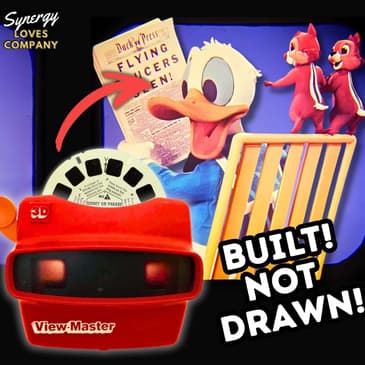
Why did a plastic toy from the 1930s look more immersive than the multi-million dollar Disney movies it was based on?
Before CGI and VR, Disney fans had a secret portal into the movies: the View-Master. But there’s a mystery at the heart of those tiny film reels. While the movies were flat, 2D animation cels, the View-Master reels featured lush, 3D worlds with incredible depth. Who sbuilt Neverland in 3D? Who sculpted a physical Baloo the Bear so you could see him from every angle?
In this episode, we explore the connection between a German piano tuner, the 1964 World’s Fair, and the legendary (but often uncredited) artists like Florence Thomas, Joe Liptak, and Martha Armstrong Hand. These sculptors didn't work for Disney, yet they were the ones who physically "built" the Disney universe in 3D, one clay model at a time.
In this video, we’ll discover:
The connection between the Carousel of Progress and the birth of 3D armchair travel.
How a corporate "spy op" purchase of Tru-Vue handed Disney to View-Master.
The painstaking process of "3D-ifying" 2D animation using clay, dioramas, and single-lens cameras.
Why the GAF sponsorship era made the View-Master the ultimate Disney Park souvenir.
Subscribe On YouTube for Disney connections you can look at:
https://www.youtube.com/@SynergyLovesCompany?sub_confirmation=1
Podcast:
Listen to Synergy Loves Company → https://synergylovescompany.com
Support the Show:
Shop official Synergy Loves Company merch → https://shop.synergylovescompany.com
Affiliate Disclosure: Some links above may be affiliate links. If you click and purchase, I may receive a small commission at no extra cost to you. Thank you for supporting the channel!
Connect with Me:
Instagram → https://www.instagram.com/synergylovescompany
Bluesky → https://bsky.app/profile/erichsynergy.bsky.social
Facebook → https://www.facebook.com/synergylovescompany
Credits / Resources:
• Synergy Loves Company is not affiliated with The Walt Disney Company or any of its subsidiaries.
• Images and clips are used under fair use for commentary, criticism, and education.
This podcast is powered by Pinecast.
00:00 --> 20:03 You hear that sound, the solid, satisfying click of the lever. And then pop. Suddenly, you're not in your living room anymore. You're standing right in the middle of Main Street, USA, the castle looming ahead. In perfect, impossible 3D, you could click through the whole park. The Matterhorn, Pirates of the Caribbean. It felt like you were really there. In your hands is the viewmaster. And it allowed you to visit the Disney parks from the comfort of your own home. But you could also swap the real. And now you're in the worlds of your favorite Disney movies like the Jungle Book. And you're looking at Baloo and Mowgli hanging out in the jungle in that real depth. Now you're looking at Peter Pan. You could see all of Neverland stretching out behind Captain Hook's ship. It was incredible. But wait, that doesn't look like the movie. Those movies were hand drawn. They were flat two dimensional animation cells. So where did this three dimensional world of View Master come from? Hey, this is Synergy Loves Company, where we explore how Disney connects to everything. I'm Eric, and today we're taking a look at how View Master built a 3D Disney World you could hold in your hands, or at least hold the View Master in your hands and see those worlds through it. All right, though, first, to understand the View Master, we have to go way back. And Disney actually gave us the perfect clue. You know the Carousel of Progress, right? That classic 1964 New York's World's Fair attraction where we follow a family through the decades of technology. In the very first scene, set around the turn of the 20th century, what's the family doing for entertainment? Well, the son, James is using his father's stereoscope to watch Little Egypt dance the hoochie coochie at the St. Louis World's Fair. And that is our aha moment. Because the View View Master is a direct descendant of that exact device. The stereoscope was the Victorian version of virtual reality. It was invented all the way back in 1838 by a man named Charles Wheatstone. He figured out the brain trick we now take for granted. If you show your left eye one image and your right eye a slightly different image, your brain slams the two of them together and creates the illusion of depth. One 3D picture. The this kicked off a huge craze. Queen Victoria was obsessed with them, and for good reason. In a world before television, this is how you could see the world. You could sit in your parlor in London or New York and experience the Grand Canyon. You could see Niagara Falls. It was the original Armchair tourism. People collected stereo view cards of famous landmarks and world wonders, the way we might collect postcards or, well, even View Master reels. That device in the Carousel of Progress isn't just a funny gag. It's a lineage marker that shows us that the desire to see the world in 3D, to be transported somewhere else, is an old, old idea. The View Master didn't invent that desire. It just found a brilliant modern way to package it. Well, modern for the 1930s, because that's where our story of the Viewmaster starts. With a German immigrant named William Gruber living in Portland, Oregon. By trade, he was a technician who specialized in fixing incredibly complex player pianos. But his passion was photography, specifically stereoscopic photography. And he was always tinkering, trying to build a better way to see his 3D photos. The old stereo cards were clunky. You had to get them lined up just so each time you switched them. But then Gruber had a eureka moment. The new Kodachrome color film had just been invented, and it was stunningly vibrant. Vibrant. He looked at the real mechanism from a player piano, the ones he was fixing in this spool that could advance a long continuous strip of paper with perfect precision. He thought, what if I put tiny pieces of color film in a circle like a reel, and built a viewer that clicks with that same precision from one scene to the next? He built a prototype. And then in 1938, Gruber was on a trip to to the Oregon caves, getting some 3D photo sets with his twin camera setup, when he was approached by another tourist who turned out to be Harold Graves, the president of Sawyer's Photographic Services, which just happened to be the largest producer of scenic postcards in the entire country. Graves saw Gruber's rig and they got to talking and a partnership was born. Together they debuted the View master at the 1939 New York's World's Fair. Those World's Fairs keep popping back up all the time. And it was sold to adults, grownups, a high tech replacement for the scenic postcard. And it tapped into that same century old desire. We just talked about armchair travel. People who couldn't just hop on a train or a ship could see the Grand Canyon or redwood forests and vivid depth filled color from their living room sofa. It's the exact same instinct Walt Disney would later tap into with his true life adventures and People in Places documentary series, using the magic of film to bring wonders of the world right to you. Then, almost immediately after the debut of the Viewmaster, World War II changed everything. The US military saw the potential and they ordered over 100 Viewmaster viewers and millions of reels for training purposes. Purposes, things like aircraft identification and range estimation. This was a serious, durable tool. And that military contract proved the format was tough and reliable and exposed thousands of soldiers to the product. So by 1950, Viewmaster was this sturdy, proven system with a great reputation. But by the early 50s, they had a problem. But it was a good problem. Even though View Masters were made for grownups, kids loved the viewers too. But they didn't just want reels of landscapes. They wanted characters. They wanted stories. So View Master made reels of stories and fairy tales. But their biggest competitor, a company called trueview, had an edge when it came to telling stories. Trueview made these filmstrip viewers similar to a View Master, but they were more linear, a little clunkier than the View Master, but they had an extreme advantage. They held the exclusive license to produce 3D film strips of popular cartoon characters, including Hanna Barbera characters and you know why you're here. Disney's characters. Sawyer's viewmaster couldn't compete in the popular characters and story driven images. So they did the next best thing. In 1951, they bought TrueView outright, the whole company. And with that purchase, the exclusive Disney character license transferred instantly over to Sawyer's viewmaster. Now View Master went from being a tool for tourists to a kids portal into the wonderful worlds of Disney. And the timing couldn't have been more perfect, because just four years later, those two worlds collided. Tourists, kids. In 1955 when Disneyland opened. Now there was this brand new magical place millions of people all across the world wanted to see. And for the kids who couldn't go, or for the families who wanted to remember their trip, Viewmaster was suddenly right there, ready with the definitive 3D souvenir. Disney was the perfect real life fairy tale View Master setting exactly what the product was made for. But let's get back to those stories and characters from Disney movies that they worked so hard to get their hands on. For View Master and trueview before that, to make the characters and stories pop, they needed artists who could turn those flat cartoon cells into a tangible three dimensional world that you could reach out and grab. Someone had to physically build Peter Pan's Neverland. Someone had to sculpt Cinderella and Bambi and Baloo the bear from the Jungle Book. There were actually a whole group of artists who brought the fictional stories to life for View Master, but we're going to dive into a few that help bring the Disney stories to life. First we got to talk about Florence Thomas. She's the forgotten foundation of the viewmaster storybook world. She was brought on as a freelance artist in 1946 and she actually worked for both Sawyer's Viewmaster and and that main competitor, Truview. The stereoscopy world was small and her talent was in high demand. So both companies had that same problem. They wanted to move beyond scenic photos and they wanted to tell stories. And Florence Thomas was one of those who figured out how to do it for all of them. Her innovation was that diorama. She would sculpt entire miniature worlds out of clay. We're talking about sets that could fit on a tabletop with tiny trees, little buildings and hand sculpted characters. She often shot these scenes with a single camera, not a stereo camera. She would put the camera on a track, take a picture for the left eye, and then slide the camera a few inches over to take a picture for the right eye. Sometimes to enhance that 3D effect even more, she would move the clay puppets a tiny bit between the two shots. It was a of piece, painstaking, frame by frame kind of magic that she created. Her clay subjects proved that this format could handle anything she did fairy tales, Mother Goose Rhymes, but she also built scenes for Frankenstein and Dracula. She was the essential bridge. She proved that this photographic viewing system wasn't just for landscapes. You could use it to act out a narrative scene by scene. You could do build a universe. Florence Thomas laid the groundwork in these techniques and she set the artistic standard that future View Master sculptors would follow. She established that these weren't just quick toys, they were meticulous pieces of art. Her work helped create the template and she did work on some Disney for trueview. So when that Disney license finally landed in Sawyer's View Master lab, their go to artists already knew how to tell a 3D story and they had this method. They just needed someone who could apply that method to their most beloved characters and animated stories with absolute fidelity. And that job would fall to the man that Florence Thomas trained. An artist who would become the main Disney viewmaster sculptor for almost half a century. Joe Liptec Liptech became the guy who would tell more Disney stories in this format than anyone else. And he took it seriously. He took over and became the primary sculptor for Disney properties. And he held that job for over four decades, from the 1960s into the 2000s. If a view Master reel was Disney and it was 3D, it probably passed through Joe Liptak's hands. And his secret weapon was access, because Disney trusted him. So completely that they gave him copies of original production art, character model sheets and background paintings. His entire job was to stay on model to the exact specific look of a whole animated scene and translate it into a physical sculpted form that was maybe only a couple of feet wide. And he was meticulous about it. To take a look at a reel he did for the Jungle Book, he didn't just sculpt Mowgli and Baloo, he sculpted every single character and piece of scenery to match the movie in 3D. He did the same for Peter Pan, Cinderella, for Robin Hood, for everything. He was rebuilding those beloved movies in a tiny clay universe. And Disney never sent a photo of his sculptures back, not once. That's the record he was most proud of. They would send him the precious model sheets, he would sculpt, photograph, and that was it. No corrections, no notes. And it was a testament to his crazy level of skill. He wasn't just making a toy. He was creating a perfect archival copy in three dimensions. His work defined the Disney movie experience in view master 3D. But the artist pipeline didn't end with Joe Liptec. There's another Disney viewmaster sculptor who specialized in the Disney characters, including some icons. Her name was Martha Armstrong Hand. Before View Master, she was a sculptor for the high end ceramic company Hagen Renaker and later for Mattel, working on dolls. She brought the dolls artist precision to the View Master studio and she had a very specific specialty, iconic character sculptures. Her genius was for characters like Donald Duck and Scrooge McDuck, where Liptech might build a whole scene. Hand was the person they called when they needed the definitive perfect three dimensional character. She was known for her perfect proportions and for engineering incredibly complex mechanical joints into her tiny sculptures. This wasn't just shaping clay, this was microengineering, making sure a character could be posed exactly right to match the energy of a cartoon frame. In addition to Donald Duck, she showed this on her Bambi art. But her wider legacy is as a legend in the Nadia doll artist world, which shows you the level of high art skill that was operating behind what we all might have thought of as just a toy. It's pretty impressive when you think about how protective this Disney is over their ip. Florence. Thomas, Joe Liptak and Martha Armstrong Hand were not Disney employees. They were independent artists hired by Sawyer to work on the View Master line. They were contractors, but they treated the Disney license with absolute reverence. Their obsessive attention to detail, staying perfectly on model, getting the proportions just right, engineering joints for the perfect pose, taking that perfect photo two times, once for each eye. That built the incredible trust. Disney knew that when they handed over their characters, they would get back a good product and a great piece of art. So when a family came home with a viewmaster packet, they were holding the painstakingly meticulous art of artists like Thomas Liptec in hand. But they probably didn't even know those names. View Master artists and photographers rarely received direct credit on the product packaging in the reels for their 3D sculpting or photography. The products were typically branded under the View Master or Sawyer name. It was considered work for hire, with all the ownership belonging to the company. And let's talk a little more about that company, because in 1966, Sawyer sold the View Master brand to General Aniline and Film, better known as gaf gaff. And this corporate handoff didn't just continue the Disney relationship, it actually supercharged it. Gaff, almost immediately after that, became the official film and camera sponsor of Disneyland and the brand new Walt Disney World. This wasn't just a license anymore. It was becoming full corporate synergy. Gaff View Masters were positioned in every gift shop and camera store in the parks, right there next to the postcards and keychains as the definitive 3D park memento for kids. This was huge. You'd come home from your Disney vacation, and that View Master reel was the closest thing to getting back there. It was how you relived your trip, showing your friends, Tomorrowland, Adventureland, Fantasyland. The partnership was so seamless that the souvenir and the memory of started to become the same thing. Or maybe you picked up a reel from your favorite movie. The Gaff partnership with Disney actually helped launch a new project, a talking viewmaster that would narrate the photos that GAF heavily promoted with their Disney reels. They had some Disney narration about the parks right there on the reel. The corporate journey kept going. After that View Master changed hands, it turned into its own thing. View Master International, then to Tyco Toys, and finally to Mattel in 1992. And through all those ownership changes, the product itself did evolve. But maybe to its detriment, viewmaster moved further from its scenic postcard roots and became even more toy. Like the expensive, detailed 3D sculpting that defined its golden age eventually fell by the wayside. To cut costs as time went on, reels often used a cheaper trick. Two flat 2D drawings, layered and offset to fake the 3D effect. The basic genius of the format, the reel and click. That satisfying click remained, but the magic inside those hand built miniature worlds had largely faded away. But we still probably have a great nostalgia for that View Master. And nostalgia brings us back to a Disney Full circle moment. For the company's hundredth anniversary in 2023, Disney and Mattel released a limited edition Mickey Mouse shaped U Master. It came with reels of Mickey from some iconic shorts. This modern release isn't just about the technology. It's a tribute. It proves the lasting power of the format and the deep enduring nostalgia. That little wheels of pictures that we could use to see into different Disney worlds. So there you have it. From the stereoscope to the carousel of progress to the souvenir rack, right down to the clay in the Sculptor Studios, the true magic was always those artists who put it together. Their work turned a photographic tool into a storytelling machine and a park souvenir that you could keep forever. So tell me in the comments, which Disney viewmaster reels did you have? Which ones do you remember? Did any have a lasting impact? And while you're down there, are you subscribed? Maybe take a moment right now to hit that subscribe button so you don't miss our next look at the nostalgic Disney connections in the world around us. Thanks for joining me for this look into stereoscopes, sculptors and the View Master and check out this deep dive into Disney nostalgia next. And until next time, keep discovering the magic in everything. Sam.