
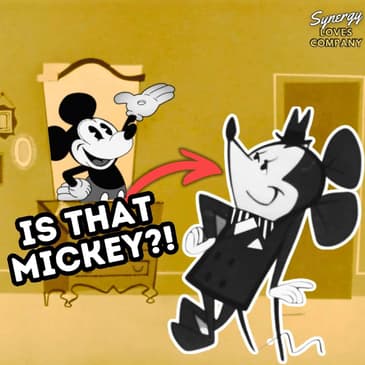
Mickey Mouse is the most recognizable character on Earth—but in the 1950s, he looked a little… different....and he sold cars! Thanks to Disney's secret ad lab department!
If you’ve ever seen the 1955 Nash Rambler commercials, you might have noticed a version of Mickey that feels more like a modern art experiment than a Disney icon. He was pointy, angular, and selling cars. But why?
In this episode of Synergy Loves Company, we’re exploring Walt Disney’s secret 1950s "Ad Lab." Long before Disneyland was a global phenomenon, Walt was using a hidden studio on the Disney lot—Hurrell Productions—to master the art of television synergy.
We’re diving into:
The mystery of the "Pointy" Mickey Mouse and why he was redesigned for TV.
The secret "H-Wing" unit that produced ads for 7-Up, Ipana Toothpaste, and Nash Motors.
How Bucky Beaver and Fresh-Up Freddie paved the way for the Disney machine.
The "6 Degrees" connection between a 1950s toothpaste jingle and the movie Grease.
Walt Disney wasn't just a dreamer; he was a strategic architect who used television commercials as a laboratory to explore television, fund Disneyland, and build the synergy model we know today.
Subscribe to Synergy Loves Company for more deep dives into Disney history, culture, and connections:
https://www.youtube.com/@SynergyLovesCompany?sub_confirmation=1
Podcast:
Listen to Synergy Loves Company → https://synergylovescompany.com
Support the Show:
Shop official Synergy Loves Company merch → https://shop.synergylovescompany.com
Affiliate Disclosure: Some links above may be affiliate links. If you click and purchase, I may receive a small commission at no extra cost to you. Thank you for supporting the channel!
Connect with Me:
Instagram → https://www.instagram.com/synergylovescompany
Bluesky → https://bsky.app/profile/erichsynergy.bsky.social
Facebook → https://www.facebook.com/synergylovescompany
Credits / Resources:
• Music licensed via Melod.ie
• Synergy Loves Company is not affiliated with The Walt Disney Company or any of its subsidiaries.
• Images and clips are used under fair use for commentary, criticism, and education.
This podcast is powered by Pinecast.
00:00 --> 21:13 Some of the most famous characters in pop culture got that way by selling products. Ronald McDonald got famous selling hamburgers. The Jolly Green giant, canned vegetables. Mr. Clean sells cleaning supplies that'll make your floors shine. Like his head. The Michelin man loves fancy food and sells radial tires. And Mickey Mouse sold the Nash Rambler for American Motors. Wait, what? That doesn't even look like Mickey. He's all pointy. His body's a rectangle. This is Mickey Mouse drawn like he just walked out of a Mr. Magoo cartoon from UPA. Come on, Mickey's like the most famous character on the planet. But he's just three circles. You know, the round head, round ears. He sells the magic of Disney, not cars. But he did. And this wasn't a one off cameo either. For a few years in the 1950s, our favorite Disney characters were moonlighting in TV commercials. Cinderella sold cars, too. Jiminy Cricket even rewrote his own song to sell sedans. Tinkerbell pushed her best friend's peanut butter when she wasn't introducing the Disneyland TV show. And there were even some new characters brought into the mix. Hey, this is Synergy Loves Company, where we explore how Disney connects to everything. I'm Eric, and today we're taking a look at Walt Disney's secret 1950s commercial side hustle. I mean, I guess it wasn't that much of a secret. They were using his characters in commercials. But to understand how Disney went full Mad Men with commercials, we'll have to understand Walt's relationship with television. While every other film studio saw TV as the enemy stealing their audiences, Walt saw the future. In 1948, he even booked a hotel room in New York just to watch television. Like to study it, to figure out what this box in the living room could actually do. And after that trip, he told his studio nurse friend Hazel George that television is the coming thing. In 1950, he made his first move. On Christmas Day, Disney aired its first ever TV special, One Hour in Wonderland, sponsored by Coca Cola. It was a mix of cartoon clips, celebrity guests, and of course, Uncle Walt himself. All designed to promote the upcoming Alice in Wonderland film. And it proved his hunch was right. People wanted to see Disney on TV in their own homes, and TV could help sell movies as well. And the whole thing was also sponsored by Coke, essentially making the special a Coca Cola commercial at the same time. And they helped pick up the bill. This TV advertising thing wasn't so bad. In fact, that's where Disney turned TV ads. Television shows needed sponsors, and the studio already knew how to Craft a message for a client. During World War II, they produced training films, war bond ads and propaganda shorts urging people to pay their taxes. Client work wasn't new for Disney, but television was. In 1952, just two years after One Hour in Wonderland, Dwight D. Eisenhower's campaign approached Roy O. Disney about having the studio make a presidential campaign ad. Irving Berlin wrote a song about how much everyone liked Ike and Disney animated the visuals. The ad was a memorable success and Eisenhower even won the election. Around that same time, Disney's ad agency was born. Now, the ad agency wasn't technically Disney. It was called Harrell Productions and it was officially independent. But it was staffed by Disney artists using Disney resources and located on the Disney studio lot. So it was practically an in house ad agency and it was in the family. The unit was run by Walt's niece, Phyllis Bounds, and her husband George Horrell, tucked away in the H wing of the animation building. George was famous for his glamour photography of movie stars in the 1940s. So he had already been in the entertainment business. But truthfully, he left in 1954 before things got really cooking and, and Phyllis became the head of the agency all by herself. Harrell Productions would create animated ads for TV and they could use the Disney characters. This was kind of Walt's genius loophole here. It was a direct pipeline from his animators to America's living rooms and have the companies foot the bill for it like Coca Cola did with One Hour in Wonderland. And the talent pool was deep. When Disney artists would finish up on a Disney project, they might get sent over to the commercial division. Tom Oreb, the legendary character designer who helped shape some of the look of Sleeping Beauty, led the art for many of these commercials. Bill justice, who had animated some of the most beloved Disney shorts, did some of this work too. And there were so many others. Even Walt's own daughter Sharon worked for the agency there as Phyllis's assistant. And the animators remembered Walt stopping by like all the time. I mean, he would just be like, well, I'm checking in on my daughter. And he'd like lean in the door, visit his daughter, kind of sneak a peek as to what kind of art was going on. And then, you know, he would be like, oh, I'm just taking my daughter home. And then about once a month, Walt would review the unit's work in a screening room. Like he was there seeing it happening. He was watching, always watching. And TV and ads, though, weren't all that Walt was focused on. This was around the same time when he was trying to make that physical manifestation of Disney magic, Disneyland. And so in 1953, Walt had hatched a plan to get his Disneyland project funded through television. He'd provide some Disney branded television, which all the networks really wanted to get their hands on, in exchange for some funding for Disneyland. At first, though, nobody wanted in the Disney branded programming thing. That sounded great, but not at the expense of this untested theme park idea. CBS passed, NBC passed. And when ABC finally bit and signed the deal, Walt didn't really have to scramble to figure out the whole commercial side of the industry. He had Harrell Productions, that H wing unit, already set up and running in his studio. So when the Disneyland anthology series and the Mickey Mouse club launched in 1954, the commercials weren't an afterthought bolted on later. They were baked in and Walt could control the shows and the ads inside them. But that was pretty common practice at the time. A lot of ads were baked into the broadcast with the stars of the show that you were watching doing those ad reads. So let's talk more about the ads and specifically the characters in the ads that Disney made. Sure, okay, the entire cast of beloved Disney characters were up for grabs to star in these commercials, and we will get to them. But Disney artists were also building brand new mascots from scratch as well. And let's start with everyone's favorite citrus loving bird, seven ups. Fresh Up Freddy. Sorry, Orange bird. You come later. Freddy was a cheerful, cocky rooster who looked kind of like a mix between Panchito and that wacky arachn bird from the three caballeros. And Freddy demonstrated how to plan successful parties and picnics by making sure you have plenty of seven UP on hand. He had catchphrases like everybody likes the fresh, clean paste of 7Up. Nothing knows it like 7Up. 7Up. Nothing does. 7Up spent a upwards of two and a half million dollars on these TV commercials. They ordered 26 one minute spots at about $100 a piece. And it worked. Because Freddy was famous. He got fan mail. They made merchandise with his face on it. Plastic dolls, rulers, stuffed animals. He was a star. And he was literally born to sell soda. Tom Oreb also designed Tommy Mohawk or Tommy Hawk for short. He was designed for Mohawk Carpets, a young native American boy with a mohawk haircut and a mischievous squirrel sidekick named Chatter who looked like he might be the cousin of like Chip and Dale. The ad unit also designed the Trix kids before that rabbit ever existed and tried to steal their Trix. But of all the characters born in that H wing of the animation building, one of them got a second life that none of us really could have predicted. Let's talk about Bucky Beaver. Bucky was designed once again by Tom Oreb for Ipana toothpaste. He was a chipper little guy with two enormous buck teeth, which made him perfect for selling dental health. His arch enemy was DK Germ, a wild kind of caveman looking villain guy who kept threatening the teeth of innocent bystanders. The commercials all kind of work like these little scenarios where Bucky and DK would be in different situations. In one, Bucky might be a white knight battling DK Durham, who had captured a fair maiden and was threatening her beautiful smile. In another, Bucky might be a train engineer whose locomotive got stopped by a blockage from DK Germ. There was always kind of a cliffhanging fight. But next time, Bucky might be a circus star on a tightrope or a space guard whose ship got shot down by DK Germs spaceship. Kind of the same formula every time. DK and Bucky battle and there's some Ipana toothpaste. And then Bucky could pull out the victory and then sing his wonderfully awesome theme song. The voice of Bucky was provided by Jimmy Dodd, who you might know as the head Mouseketeer, the guy who led the Mickey Mouse club in the 50s. And in addition to performing the character, Dodd, just like with the Mickey Mouse Club, wrote that jingle for Bucky as well. Brusha brusha brusha here's the new Ipana and that jingle is why you might even know Bucky Beaver, even if you've never heard his name or even used Ipana toothpaste. Because it shows up in the movie Grease during the Pink Lady's sleepover scene. Jan, she's singing along to the commercial on the tv. Brusha brusha brusha Use I pan a toothpaste. That's Bucky's commercial she's singing along to. You can even catch a quick glimpse of him in the tv. He's a Disney designed character created to sell toothpaste, immortalized decades later in a 70s musical about the late 50s that had absolutely nothing to do with Disney. But that's how much Disney permeates the culture. It connects to everything. These characters all had one job. They had to be memorable on TV just to sell that specific thing they were selling. They were corporate mascots, but with that unmistakable Disney charm and craftsmanship that made them stars. It was building a whole new stable of TV pitchmen and Secret Disney characters. But what happened when the ad men got their hands on the crown jewel, Mickey mouse himself? The 1955 Nash Rambler commercial opens with Mickey standing in front of a mirror and he's admiring his reflection. The reflection talks back to him. And then the real star of the commercial arrives. A car. The new four door Rambler pulls up and Mickey and the gang pile in. But here's the thing. You barely recognize him. This isn't the round, familiar Mickey we're used to. Tom Oreb gave him an angular, almost triangular face, a sharp nose, a rectangular body. His ears aren't even that round. They're like these large, kind of floppy shapes. He looks like he stepped out of some sort of modern art gallery. Not really a cartoon. Minnie got the same treatment. So did Morty and Ferdy, Mickey's nephews, making their first animated appearance in over a decade just for this, to show off the family car. Even Pete showed up in a redesigned, sleek, stylized cat kind of look. But like, why did Orb do this to Mickey? It wasn't just an artistic whim. There was some artistry there. But television screens in the 50s were small and fuzzy and black and white. And the old Mickey, with his subtle curves and detailed features would have turned maybe more into a gray smudge on a 10 inch screen. The new design used bold lines, simple shapes and strong silhouettes. It read clearly no matter how bad your reception was. The limited animation required efficiency too. Fewer lines meant faster, cheaper production. And Orb understood how to reduce a character to its essential form without losing its personality. But like we said, there was a little bit of artistic liberty happening, and this wasn't happening in a vacuum. Upa, a studio started by former Disney artists after the animator strike in the 40s, turned this sparse, bold line animation into a mid century modern art form with shorts like Gerald McBoing Boing and the cartoons of Mr. Magoo. Disney artists, especially Tom Oreb, were taking notice. Orb was working on Sleeping Beauty around the same time, creating those elongated, angular characters that would define the film's look. And later, Orb's work showed up in 101 Dalmatians. But before that, this style he tested in these commercials. The Nash ad Mickey wasn't an outlier. More spots followed. Mickey and Pluto did another commercial for Nash with Pluto getting his head stuck in a fishbowl to demonstrate the car's big windshield. Donald and his nephews did a commercial for Hudson Cars, also American Motors. Jiminy Cricket, voiced by Cliff Edwards, stood on the windowsill and sang a rewritten version of his own song about the Nash cars. A Nash is the star of car made. Cinderella even got in on selling for American Motors. And so did cast of Song of the South. They were all selling cars. That was like the big product that all the Disney characters were selling American Motors vehicles. But then came the letter a young fan wrote to Walt. And the kid had been writing for a while, warning Walt to stay away from modern art because they thought it was communistic. When the Nash commercial aired, the letter arrived. Walt didn't like if you know. Walt didn't want to be thought of as anything near a communist. It was the 1950s in the United States, so Walt immediately outlawed using any Disney characters in the commercials ever again. Everyone at the studio was pretty upset about it. These commercials were working. They were great. People loved them. The companies were coming specifically for the right to use the Disney characters. And now the door to those characters was slammed shut. Not every partnership ended with that slam door. Some just kept going because they just made too much sense. Peter Pan peanut butter had been around since the 1920s, but Derby Foods, the company behind it, became one of the earliest sponsors of the Disneyland TV show on abc. And Disney created a series of commercials featuring Tinkerbell, who didn't talk much in those days, who pantomimed her delight at the peanut butter that melted on toast like butter and spread smooth enough for basically anything. The commercial's premises were pure Disney. Captain Hook ties up, Tink tries to force her to reveal where the peanut butter's hidden. These commercials had the voices of Cliff Edwards, who you might know as Jiminy Cricket's voice in Sterling Holloway, who you might know as Winnie the Pooh. But the ads were great and they played for years, and the brand is still on grocery store shelves right now. And that's kind of the other side of the coin, because they kept on using that Peter Pan and Tinkerbell and Captain H look in the Peter Pan peanut butter commercials, While Bucky the Beaver and Fresh Up Freddy faded into obscurity and other Disney characters stopped showing up in commercials. The Peter Pan example, though, was the ideal that Walt was chasing. A seamless blend where the character enhanced the product and the product supported the character's world. By the late 50s, though, Walt's television takeover was pretty much complete. If you've ever seen the famous Disney synergy map, the arrows pointing in every direction. I just love that synergy map. This is the era where it really comes to life. The TV shows promoted the park and the films, and the park visits sold merchandise and sponsorships had. Ad revenue kept the lights on for Walt when he built his kingdom. But the commercial unit had a fatal flaw buried inside the business model. Disney didn't own the characters they made for other companies. There was no real ongoing residual value. Every Bucky Beaver and Fresh Up Freddy, every jingle and gag and character design they were building was building equity for Ipana and 7up. After the initial deal, those characters belonged to the client forever. The frustration piled up. Client interference also meant twiddling thumbs at every stage of production, waiting for the appeal approval before moving forward. Walt hated not having final say on these things. Then came the last straw. A sponsor of the Mickey Mouse Club dropped a Woody Woodpecker commercial into the show, a competitor's cartoon airing inside Disney's own program. Walt noticed immediately the volume was off from the rest of the show. The edit was more sloppy than he would have liked. It was dropped in after his show was mixed and it stuck out like a sore thumb. And he did not like it at all. By 1959, Disneyland was profitable. The studio was on solid ground and the Harrell Agency commercial division quietly shut its doors. So Mickey Mouse, at least for a little while in the 1950s, was a car pitchman. Because Walt Disney understood television better than anyone in Hollywood at the time. While other studios ran from it, he built entire ecosystem inside it. Television specials, promoting the movies series, building up the brand and promoting Disneyland and commercials helped fund it all. And today, Mickey's still out there selling. He's just selling you on a vacation to Walt Disney World now, you know, keeping it inside the company. And Mickey did show up one more time in that Nash Rambler look in the wonderful world of Mickey Mouse short steamboat Silly. So we got that too. Those lost characters in those commercials are a time capsule of the Disney studio in transition. Betting everything on television in a theme park. They prove that Disney magic could sell anything. Thanks for joining me for this look into Bucky Beaver, Mid Century Mickey and the Mad Men of the Magic Kingdom. I'd watch that show. Remember, Disney magic isn't just in the parks. It's all around us. And sometimes it's trying to sell you a car or a tube of toothpaste. You'll never watch Grease the same way again. Don't forget to like this video and subscribe to Synergy Loves Company. If you want to discover more ways to experience Disney magic all around us, watch this next and until next time, keep discovering the magic in everything. Sam.