
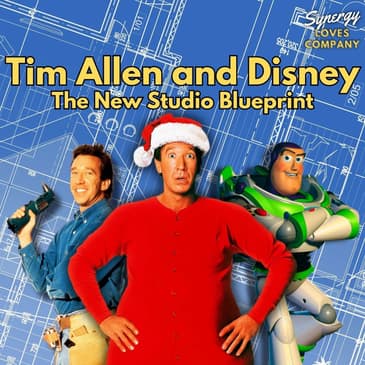
Did you know one comedian, Tim Allen, was the secret weapon behind Disney's massive corporate makeover in the 90s?
In this video, we reveal The Tim Allen Blueprint: the calculated strategy Disney used to turn a single star into a multi-billion dollar corporate synergy machine. From his hit sitcom Home Improvement (ABC) to his blockbuster film debut in The Santa Clause (Touchstone), and his iconic voice role in a certain animated masterpiece, Tim Allen was the key figure connecting Disney's newly acquired and developing divisions.
We break down how Disney used his star power to create a self-feeding "flywheel" of success that changed Hollywood forever...(again)
If you've ever wondered how Disney became the IP giant it is today, the answer might just be "To infinity and beyond!"
Subscribe on YouTube for more deep dives into How Disney Connects to Everything!
https://www.youtube.com/@SynergyLovesCompany?sub_confirmation=1
Podcast:
Listen and Subscribe to Synergy Loves Company → https://synergylovescompany.com
Support the Show:
Shop official Synergy Loves Company merch → https://shop.synergylovescompany.com
Affiliate Disclosure: Some links above may be affiliate links. If you click and purchase, I may receive a small commission at no extra cost to you. Thank you for supporting the channel!
Connect with Me:
Instagram → https://www.instagram.com/synergylovescompany
Bluesky → https://bsky.app/profile/erichsynergy.bsky.social
Facebook → https://www.facebook.com/synergylovescompany
Credits / Resources:
• Music licensed via Melod.ie
• Synergy Loves Company is not affiliated with The Walt Disney Company or any of its subsidiaries.
• Images and clips are used under fair use for commentary, criticism, and education.
This podcast is powered by Pinecast.
00:00 --> 24:31 In 1990, Disney Studios chief Jeffrey Katzenberg and CEO Michael Eisner made a visit. They weren't lunching with a famous director or schmoozing on set with a movie star. They were headed to a comedy club to see a standup comedian from Detroit who was about to headline a showstop in la. The comedian was Tim Allen, and Eisner and Katzenberg had a proposition that would make him a star. Alan initially refused. He was making good money living on the road. But then Disney offered to take Alan's stage Persona, the grunting tool obsessed, exaggeratedly masculine guy, and build a sitcom around it. Better yet, they made a guarantee that changed everything. Complete editorial freedom. Disney would build the show from scratch around Alan's act. That visit didn't just create a TV show. It, it created a model. A blueprint that would connect a comedian to an animation studio, a live action film division, and a whole media empire. It was the beginning of a new shade of Disney synergy. And it all started with a guy who just wanted to grunt and make jokes about power tools. Hey, this is Synergy Loves Company, where we explore how Disney connects to everything. Hi, I'm Eric. And today we're taking a look at how one comedian's career became a blueprint for the strategy of the Disney decade and beyond. To understand why Disney was making that call, Taking a bet on a stand up comedian, you have to understand the television landscape of the late 80s and early 90s. It was a gold rush for standup comedians. Networks were practically handing out sitcom deals left and right. If you had a solid 10 minutes on the Tonight show, you, you were in business. This was the era of the standup to sitcom pipeline. Making a standup comedian the star of a sitcom wasn't new, but after the success of the Cosby Show. Yeah, that Cosby. All the networks wanted to find the next big standup comedian hit sitcom. And it worked. Look at the titans that came out of this period. We got Jerry Seinfeld, Roseanne Barr, Robert Ray Romano. These weren't actors being cast in roles. They were comedians playing amplified versions of their stage Personas. The sitcom became an extension of the act for the networks. It was the safer bet. You already knew the comedian could get laughs. You already knew they had a point of view and you were just building a world around a personality you'd already market tested. Well, they market tested it with their actual. And so of course, Disney under Michael Eisner and Jeffrey Katzenberg had to get in on this trend. Disney's touchstone television had had their first major hit with the Golden Girls. But they wanted to get in on the standup sitcom action for their follow up. They saw the success other companies were having with comedians like Seinfeld and Roseanne and they wanted a piece of that gold rush. For Disney, this was about more than just ratings. It was about building relevance for their relatively new television division in a crowded landscape. They needed their own bankable star to anchor their primetime lineup and prove that they could compete with the established players. But who knew it could lead to other things. A comedian does a sitcom on your Touchstone Television label and that sitcom becomes a massive hit, creating a beloved character. Then you can maybe spin that character off into a series of movies for your film studio. Then his voice could become the star of an animated feature. And all of this, of course, can be supported by merchandise, toys, video games, everything. That's not just a career, that's an integrated corporate strategy. And Tim Allen, the guy from Detroit with the power tool routine, was about to become the test case for whether this new modern studio system could actually work for Disney. Home Improvement premiered in September of 1991. And the setup was pure Tim Allen. He Tim Taylor, the host of a fictional local cable TV show called Tool Time. A direct lift from his standup act about hilarious dangers of over enthusiastic masculinity. The grunts, the love of power, the catchphrases like I don't think so, Jim. It was all there. But the show was smarter than just a guy with a saw. It was framed around his home life with his wife Jill and their three sons, Creating a contrast between the larger than life TV Persona and the often clueless reality of being a husband and father. And it was an immediate massive hit for abc. It shot to the top of the ratings, often landing in the top 10 for Disney. This was the first piece of the blueprint falling into place. The show was produced by Touchstone Television, Disney's label for more adult oriented content, but still had a family friendly dynamic. This was strategic. It allowed Disney's Touchstone to build a primetime powerhouse. Home Improvement became the anchor of ABC's Tuesday night lineup. A tent pole that helped lift the entire network. The eight season run of Home Improvement created stability. It gave Disney a dependable star attached to a dependable hit. This allowed for long term planning. They knew they had Tim Allen for the better part of a decade. So while he was grinding out episodes on the ABC lot, the executives at Walt Disney Studios across town were looking at the next square on the blueprint. How to transition the TV star into a movie star. And for the movies, the tool belt was coming off and the red suit was waiting in the wings. In 1994, Tim Allen starred in the Santa Clause for Walt Disney Pictures. This wasn't an accident. This was the blueprint in motion, leveraging the television star to launch a film franchise. The film was a perfect vehicle. Alan played Scott Calvin, a cynical toy executive who accidentally becomes Santa. It was a role that mirrored his TV Persona, a regular guy, but now he's thrust into an extraordinary situation and. And with the added magic of a Christmas movie, of course. It was a monumental hit, grossing over $189 million worldwide. But the real story wasn't the box office. It was that corporate machinery whirring behind it. This is pure uncut Disney synergy. The movie was produced by Disney's Hollywood Pictures and released under the Walt Disney Pictures banner. But it was marketed heavily on abc, which was airing Home Improvement. The network ran prom during the sitcom, using Tim Taylor to sell Scott Calvin or Tim Allen to sell Tim Allen. They were cross promoting their own star across their corporate divisions. And it was a closed loop. And it worked so well that it created that model for Disney. The Santa Clause proved that a Disney television star could open a movie and gave Disney a property they completely owned. This was all theirs and they would milk it for everything it was worth. Spawning two sequels over the next decade and of course, a recent series on Disney. But it didn't end there. While Alan was filming the Santa Clause, he was also in the recording booth for a secret animated project. Disney was leveraging their exclusive access to Alan's voice and Persona across completely different divisions around the same time for another project. That was kind of of a gamble. And this part of the blueprint wasn't exactly a Disney project in the traditional sense. Tim Allen was recording lines for a desperate little animation studio that Disney saw as a potential gold mine or a total disaster. That studio was Pixar. Now the creation of Toy Story is its own legendary story of mere failure and last minute creative salvation. But from a corporate perspective, the casting of Tim Allen as Buzz Lightyear was a strategic masterstroke. Think about it. John Lasseter and the Pixar team were building this entirely new kind of a movie, the first fully computer animated feature. And it was a huge risk. So when it came time to cast the co lead, that arrogant, hilarious space ranger who doesn't know he's a toy, they needed a very specific energy. But before they got to Tim Allen, they first went to Billy Crystal and several other Actors who all declined the. But Disney saw the connection. They knew that they had this guy under contract that would be perfect for it. Tim Allen was right there, already on the Disney lot, already a proven Persona on television. He played Santa Claus, who knows more about toys. So it was the easiest, most logical synergy imaginable. They weren't just hiring an actor. They were importing a pre tested audience approved Persona directly into their risky new animation experiment. And they gave Tim Allen the creative freedom to shape Buzz Lightyear with his distinctive comedic voice into the Buzz that we know and love today. And the genius of Buzz Lightyear is how he perfectly channeled the essence of Tim Allen's standup and sitcom Persona into an animated form. Well, not exactly, but hear me out. Buzz's delusional self confidence. You are a sad, strange little man. Was just Tim Taylor's I'll put my banjo up against anybody. Translated into a sci fi action figure his genuine belief that he was a real space Ranger. That overconfidence mirrored the exaggerated reality of Tim Allen's stage act. They took the essence of what made Alan a star and literally turned it into a plastic action figure. The success of Toy story in 1995 changed everything. Not just for animation, but for Disney's entire strategy. IT grossed over 373 million and launched a franchise that would eventually be worth billions. And Tim Allen was now a voice at the center of it. This completed the trifecta. He was a television star on abc, a Walt Disney Pictures live action movie star, and now an animated icon for Pixar. No other performer at the time was so completely embedded across every single division of a major media company. Disney now had a proven playbook. They had taken a stand up comedian and successfully deployed him across three separate revenue streams that all fed back into the mothership. The sitcom sold ads for the network, the live action films built the franchise value. And the animated feature through Pixar, created an entire new univers of intellectual property. And it really moved merchandise. And it was all anchored by that one recognizable bankable star. Even Tim Allen's book Don't Stand Too Close to a Naked man, which was based on his standup comedy, was published by Disney's Hyperion Press. The blueprint was no longer theory. It was a replicable corporate model. They had successfully resurrected the old studio system's control of talent, but through contracts and synergy instead of ownership. The next step was to see how far this model could be stretched and who else could be plugged into it. So what do you call this new model in the early 90s, Disney CEO Michael Eisner called it the Disney Decade. Well, not just this. It was part of his grand vision for the company's future. A plan for massive expansion that included theme parks, new hotels and a blitz of entertainment. But the real engine of the Disney decade wasn't the bricks and mortar. It was this new system of intellectual property management that Tim Allen's career had just road tested. This wasn't a new idea for Disney. In fact, it was a return to the oldest idea in Hollywood, the studio system. From the 1920s to the 1950s, the big studios like MGM, Paramount and Warner Brothers operated as vertically integrated. They owned production lots, they had actors under long term contract. They owned the theaters where the movies that they made played. They controlled the entire pipeline from creation to exhibition. That system was broken up by the Supreme Court in 1948 in the Paramount case, which forced studios to sell off their theater chains. The era of the all powerful studio was coming to a close. You could see glimmers of that system still in Hollywood and even in Disney, with stars like Hayley Mills and Kurt Russell in the 60s. But what Eisner and Katzenberg realized was that while they couldn't own the theaters, they could build something just as powerful through corporate synergy. They could own the network, abc. They could own the production studio, Touchstone Hollywood and Walt Disney Pictures. They could even own the film distributor Buena Vista. And they could of course own the merchandise and home video operations. And then if they could control the talent that moved between these divisions, they could make a modern legal version of the old studio system. And Tim Allen was the proof of concept. The key was the contract. Under the old system, actors were signed to seven year contracts with a single studio. Under the Disney system, a star like Allen was signed to a multi picture, multi platform deal that gave Disney first right a refusal on his services across television, film and even voice work. It was a golden handcuff, but it was a two way street. Alan got stability and a guaranteed platform and Disney got a reliable asset they could deploy whenever it would generate the most value. This was the blueprint for media in the Disney decade. Not just creating content, but creating interconnected content ecosystems where every success lifted every other part of the company. The goal was to make the whole greater than the sum of the parts. And you could see this blueprint in everything they did during this period. The push of the Disney Channel as a premium outlet for original programming. The acquisition of abc, which gave them the broadcast platform to promote their films and stars. The creation of Touchstone and Hollywood Pictures to produce more adult oriented material without diluting the Disney brand. And it was all about creating channels. And once you have the channels, you need the talent to flow through the channels. That's where once again some stand up comedians came in. They were the perfect fuel for this machine. Prepackaged audience tested personalities ready to be plugged into the system. Tim Allen was the first, most successful plug, but he wouldn't be the last. The next big test case was Ellen DeGeneres. Like Tim Allen, she was a stand up comedian with a very distinct relatable Persona. In 1994, the same year the Santa Claus hit theaters, Disney debuted Ellen on abc. It was a mid season replacement that quickly found an audience. The show was produced by Touchstone Television following the exact same model as Home Improvement. It was a sitcom built around a comedian's act and personality. The synergy machine kicked into gear. Disney leveraged Ellen's rising TV fame and 1996 they built a theme park attraction around her Ellen's energy adventure and cast her in the Touchstone Pictures film Mr. Wrong. It was the same playbook. Take the TV star, give him a movie vehicle. The film wasn't a huge hit, but it demonstrated the system was in place and repeatable. The real moment of course came in 1997 with Ellen's famous puppy episode where Ellen's character comes out in. That was a massive cultural event that transcended the typical Disney synergy model. But it happened within the Disney ecosystem on abc, produced by Touchstone. And it showed that Disney and the platform could handle even the most high stakes storytelling. Drew Carey was another stand up who got his break around the same time. But his path was a little different. His first sitcom, the Drew Carey show debuted on ABC in 1995. It was a hit. But Carrie's deal wasn't as exclusive as Allen's. This is where the model started to get refined. Disney still though could apply the synergy. Even though the show was produced by Mohawk Productions in association with Warner Bros. Television. But it aired on abc, the Disney network. So Disney benefited from the advertising revenue and the hit show, even though they didn't own the production outright. They even incorporated Drew Carey into parks. Attractions like Sound Dangerous at Hollywood Studios and Superstar Limo at Disney's California Adventure. Wait, that's right. Tim Allen was in Superstar Limo too. This showed a flexibility in the blueprint. If you can't own the star completely, you can still profit by controlling the distribution platform. By the end of the 90s. This wasn't just a Disney strategy. It was the strategy for every major media conglomerate. But Disney did it first, and they did it best because they had the most fully integrated system him at the time. They had the parks, they had the consumer products, the network, the studios, all under one roof. Tim Allen's career was the key that unlocked the door, and he proved that in the new media landscape, the most valuable thing wasn't a hit movie or a hit TV show. It was a hit ecosystem. And for a while, Disney owned the blueprint to build one. The irony of this whole system was just how much it mirrored the very thing that was supposed to be extinct. The original Hollywood studio system. Think about the parallels, though. Under the old system, MGM would have an actor like Spencer Tracy under contract. He'd make a drama, then he'd make a comedy, then he'd make an adventure film, all for mgm. The studio owned his image, his time and the profits. Under the new Disney system, Tim Allen was making a sitcom for their network, a family film for their studio, and voicing a character for their animation partner. Disney didn't own Tim Allen, but they controlled the flow of his creative output across their empire. The mechanism was slightly different, but the effect was strikingly similar. In this new system, it had the same vulnerabilities as the old one. It was entirely dependent on the star. When Home Improvement ended its run in 1999, the central pillar of the Tim Allen ecosystem was gone. The machine kept running. There were Santa Claus sequels and and Toy Story sequels. But the constant weekly presence that fed the brand was absent and the momentum began to slow down. This is the inherent risk of building a strategy around one single personality. The old studios faced it when their stars aged out or their popularity faded. And Disney faced it when Tim Allen's sitcom era ended. The system they built was brilliant, but it wasn't a perpetual motion machine. It needed fuel. And the most volatile fuel in entertainment is talent. So what's the legacy of the Tim Allen blueprint? You can actually see it everywhere in today's media landscape, just evolved and hypercharged. The model Disney perfected in the 90s is now the standard operating procedure for every major streaming service and studio. Look at the Marvel Cinematic Universe. Disney is still using it. It's the ultimate expression of this synergy, but built on a scale Tim Allen couldn't even imagine. Instead of an ecosystem around one star, they built it around an entire comic book library and tons of stars. But the principle is identical. Create an interconnected content stream across multiple platforms. Movies, TV shows, Disney plus theme parks. Merchandise. And it all feeds back into that central brand. The same goes for the Star wars universe. The goal is no longer just a hit show or a hit movie. The goal is a franchise, a universe, an ecosystem. Disney's acquisition of Fox, Marvel, Lucasfilm, Pixar was essentially a massive corporate effort to acquire more channels to apply the blueprint, more ecosystems they could plug into their machine. Lin Manuel Miranda could write the music to Moana and Encanto. Then Disney could put his smash Broadway musical Hamilton streaming on Disney. And he could even voice the character of Gizmo Duck on the reboot of DuckTales. Across Hollywood, the talent deals have evolved accordingly. More recent megadeals for producers like Shonda Rhimes or Ryan Murphy to create content exclusively for Netflix are the direct descendants of the Tim Allen model. Instead of a star, you're locking down a hit maker. The platform provides the distribution and the creator provides the pre tested brand. It's the same closed loop system, just with a different kind of fuel. But the core idea still remains control the channels and guide the talent. And the standup comedian pipeline itself still exists. It's just moved to a new venue. Instead of getting a sitcom after a Tonight show spot, a creator today might get a Netflix special and development deal after a viral TikTok clip. The platform is different, but the corporate machinery waiting in the wings is the same. Disney's experimentation in the 90s using Tim Allen as their primary test case didn't just define their corporate decade. It defined the next 30 years of how media conglomerates would think about content, talent, and the very structure of the entertainment industry. They proved that in a fragmented media world, the most powerful position to be in is in the center of your own universe. And it brought Disney synergy to infinity and beyond. And speaking of Buzz Lightyear, I can't believe Toy story is over 30 years old. That's three decades of Tim Allen as Buzz. And it's still going. Toy Story 5 is officially on its way. In honor of these Toy Story milestones, next time we're going to take a look at Woody Tom Hanks. So take a second and click that subscribe button so you don't miss it. Tim Allen's true legacy isn't just Home Improvement or Buzz Lightyear, not even his other work with ABC Television like Last Man Standing or Shifting Gears. It's that he was the living, grunting proof that the old Hollywood system could be reborn. His career became that blueprint for the modern media ecosystem, where every star, every show, every movie is a potential spoke in a giant corporate wheel. That decision by Eisner and Katzenberg to call on a comedian at an LA comedy club didn't just get a TV show made, it helped build the template for the entertainment world we live with today. Thanks for joining me for this look into tools and toys and Disney synergy. And until next time, keep discovering the magic in everything.