
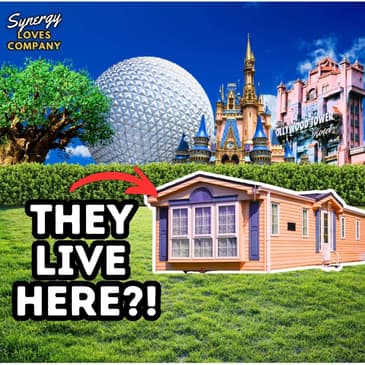
Have you ever wondered what it would actually be like to live inside the Disney bubble? Not just near the parks, but right on the property?
In this episode, we’re exploring the secret history of Disney’s residential experiments. From the original ranch houses hidden behind Main Street at Disneyland to Walt’s unbuilt "City of Tomorrow," we trace the evolution of living at Disney. We’ll dive into the nostalgic streets of Celebration, the multi-million dollar luxury of Golden Oak, and the two tiny, gated cul-de-sacs that almost no one knows exist—where a handful of secret residents have lived for decades to keep the legal gears of the "Kingdom" turning.
We’re breaking down how Disney connects to urban planning, luxury real estate, and the legal loopholes that created the most unique neighborhoods in the world.
- The original residents of Disneyland: Owen and Dolly Pope.
- Walt Disney’s vision for EPCOT as a real, working city.
- The rise and complicated reality of Celebration, Florida.
- Golden Oak: What it’s really like to live in a $10M Disney home.
- The secret mobile home parks of Bay Lake and Lake Buena Vista.
- Disney’s newest chapter: Storyliving by Disney and Cotino.
Subscribe for more Disney connections:
https://www.youtube.com/@SynergyLovesCompany?sub_confirmation=1
Podcast:
Listen to Synergy Loves Company → [https://synergylovescompany.com](https://synergylovescompany.com/)
Support the Show:
Shop official Synergy Loves Company merch → [https://shop.synergylovescompany.com](https://shop.synergylovescompany.com/)
Affiliate Disclosure: Some links above may be affiliate links. If you click and purchase, I may receive a small commission at no extra cost to you. Thank you for supporting the channel!
Connect with Me:
Instagram → https://www.instagram.com/synergylovescompany
Bluesky → https://bsky.app/profile/erichsynergy.bsky.social
Facebook → https://www.facebook.com/synergylovescompany
Credits / Resources:
• Music licensed via [Melod.ie](http://melod.ie/)
• Synergy Loves Company is not affiliated with The Walt Disney Company or any of its subsidiaries.
• Images and clips are used under fair use for commentary, criticism, and education.
This podcast is powered by Pinecast.
00:00 --> 18:12 Have you ever thought about what it would be like to actually live on Disney property? Not just in a nearby suburb, but right inside the bubble? Well, people have been doing exactly that since the very beginning, when Walt Disney was quietly buying up orange groves and Anaheim for what would become Disneyland. That land wasn't empty. There were already houses on it. And Walt Disney, in a move that feels very telling, didn't just bulldoze them, he found a use for them. The Dominguez family's home was carefully moved behind what would become Main street and converted into offices. Then there was the Witherill Bungalow, a 1300 square foot ranch house that became home to Owen and Dolly Pope, a couple who lived right there on site for years. And they moved in just three days before Disneyland opened in July of 1955. This wasn't a grand city, but it created this tangible physical link. A home literally inside the kingdom. It was the seed of an idea. The real dream, though, wasn't just for a few caretakers to live there. The dream was for a whole community to live inside the magic. And that bigger, bolder dream to that's the one that packed its bags and went to Florida. Hey, this is Synergy Loves Company, where we explore how Disney connects to everything. I'm Eric, and today we're taking a look at the places where you could live on Disney property and the secret residence of Walt Disney World. In 1966, Walt Disney made a film, and it was a pitch for what he was going to build in Florida. And. And it wasn't just the theme park. He pointed to a massive map of a place he called epcot, the experimental prototype community of tomorrow. This was supposed to be a real working city for 20 people. A living laboratory for technology and urban planning. No retirees. Constant innovation. A place that was never finished. It was the ultimate version of the dream. Living inside the Disney magic every single day. But the then Walt Disney died in December of that same year. And the company, faced with the monumental task of just building the first theme park on this land, they made a decision. They abandoned Walt's city plan. The Epcot we know today, the theme park with spaceship Earth, the big silver ball. It's a monument to an abandoned idea. It's not a place anyone lives. But here's the thing. That legal framework for Walt's city idea, it was already in motion. To get the autonomy to build his futuristic metropolis, Walt's team had lobbied the Florida legislature for something unprecedented. And in 1967, they got it. The Reedy Creek Improvement District. This Special district gave Disney the powers of a municipality to build its own roads, its own utilities, to enforce its own building codes so that people could could live there. And it came with two incorporated towns within it, Bay Lake and Lake Buena Vista. Real towns on paper, but it was a government created for a city that would never actually be built. But if EPCOT wasn't a city and nobody was supposed to live in a theme park, that left a lingering legal question. If the district needed towns and towns by definition needed people, then who gets to live on Disney property? Fast forward to the 1990s. The Disney company, now under Michael Eisner, looks at a huge chunk of that Florida land and decides to try this city thing again. Not with a futuristic Tomorrowland like city, but with a town that looks backwards, more like a Main street usa. And they call it Celebration. Now. This was the era of New Urbanism, the idea of building walkable Italian idyllic communities that harken back to small town America. And Disney went all in. They hired famous architects and they built a picture perfect downtown with buildings from those world class architects. A post office by Michael Grave and a town hall by Philip Johnson. So many more. They planted trees, they built schools, and they even hid speakers in the bushes that played, recorded bird songs and could even make community announcements. The whole place was super idyllic. The municipal seal was a girl on a bike and a dog and a picket fence. They sold a lifestyle, spaghetti dinners, fourth of July parades, fireflies in a jar. It was Main street usa, but you could actually buy a house there. And people, of course, wanted in. For the first 474 home sites in 1995, they got 55 lottery entries. The first family, the McDonald's, moved in in 1996. But celebration had a corporate reality. It was a real estate project, a very expensive, very controlled one. The residents got a 70 page book dictating which of six approved house styles they could actually build and what colors they could paint it. The homeowners association was famously strict. And that experimental school, it was an ambitious idea that hit major growing pains almost right away. The model of combining multiple grades in large classrooms, sometimes with up to 80 kids, proved chaotic in practice. Parents pushed back, the principal left after a year and the school had to be completely restructured into a more traditional format. Celebration also faced a complicated reality, and that conflicted with its idyllic marketing. Despite aiming for diversity, the 2000 census showed that the town was 88% white. And like any community, it wasn't immune to crime, including its first murder in 2010. And a poorly designed road curve led to a tragic series of accidents at a retention pond, which unfortunately earned the grim nickname of the death pond in local lore. But the biggest Twist came in 2004. Disney, deciding it didn't want to be in the landlord business forever, sold off the downtown commercial district to a private equity firm called Lexin Capital. Suddenly, the people who owned homes in the center of town had no say in their own homeowners association, because Lexin owned the majority vote. And when the shoddy rushed construction from the 90s started to fail in some homes, leaky roofs, cracking foundations, Lexin wasn't fixing it. They were allegedly refinancing the properties and pulling money out, leaving residents with massive repair bills. By the late 2000s, when the housing market crashed, Celebration was facing foreclosures at twice the rate of Florida. The dream had settled into a complicated reality. And at this point, it was a town near Disney with Disney's fingerprints all over its origin. But it wasn't a town of Disney. In fact, Disney had made sure of that since the beginning. They de annexed Celebration from the Reedy Creek Improvement District early on. Why? Because 20 new residents would have voting rights within Disney's private government, and Disney wanted to keep control of its Disney bubble. So Celebration always existed just outside the gates. A beautiful, sometimes troubled experiment in curated nostalgia. But it wasn't the answer to the original question. Our search for the true residents of Disney World has to look closer to home. In 2010, just six years after Disney got out of Celebration, they announced Golden Oak, named after Disney's backlot studio ranch in California. This wasn't a civic experiment. This was a luxury real estate venture. And the location says it all. Inside the gates of Walt Disney World, about four miles from the Magic Kingdom parking lot, you're not just near the Magic, you are in it. The lifestyle is the pitch. We're talking about a private club called the Summer House, with multiple restaurants, a 24 hour fitness center, and a member services team that handles everything from dinner reservations to VIP tours. They even got their own hotel for when their family comes to visit. And you can actually stay there too. It's the Four Seasons. And Golden Oak is that Four Seasons level of service, but with a Disney touch. The neighborhoods themselves are themed and named after Disney history. Carrollwood, after Walt's backyard railroad. Marceline, his Missouri hometown. Kimball Trace, after animator Ward Kimball. So you buy a custom built home that starts in the low millions and can go up to anywhere like 20 million, and we're not just, just talking about big houses. We're talking about homes overflowing with Disney elaborately themed rooms, fantasy architecture. The former CEO of Walmart has a home there. NBA player and more importantly, Disney super fan Brooke Lopez has a home there. But here's the major catch. And it connects right back to that Reedy Creek framework. These are more of a second home for their residents. You know, like a vacation home, not a primary residence. You buy this multi million dollar dream home, but you get zero voting power over Disney World itself. None. Because early on, Disney also deannexed the Golden Oak property from the Reedy Creek Improvement District. It's physically on Disney property, but legally it's just part of Orange County. So you have all the perks. The private bus stops, the parks, the exclusive event access, watching Magic Kingdom fireworks from your backyard. But you don't actually live there on Disney property. You have no say in the government that runs the utilities under your street or the fire department that would respond to your home. And that was a very deliberate choice. Golden Oak is residential, but it's not civic. It's a luxury enclave, a resort style living experience for a few hundred very wealthy families. It's the ultimate expression of the dream as a product. Not a shared community, but a private club. You're not a citizen of Walt City of Tomorrow. You're a member of the Golden Oak Club. And your membership dues on top of a multi million dollar home price tag and a HOA fee that can be $30 a year buy you a curated slice of the magic. With all the control firmly remaining where it's always been with Disney. But hold on a second, because while Golden Oak was being built for millionaires and Celebration was being sold to upper middle class families, there were already people living on Disney property. And they had been there since the beginning. They weren't in mansions or pastel colored homes. They were actually in mobile homes in trailer parks. All right, let's get back to that legal framework. Remember the Reedy Creek Improvement District? We've just been talking about it and its two towns, Bay Lake and Lake Buena Vista. For that special district to function as a legitimate government, those towns needed something. Registered voters, residents. So Disney created them. Tucked behind the pine trees near the Magic Kingdom, there is a small cul de sac called Bay Court. And over by Disney Springs, north of Saratoga Springs, there's another one called Royal Oak Court. These are two hidden residential pockets of Bay Lake and Lake Buena Vista. And they have been there all along. We're talking about a total of maybe 40 people. They own their own mobile home and they pay Disney about $75 a month to rent the lot. The residents are handpicked, longtime Disney employees, people in utilities, facilities management, you know, like on call roles where living minutes from the park is a genuine operational benefit. Some of the families have been there for 30 plus years and the perks are uniquely Disney. They have a private dock on Bay Lake with a perfect unobstructed view of the Magic Kingdom. Fireworks every single night. Their commute to work is like a five minute golf cart ride. For decades, this tiny group served a monumental legal purpose. They were the only registered voters in the two cities. Their votes provided the legal legitimacy required by the Reedy Creek deal. They would vote on things like bond approvals for park improvements or contracts with the Orange County Sheriff's Office. As one former Disney government affairs executive said, they were an apolitical little group. Government without the politics. The mayor of bay Lake in 2015 was a Disney construction project manager named Todd Wattsel. He described his political career as uneventful. And it was. The councils met, they approved what needed approving, and life went on in these two quiet gated cul de sacs surrounded by the most visited vacation resort on earth. Now I know in 2023, the shift to the state controlled Central Florida Tourism Oversight District, not as cool sounding as Reedy Creek Improvement District. It technically removed that specific need for voter residents. The state appoints the the board now, but these neighborhoods, they're still there. And they're an essential on call housing for the cast members who keep the kingdom's lights on and its water flowing. They're the human element in a story about land law and loopholes. And they prove that from the very beginning, the original Epcot dream, the dream of a real community, had a lasting tangible impact on the property's very structure. It created not a city of tomorrow, but two tiny secret streets of today, where the Magic's backbone lives. So we've gone from offices in Anaheim to a town in celebration, a luxury club in Golden Oak, and a legal necessity in Bay Lake. The dream of Disney living keeps evolving. And in the 2020s, it evolved again with a concept called Story Living by Disney. Now this isn't about building cities or even governing them. It's about branding a lifestyle. The first project is called Coutinho and it's not in Florida. It's in Rancho Mirage in the Coachella Valley near Palm Springs, California. And this is a full circle connection. Walt Disney personally loved the Coachella Valley. He owned A home there and he vacationed there. Now Disney is building a community there, but the keyword is branded. Cotino is a Disney branded community, not a Disney governed one. The imagineers provided creative insight on the home designs which are inspired by Disney stories. There's a home design called Melodia, inspired by the black and white palette of 101 Dalmatians. Another, the moderne, draws from the adventurous landscapes of Disneyland's Adventureland. The centerpiece is a community clubhouse called the Artisan Club with a restaurant, a fitness center and access to a giant, giant man made beach lagoon called Cotino Bay. They even got a recreation of the Parr family's mid century modern home From Pixar's the Incredibles 2 called the Parr House as a club amenity. It's the next step in the curation of experience. But the big difference from say, celebration is the hands off approach. Disney is not the developer or the long term landlord. They've been partnered with a home building company called DMB Development. Disney's role is to infuse the story and manage the club and the branding. They're selling the aesthetic, the community events and the feeling. You're buying into a vibe meticulously crafted by imagineering, but you know, with a more hands off approach. It's the distillation of this entire journey from Walt's ambitious all encompassing civic plan for Epcot to a luxury desert community where the Disney touch is in the design details and the club membership brochure. The dream of living inside a Disney story never died. It just got a homeowners association, a voluntary club fee and a sales office in the desert. The through line though, is clear. The desire to extend the narrative beyond the movies and the park gates, to make the magic a place that you don't just visit, but where you belong. The setting changes, the business model adapts. But the core idea that Disney can sell you a chapter of your own life story, that's what keeps the dream alive. The core truth is people have always lived within Disney's land, just not how Walt first imagined. They've been caretakers and voters, wealthy enthusiasts, and now club members. Each iteration is an answer to who gets to live inside the magic, filtered through the realities of law, business and time. So I want to hear from you. If you could live in any of these Disney living situations, which would you choose? That secret mobile home court in Bay Lake, A luxury of golden oak, the nostalgic streets of celebration, or the desert story of Coutinho? Let me know. Down in the comments below. And don't forget to like this video and subscribe to Synergy Loves Company for more of these Disney stories. And if you want to see how Disney secretly bought all of that Florida land in the first place, you should watch this next. And remember, keep discovering the magic in everything.