
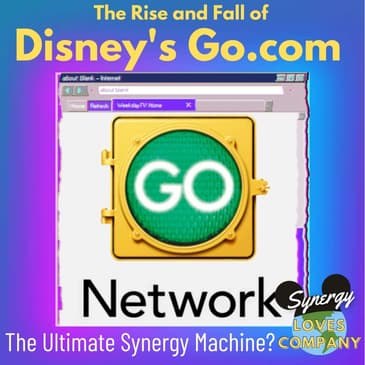
In this episode of Synergy Loves Company, host Eric delves into the fascinating history of Disney, the Internet, and go.com. From Walt Disney's innovative foresight into budding technologies to the rise and fall of go.com, Eric discusses the merging of Disney with Starwave and Infoseek, the birth of the Go network, the dotcom bubble burst, and the lingering legacy of go.com in today's Disney parks websites. Join in as he explores the tangled web of Disney's online presence and its impact on the company's current digital landscape. Tune in for a comprehensive look at the Internet and Disney's evolution, from its depictions in film from Tron to Ralph Breaks the Internet, and the influence of the early search engines like Infoseek. So dial in and connect with this intriguing exploration of Disney's brief yet everlasting Internet journey.
Thanks for listening to Synergy Loves Company: How Disney Connects to Everything.
https://www.synergylovescompany.com
Donate to the show: https://ko-fi.com/synergylovescompany
Youtube: https://www.youtube.com/@synergylovescompany Twitter: https://twitter.com/EricHSynergy Facebook: https://www.facebook.com/synergylovescompany Instagram and Threads :https://www.instagram.com/synergylovescompany/
00:04 --> 00:06 Synergy loves company on the World Wide.
00:06 --> 00:07 Web.
00:10 --> 00:34 We have this coterie of rich franchises. The company now that people want to engage with. I came here to try and continue what Walt Disney and his associates set in motion 50 years ago, which is to experiment with every new and innovative kind of entertainment possible.
00:40 --> 00:53 It's what we hope to do here to really develop something that, well, it's just more than an entertainment enterprise. It's something that contributes in many other ways.
00:59 --> 01:04 Hey, this is Synergy Loves company, where we explore how Disney connects to everything.
01:05 --> 01:06 Because you dont have to be at.
01:06 --> 01:14 The Disney parks to experience the magic every day. Im Eric and I just got back from Walt Disney World and I will.
01:14 --> 01:16 Be talking about that soon.
01:16 --> 01:29 But for now Im trying to get connected to the World Wide Web so I can download my Disney World photopass photos and share them on Instagram on the Internet. Which is great because today we're going to be taking a look at the.
01:29 --> 01:33 Internet and Disney and go.com dot.
01:38 --> 01:40 Okay, so once I get dialed in.
01:40 --> 01:44 To the Internet and logged on to my account, I'm going to head on.
01:44 --> 01:46 Over to Disney World's website, which is.
01:47 --> 01:57 Disneyworld dot Disney dot go.com. go.com re remember go.com that time when.
01:57 --> 02:09 Disney attempted to make one of those Internet directory portal sites, one site to rule them all? You know, us Disney adults would be all over Go.com if it were still there today.
02:10 --> 02:22 Come on, you'd want one of them sweet go.com email addresses. I know I would. But Go.com is actually still there, hanging out in the middle of Disneyworld dot Disney dot go.com.
02:23 --> 02:24 So let's take a look at what.
02:24 --> 02:27 Go.com was and why it's still there.
02:28 --> 02:41 At least kind of. When you talk about Walt Disney, you can't help but think about innovation and technology. From the beginning, he was innovating animation with sound, innovating in storytelling, live action.
02:41 --> 02:49 Films, documentaries, innovating amusement parks with theming ride systems, audio animatronics, and cleanliness.
02:49 --> 03:05 He was innovating in the way that he embraced television when all the other Hollywood studios were hoping it was just a fad. Then before he passed away, he was planning to innovate city planning with the experimental prototype community of tomorrow.
03:06 --> 03:11 Walt was definitely an early adopter and an innovator, a futurist.
03:12 --> 03:14 But the Walt Disney company post Walt.
03:14 --> 03:19 Disney did not have so much luck with technological innovation.
03:20 --> 03:29 For instance, when computer based animation was served up as the future of animation, Disney was given the first opportunity to invest.
03:29 --> 03:33 But they passed Steve Jobs instead invested.
03:33 --> 03:35 And took Pixar to the next level.
03:35 --> 03:38 At that point, Disney was just tagging along with Pixar.
03:39 --> 03:54 And Pixar movies were outperforming Disney animation in the early two thousands. Disney ultimately course corrected, and in 2006, they finally bought Pixar. But they could have gotten in on the ground floor. So let's get to the story of.
03:54 --> 04:04 The Internet and Disney with go.com. dot computers were everything. In the 1990s, more people were starting to have them in their homes.
04:05 --> 04:13 The Internet itself started back in the 1960s. Remember that big mainframe computer in spaceship Earth? The one with the go go booth.
04:13 --> 04:22 Scientist standing in front of it? Back then, computers could communicate with each other, but computers were big, they were.
04:22 --> 04:27 Expensive, and only a few were actually connected. So lets turn our heads to the.
04:27 --> 04:30 Left as we continue on spaceship Earth.
04:30 --> 04:31 Because this is when we see that.
04:31 --> 04:34 Garage where maybe Apple computers was started.
04:35 --> 04:39 And this scene marks the beginning of the boom in the 1980s when home.
04:39 --> 04:42 Computers became more and more common.
04:43 --> 05:02 By the 1990s, it became even easier to have a PC in your home. Windows made the user interface very intuitive and everybody wanted one. Now that computers were super common, it was getting easier and easier to connect them. Not only could computers connect with each.
05:02 --> 05:05 Other in the giant interconnected network, but.
05:05 --> 05:26 People, you and me could use computers to connect with each other and other people. The Internet is great. I was in middle school when the Internet was booming and we had a state of the art computer lab filled with Dell PCs. Dude, you're getting a Dell. They were loaded with the latest and greatest Windows 95.
05:26 --> 05:30 And our computer teacher was going to let us get on the Internet.
05:30 --> 05:41 It was so exciting. But first she had to teach us about this shiny new Internet thing. And the way she did it was so super nineties that it stuck with me for its.
05:41 --> 05:43 Well, it's still with me today, and.
05:43 --> 05:49 I just have to share it with you. She told us that the Internet was like a mall.
05:49 --> 05:51 I know, super nineties.
05:51 --> 05:53 She said that the websites that we.
05:53 --> 05:55 Wanted to get to would be like.
05:55 --> 06:00 The stores in the mall, like Spencer gifts or Sam Goody. But before we could get to the.
06:00 --> 06:04 Websites or stores, we would probably have.
06:04 --> 06:09 To enter the mall through an anchor store. You know, those big department stores that.
06:09 --> 06:12 Were trying to be everything to everyone, like Sears.
06:12 --> 06:16 Maybe you don't need to go into the mall. If you could find what you needed.
06:16 --> 06:20 At Sears, then you could just go in that store and then, and then leave.
06:20 --> 06:24 Those anchor department stores, she told us.
06:24 --> 06:27 Were like AOL and Yahoo and all.
06:27 --> 06:36 Those other Internet directories, the early search engine. They were portals that connected you to the rest of the mall or Internet.
06:36 --> 06:39 But they had a lot to offer on their own.
06:39 --> 06:53 I really like this description of the mall as it serves my millennial mind pretty well, but it has become somewhat outdated. But then again, if you look at the evolution of Disney's physical representations of.
06:53 --> 06:55 The Internet in film, my middle school.
06:55 --> 07:08 Teachers mall thing is pretty much right on. In 1982, before the World Wide Web was a household name, the movie Tron had an internal network where all these programs were linked and end incom could.
07:08 --> 07:10 Somehow access them all.
07:11 --> 07:13 The master control program was taking poor.
07:13 --> 07:16 Unfortunate data and programs that were meant.
07:16 --> 07:31 For finance and other business functions and turning them into digital gladiators in the barren wasteland of the grid to be de resed or deleted. Connecting computers is new and exciting, but also pretty scary.
07:31 --> 07:36 And we dont know exactly how it works, but it sure looks cool by 2018.
07:36 --> 07:42 Ralph breaks the Internet showed a complex, bustling city full of inside jokes dealing.
07:42 --> 07:48 With social media, YouTube, search engines, video gaming and even Disney's website.
07:49 --> 08:01 Inside the Internet, Ralph and Vanellope's network is a lot more familiar and inviting than the world of Tron. And if you ask me, Ralph's Internet is really just a more complex mall.
08:02 --> 08:04 So my teacher wasn't that far off.
08:04 --> 08:16 In the time after Tron, but before Ralph broke the Internet, the Walt Disney company got itself tangled in the World wide Web. And they got there by making some good old fashioned Disney acquisitions.
08:17 --> 08:21 Look out Bob Iger. Michael Eisner could make acquisitions too, but.
08:21 --> 08:38 His were a little different in the early 1980s as home computers were just getting their start. The companies you know now, today as juggernauts of tech, were just budding startups. Microsoft had just gone public and the co founders, Bill Gates and Paul Allen.
08:38 --> 08:40 Were in a dispute about how much.
08:40 --> 08:45 Control each of them would have over the company. Ultimately, Bill Gates took more control and.
08:45 --> 08:48 Paul Allen left the company in 1983.
08:48 --> 08:54 A decade later, he founded Starwave, a software company focusing on the budding new.
08:54 --> 09:09 Technology of CD roms for Microsofts Windows computers. Starwave made a lot of CD ROM software and games focused on pop culture. There were a few that were themed to musical artists.
09:09 --> 09:11 There was a Clint Eastwood two disc.
09:12 --> 09:22 Set that was basically an overblown IMDb page and biography that looked like you were exploring a virtual museum of Clint Eastwood.
09:23 --> 09:27 Another was Muppets inside. It was a play on intel inside.
09:27 --> 09:32 At the time, that was a common advertising thing for intel computers.
09:32 --> 09:41 In Muppets Inside, you would rescue Muppets that were trapped inside your computer by playing mini Muppet games. And they actually were kind of spoofs on games at the time.
09:42 --> 09:48 There's this swedish chef kind of like doom game included in there. Lots of mini games, lots of fun.
09:48 --> 10:12 But the thing Starwave became known for was their integration with the Internet. In 1996, they released Castle Infinity. It was one of the first massively multiplayer online games, or mmo, games made for children. You can say that Castle Infinity walked so that club Penguin could run. As the nineties turned to more and.
10:12 --> 10:15 More online content, Starwave began ditching the.
10:15 --> 10:47 Cd roms and leading more into coding high profile websites for big name companies who wanted to gain a presence on this new world Wide Web. In the late 1990s, Starwave made some pretty popular websites for ESPN and ABC News. Those two should sound pretty Disney to you. So on one hand, we had companies like Starwave that moved from coding computer software into coding websites that made the first web design firms of the Internet.
10:47 --> 10:53 But meanwhile, people needed help finding the websites that were out there.
10:53 --> 10:54 You could make a really great website.
10:55 --> 11:03 But who was going to know it's there? If you didn't know what the web address was, you couldn't find a website. Today you got Google and we're so.
11:03 --> 11:11 Used to just being able to ask Siri and Alexa for information and they just go and find us some results. But back in the nineties, if you.
11:11 --> 11:13 Didn'T have that full URL, it was.
11:13 --> 11:18 Kinda hard to find a website. So developers were inventing and innovating search.
11:18 --> 11:22 Engines and a pretty popular one called.
11:22 --> 11:39 Infoseek came on the scene in 1993. Infoseek was probably the first search engine to approach Internet search as a money making business. When it first launched, it was meant to be a pay to search service that didnt work because there were other.
11:39 --> 11:41 Free search engines out there.
11:41 --> 11:44 They decided to pivot and instead show.
11:44 --> 11:46 Ads in their searches.
11:46 --> 11:48 They also invented this little gem of.
11:48 --> 12:00 An idea where ads would pop up and new windows called Daughter Windows. This idea, though caught on and other websites started making new pop up windows.
12:00 --> 12:07 Infoseek would later get into suggesting certain ads to different people based on their search habits.
12:07 --> 12:09 And now you've probably guessed that we.
12:09 --> 12:14 Have InfoSeek to thank for pop ups and targeted search ads.
12:14 --> 12:16 Yay, Infoseek. Ugh.
12:16 --> 12:28 Infoseek was seeking to be the biggest search engine around. So they struck up a deal with Netseek, the biggest web browser around, to become their default search engine.
12:28 --> 12:30 All of these steps led to them.
12:30 --> 12:47 Becoming one of the top ten most visited websites in the world. But in the early nineties, search was only part of the web surfing experience. It was all about the web directory or the web portal. Web directories were a bridge between old.
12:47 --> 12:53 Familiar technology and this new Internet technology. People understood the yellow pages.
12:54 --> 13:09 If you needed a plumber, you opened up the book sent to you by the phone company and leafed over to the letter p. You found the section for plumbers in your town and you called one. People werent ready for a blank search bar in the middle of a page. Sorry, Google, youll have to wait till.
13:09 --> 13:10 The end of the decade.
13:10 --> 13:23 A web portal was this idea of organizing commonly used websites categorically and alphabetically, just like the yellow pages. Then you put your search bar up on top of those listings and you've.
13:23 --> 13:30 Got yourself a full web directory with search, your portal to everything that the Internet has to offer.
13:30 --> 13:32 Then you could add some services in.
13:32 --> 13:37 Like weather information, email, community chat rooms. And people come back and make it.
13:37 --> 13:40 Part of their daily Internet routine.
13:40 --> 13:47 Yahoo's was a big deal and tons of people used AOL's directory because America.
13:47 --> 13:49 Online sent them a disk with free.
13:49 --> 13:51 Internet minutes that dropped them off at.
13:51 --> 13:56 The portal when they connected. In the early Internet, companies all wanted.
13:56 --> 13:58 To have their sites listed on all.
13:58 --> 14:19 Of the popular web directories. And even more ambitious companies wanted a web directory of their own, one where they could list their subsidiaries first and direct people to their company and their own content. The idea was to get everyone to visit your web directory as the first.
14:19 --> 14:24 Stop on the Internet. From there, you could really steer the.
14:24 --> 14:27 Experience of the Internet and make visitors.
14:27 --> 14:29 See what you wanted them to see.
14:29 --> 14:32 The ultimate synergy machine.
14:32 --> 14:38 So of course, Michael Eisner needed a web directory for Disneyland.
14:38 --> 15:01 Disney had worked with Starwave to develop those sites for ABC News and ESPN just after the ABC capped Cities acquisition in 1996. So in 1997, they started buying up shares of Starwave and eventually bought the whole company. Starwave could code the ultimate Disney web directory in the same way they had.
15:01 --> 15:06 Made those other websites. But Starwave did not do search to.
15:06 --> 15:22 Make a full web directory. With Search, Disney set their eyes on the very popular infoseek. Disney acquired Infoseek and just like that legendary moment when John Hench and Marty Sklar slowly pushed together the models of.
15:22 --> 15:28 The world showcase and future world to make one Epcot center, the newly formed.
15:28 --> 15:32 Disney Internet group pushed Infoseek and Starwave together.
15:32 --> 15:43 And in 1999, they birthed go.com or the Go network. The Disney Web directory, the ultimate Synergy machine.
15:43 --> 15:52 The Go network was a big deal. Everything. Disney had a web presence listed under it. It was all part of the Go network.
15:52 --> 15:59 ABC stations, individual TV shows like General Hospital, Sabrina, the Teenage Witchen, and the.
15:59 --> 16:04 ESPN sports Center were all part of the Go network.
16:04 --> 16:08 The Disney parks, Disney movies, Disney characters.
16:08 --> 16:10 All part of the Go network.
16:11 --> 16:14 But for all the Disney synergy, go.com.
16:14 --> 16:30 Actually tried to distance itself from Disney in some ways. I remember this weird commercial where there were hamsters on hamster wheels at the pet store, and one of them went so fast that it broke through the side of the cage and out of the wall and out of the pet store itself.
16:30 --> 16:33 And then it said, Go.com is coming soon.
16:33 --> 16:35 And then it showed off this really.
16:35 --> 16:38 Generic looking stoplight logo.
16:38 --> 16:49 The stoplight logo would actually get them in copyright trouble because it was so generic. There was another company, Goto.com, who had an equally generic green circle logo.
16:49 --> 16:53 Disney actually lost that one and had to stop using that logo.
16:53 --> 16:59 But why was Go.com so generic for their web portal? Why not Disney.com?
16:59 --> 17:03 It was the Disney directory, the Disney.
17:03 --> 17:17 Portal into the Internet. One reason I think they opted for Go instead of Disney is that in the early Internet we used to have to use the whole web address, the whole URL. You had to type in that HTTP.
17:18 --> 17:20 Www stuff.
17:20 --> 17:22 And so it was a lot easier.
17:22 --> 17:26 To remember go.com than disney.com.
17:27 --> 17:32 But also I think it actually had to do with a little bit of a trojan horse situation.
17:33 --> 17:37 Go had this generic universal appeal.
17:37 --> 17:49 To compete with other web portals like Yahoo, it had to expand beyond the Disney universe and offer information on so many different topics. Go could potentially draw in non Disney.
17:49 --> 17:52 Fans as a great Internet portal site.
17:52 --> 17:58 And then secretly turn them into Disney adults. And that's how the go.com synergy machine.
17:59 --> 18:06 Would do its magic, or how it was supposed to work anyway. But it didn't work at all.
18:06 --> 18:08 Just about as soon as Disney created.
18:08 --> 18:11 The Go network, the.com bubble burst.
18:11 --> 18:16 Basically all these Internet companies were running out of money fast.
18:16 --> 18:18 Lots of people invested in these shiny.
18:18 --> 18:21 New Internet companies, but they weren't making.
18:21 --> 18:23 Any money and their stock crashed.
18:23 --> 18:26 Lots of companies closed and lots of.
18:26 --> 18:29 Investors lost lots of money.
18:29 --> 18:32 Go.com itself didn't actually make that much money.
18:32 --> 18:37 It spent a lot and it had to go.com.
18:37 --> 18:44 The idea was that it would direct potential customers to Disney content, but the problem was that people didn't exactly know.
18:44 --> 18:50 What to make of Go.com. what exactly was it? It seemed like it was trying to.
18:50 --> 18:51 Be too many things.
18:51 --> 18:54 It was advertised that your favorite tv.
18:54 --> 18:55 Shows were part of the Go network.
18:55 --> 19:16 But it was also email and a search engine. As early as the year 2001. Year after its launch, Disney started paring down Go.com dot. They dropped the Go network marketing shifted focus on making it a web portal with an emphasis on entertainment.
19:16 --> 19:22 By 2001, Disney announced that they would start to close its Go.com operations.
19:22 --> 19:24 But it would be a long process.
19:25 --> 19:31 A very long process. In 2001, they laid off over 400.
19:31 --> 19:34 Employees and they outsourced their search box.
19:35 --> 19:37 Actually to go to.com comma, the same.
19:37 --> 19:42 Company that sued them for their logo in 2010.
19:43 --> 19:56 Eight years later, they shut down the go.com email service. In 2013, they cut the page itself down to a Disney landing page. Throughout the two thousands Disney owned companies.
19:56 --> 20:20 Started dropping the go.com on their individual URL's. Espn dot go.com just became espn.com dot. Abcnews dot go.com became Abcnews.com. it took until 2022 just two years ago for freeform dot go.com to become freeform.com dot.
20:20 --> 20:22 Now, free form didn't even exist as.
20:22 --> 20:43 Freeform until 2016, but they still gave it a go.com URL. Are you kidding me? And if you still today want to visit Walt Disney World's website like I'm trying to do, you have to go to Disneyworld dot Disney dot go.com. it's still there.
20:44 --> 20:47 Go.com is still holding on for dare.
20:47 --> 21:08 Life in the Disney parks. There's also Disneyland dot Disney dot go.com disneyparks dot Disney dot go.com disneycruise dot Disney dot go.com disneyvacationclub dot disney dot Go.com at least Alani got its own domain.
21:08 --> 21:13 But the rest of the domestic american Disney parks and resorts are still part.
21:13 --> 21:20 Of the go network. And that's probably why we still have so much trouble with Disney Parks websites.
21:20 --> 21:22 Disney has had a history of having.
21:23 --> 21:25 Trouble with some websites and apps.
21:25 --> 21:32 They just don't always hit the mark. Sometimes they're bulky and laggy, some slow you down, some break.
21:32 --> 21:40 And this go.com is actually the beginning, the origin story of the not so great Disney website.
21:41 --> 21:45 And that's because those current Disney websites, the ones that give us the most.
21:45 --> 21:49 Problems, are built on the remains of go.com.
21:50 --> 21:53 So let's have a moment of silence for the Go network.
21:55 --> 21:56 Welcome.
21:56 --> 21:57 You've got mail.
21:57 --> 22:02 Oh, there, look, I'm finally connected. That's that 56k modem for you.
22:02 --> 22:04 Thanks for hanging around and keeping me.
22:04 --> 22:14 Company while I dialed up. Now I gotta go download those photos Disneyworld Dot Disney dot go.com maybe I.
22:14 --> 22:34 Could update that old pal Mickey while I'm there. It should have some updates by now, right? But you can make sure that you're ready to dial into some more synergy love's company if you enjoyed this episode and want more, you can subscribe or follow me on the podcast app of your choice or on YouTube for the video version where you can actually see.
22:34 --> 22:39 Me and what I'm talking about on the screen. It's the future and you can find.
22:39 --> 22:40 Me on the Internet.
22:40 --> 22:43 We can connect on social media, so.
22:43 --> 22:55 Go find me on Instagram and threads. Follow mergy lovescompany I'd also love it if you would share the show with another Disney fan friend of yours. Just tell them to visit my web.
22:55 --> 22:59 Portal, synergylovescompany.com, not part of the Go network.
22:59 --> 23:10 You could share a hyperlink with them in the chat room of your choice or maybe post about the show on your favorite message board. And remember, this show is listener supported.
23:10 --> 23:13 There's no sponsors, it's just you and me.
23:13 --> 23:15 And if you feel like you get.
23:15 --> 23:16 Value from the show and you want.
23:16 --> 23:25 To give some back, you can buy me a coffee on Ko fi on Ko fi. K o f I. You can make a donation. Let me know that you get some.
23:25 --> 23:27 Value from the show and you want.
23:27 --> 23:33 Me to continue making more great episodes just like this. If you look in the show description.
23:33 --> 23:36 Or go to synergylovescompany.com, you can find.
23:36 --> 23:56 A link to my Ko fi page where you can give back to the show to help it keep going no matter how you decide to support the show. I really appreciate you and the time you spend with me. So thank you. That's all for today. Thanks for exploring Disney's connections with me. And until next time, keep discovering the.
23:56 --> 24:12 Magic of in everything. Goodbye.