
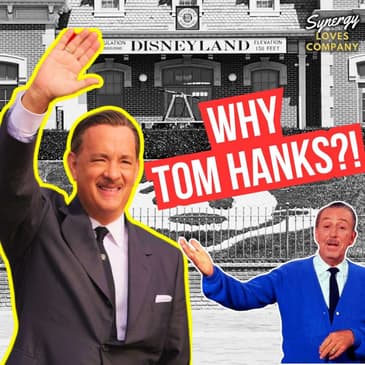
Why Tom Hanks Played Walt Disney: The 30-Year Disney Connection
Discover the untold story of how Disney strategically built the perfect actor to play its founder. Tom Hanks didn't just get cast as Walt Disney in Saving Mr. Banks—he was engineered for the role across three decades of calculated partnership.
From Splash and Touchstone Pictures to Toy Story and beyond, explore how Disney's synergy with Tom Hanks created the most iconic casting decision in Hollywood history. This is the real reason Tom Hanks became Walt Disney.
In This Episode:
Why Disney created Touchstone Pictures and cast Tom Hanks
How Splash (1984) launched the Tom Hanks era
The brilliant Pixar pitch that convinced Hanks to voice Woody
How Tom Hanks became "America's Dad"
The perfect synergy between actor and founder
Why no other actor could have played Walt Disney
Subsribe to Synergy Loves Company on YouTube for deep dives into how Disney connects to everything in entertainment, culture, and history.
https://www.youtube.com/@SynergyLovesCompany?sub_confirmation=1
Podcast:
Listen to Synergy Loves Company → https://synergylovescompany.com
Support the Show:
Shop official Synergy Loves Company merch → https://shop.synergylovescompany.com
Affiliate Disclosure: Some links above may be affiliate links. If you click and purchase, I may receive a small commission at no extra cost to you. Thank you for supporting the channel!
Connect with Me:
Instagram → https://www.instagram.com/synergylovescompany
Bluesky → https://bsky.app/profile/erichsynergy.bsky.social
Facebook → https://www.facebook.com/synergylovescompany
Credits / Resources:
• Synergy Loves Company is not affiliated with The Walt Disney Company or any of its subsidiaries.
• Images and clips are used under fair use for commentary, criticism, and education.
This podcast is powered by Pinecast.
00:00 --> 05:25 When Disney announced they were making a film about the making of Mary Poppins, the casting for Walt Disney initially raised a few eyebrows. Tom Hanks. But the moment the news settled, a different thought took hold. Of course Tom Hanks would play Walt Disney. But hold on a second. Why was it so obvious? Because when you think about it, Hollywood is filled with talented actors. Walt Disney was a real complex and frankly, sometimes difficult person. So why was Tom Hanks, this specific, beloved everyman actor, the only choice? The answer isn't found in a single moment. It's a story that starts 29 years earlier with a movie about a mermaid, a brand new movie studie label, and a decision by Disney to take a chance on the exact kind of American everyman hero who could one day play their own founder. Hey, this is Synergy Loves Company where we explore how Disney connects to everything. I'm Eric. And this is the real story of how Disney helped build Tom Hanks into the actor who would become Walt Disney on film. And let's get right into it. To understand this, we need to get back to 1984. Disney was in a weird spot. They were the undisputed kings of family entertainment. But that was also their biggest problem. They were trapped. They couldn't make movies for adults. They anything with even a hint of mature content, a little language, a little adult situations. It didn't fit the Disney brand. So what did they do? They created a whole new brand and they called it Touchstone Pictures. This was their brand image loophole. A way to make Hollywood movies without the Disney name attached. And the very first film they released under this new label was Splash, a romantic comedy starring a then mostly unknown TV actor named Tom Hanks and a mermaid played by Daryl Hannah. Remember, back then, TV stars didn't really do movies, and movie stars really didn't do tv. Think about that for a second. Disney's first foray into films for a mature audience wasn't a gritty drama. It was a fantasy romance. And, and the hero wasn't a muscle bound action star. He was Tom Hanks as Alan Bauer, a shy, slightly neurotic wholesale fruit businessman. He was the definition of an everyman. The guy you could imagine living next door to. The movie was not a full grown up departure. It was kind of a Disney story for a more mature audience. And it was a massive hit. It made over $69 million. More importantly, it worked. It, it proved that Touchstone could work. You could make a successful, slightly edgy film with a relatable lead. And that relatable lead of course, was Tom Hanks. And this was the foundation. Disney, through Touchstone, gave Hanks his first major film role. They bet on him as the face of their new Touchstone identity. And they actively participated in crafting his Persona from the very beginning. He wasn't just an actor they hired. They helped create the time Tom Hanks we know today. They established him as the guy you trust, the guy you root for, the good hearted, all American regular guy. And they didn't just stop there. They kept him in the family when they could. His next film for Touchstone was Turner and Hooch, five years later in 1989. That's the one with the slobbering dog. Again. Hanks plays a regular guy, a clean freak, by the book cop who has his life turned upside down by a messy, lovable animal. It's the same formula. You put that normal, slightly fussy guy in an extraordinary situation and watch his good heart win out. While Tom Hanks would go on to play similar everyman roles for many studios, Disney kept the relationship strong. They continued to call on them when they needed that specific Tom Hanks quality, the trustworthy regular guy. And he consistently answered the call, even as his fame was skyrocketing. And the next time that they needed to call on him came in 1995. Pixar was this tiny, unproven computer animation studio that Disney was working with, but still trying to keep at arm's length. They were making their first ever feature film, Toy Story. And Disney saw it as a potential huge risk. The whole concept, toys coming to life, was maybe a little weird and it could come off as creepy. So they needed a voice that audiences would immediately trust. The voice that felt like a friend. So who did they call? Tom Hanks. But get this. Hanks needed some convincing. Pixar wasn't the powerhouse that it is today. So they came up with this brilliant pitch idea. They took audio of Tom Hanks from another movie, specifically a scene from Turner and Hooch where he's yelling at the dog for eating his car.
05:25 --> 05:31 Oh, no, no, no. You're eating the car. Don't eat the car. Not the car.
05:32 --> 05:35 And then they animated a prototype, Woody to that audio.
05:35 --> 05:41 Oh, no, no, no. You're eating the car. Don't eat the car. Not the car.
05:42 --> 21:28 They showed Hanks the video of this little cowboy doll with his dramatic hand gestures. And it was all synced to Hanks's own frustrated yelling voice. And Tom Hanks said it was undeniably great. He was sold. And he saw the humor in the heart Immediately, it's a perfect circle. They used his performance in the Disney owned Touchstone film to convince him to star in the film that would become Disney's next big franchise. And think about Woody. Woody is the absolute pinnacle of the Hank's everyman Persona. He's the leader, but he's insecure. He's loyal, but he gets jealous. He's dramatic, he's funny, he's deeply caring and he's the moral center of Andy's room for an entire generation. Tom Hanks is the voice of childhood loyalty and friendship. This is where the contrast with someone like Tim Allen is so interesting. Tim Allen as Buzz Lightyear is fantastic, but Allen's relationship with Disney is different. He was the star of Home Improvement on abc, which Disney owned. He became the star of the Santa Claus franchise for Disney. And he's deeply embedded in the Disney television and family film machinery. You can check out the video on him here. But Tom Hanks's relationship was different. He wasn't a Disney sitcom star. He was a movie star who kept popping up in key foundational Disney projects. He was the star they could bring in to lend credibility and heart to their biggest swings. First with Touchstone, then with Pixar. That distance, that selective partnership, made his association with Disney feel like more of an event. It felt more special. It wasn't just corporate obligation. It was a series of deliberate, high stakes collaborations. So by the mid-90s, through a decade of strategic partnership, Disney had tied itself to Tom Hanks, who had been solidifying himself as the most trusted man in American cinema. He was the guy who made a mermaid love story work. He was the guy who made a cartoon cowboy feel like your best friend. Disney had a hand in meticulously crafting the perfect man hero. And as it turned out, they were going to need that exact Persona for their most important role yet. All right, all right, we got all the players set up. So what happens next? The 90s roll on and Tom Hanks doesn't just become a movie star. He becomes something entirely different. He becomes America's dad. And this wasn't an accident. It was a direct result of the foundation Disney helped him build. And after the 12 punch of Touchstone, Splash and 20th Century Fox's Big, Hollywood knew exactly what it had. An actor who could be funny and deeply heartfelt, often in the same scene. He could make you believe in the magic of a mermaid or the innocence of a kid in an adult's body. But then he did something no one saw coming. He pivoted hard he took the goodwill, the trust, the everyman charm that projects like Disney's had baked into his DNA. And he applied applied it to serious dramatic roles. And it worked because we already believed in him. Philadelphia in 1993. This was a huge risk. A major studio film about AIDS and homophobia at the height of the AIDS crisis. But they cast Tom Hanks as the sympathetic lead. And because it was Tom Hanks, the guy from Turner and Hooch in A League of Their Own, Middle America let him into their living rooms to tell that story. They trusted him and he won his first Oscar. Then the very next year, Forrest Gump. It's the ultimate expression of the Hanks everyman. A simple, kind hearted man who accidentally stumbles through the most important moments in American history. He wasn't a superhero, he was just a good guy. And it cemented his status as a national treasure. And he won his second Oscar. Think about the through line here. The guy who was worried about his fruit business in Splash became the guy taking over his friend's shrimp business in Forrest Gump. And the through line is that good heart. Disney's touchstone gave him the springboard to define that Persona. And then he took it from there and ran all the way to the top of the industry. He became probably the most trusted actor in the world. The guy you'd believe as an astronaut in Apollo 13, a soldier in saving Private Ryan, or a castaway talking to a volleyball. He was, for all intents and purposes, America's dad. And that's a title you can't buy. It's earned through years of curated, consistent and heartfelt performances. Performances that started with a mermaid on a Disney lot. Now, let's get back to business on the other side of this equation, Disney itself. Because while Tom Hanks was becoming America's dad, Disney was perfecting its own form of magic. They weren't just making movies, they were making myths. Sometimes even about themselves. The company has always been in the business of storytelling. And its greatest story has always been its own origin. The tale of Walt Disney, the humble cartoonist who built an empire on a mouse. It's the bedrock of the entire company's identity. But here's the thing. The real Walt Disney was a complicated figure. A visionary, sure, but also a demanding perfectionist, a tough businessman, and a man with his own flaws and complexity. The Walt Disney that the public knew, however, was different. That was Uncle Walt, the friendly, smiling host of the wonderful world of Disney, who came into your living room every week. That was a character, carefully constructed Persona designed to be the warm, trustworthy face of a company. He was in essence, the original America's dad or uncle. This is the crucial piece. For decades, Disney had maintained this mythos. The protected image of Uncle Walt, the innovator, the storyteller, the kindly grandfather figure, actual complicated man was kept separate from the brand. The brand was about hope, optimism, and sheer uncynical belief in magic. So flash forward to the early 2010s and Disney decides to make Saving Mr. Banks a film about the television difficult behind the scenes struggle to get the movie Mary Poppins made. It is a story that requires someone to portray Walt Disney. But which Walt Disney do you portray? The complicated real life businessman who had to cajole and negotiate with PL Travers? Or the mythic Uncle Walt that audiences around the world had come to love and trust? The answer might seem obvious. The film wasn't a warts and all biography. It's Disney, after all. It was a celebration of the Disney magic. And it needed its protagonist to be the embodiment of that magic. It needed the myth. It needed Uncle Walt. And so the casting decision became not just obvious, but inevitable. They didn't need an actor who looked exactly like Walt Disney. They needed an actor who was Walt Disney in the public consciousness. They needed an actor who who embodied trust, warmth and unwavering optimism. They needed someone with a title like America's Dad. They needed the actor whose entire film career was launched by a Disney studio, who became a superstar by voicing the heart of Disney and Pixar's biggest modern franchise, and who spent 30 years building a Persona of impeccable decency. The synergy was complete. The Walt Disney Company had spent decades connecting with the perfect actor to play its founder. So the call goes out and of course Tom Hanks says yes. But this wasn't just another role. This was the culmination of everything. When Hank steps into the role of Walt Disney in saving Mr. Banks, it's not just an actor playing a part. It's the final piece of a puzzle falling into place. Think about the trust factor. The entire film hinges on the audience believing that Walt Disney, despite being a shrewd negotiator, has a good heart and pure intentions. He has to be charming enough to win over a skeptical P.L. travers, but he also has to be a formidable businessman. Who else can you cast where the audience immediately knows instinctively that he's one of the good guys? It had to be Tom Hanks. Any other actor, even a great one, would had to have worked harder to prove that Walt's motives were genuine. With Hanks, you just accepted it. You believe him because Disney and Hanks spent 30 years teaching you to believe him. And this is where the contrast with his Toy Story co star becomes so telling. Imagine for a second if they had cast a Tim Allen as Walt Disney. It would have been a completely different movie. Allen's Persona is brilliant, but it it's the brash, know it all comedic Persona of Buzz Lightyear, Tim the Toolman Taylor. It's not the gentle, authoritative, mythic quality needed for Uncle Walt. Hanks's selective partnership with Disney gave him a unique aura. He wasn't the in house guy. He was the special guest star for their most important events. That made his casting as Walt feel like an event in itself. And the synergy is almost magical. Disney created Touchstone and took a chance on a star to anchor its adult oriented, heartfelt story. That star, Tom Hanks then became the voice and the emotional core of their animation renaissance in Pixar. And that same star, now an icon of American decency, was the only possible choice to play and embody the mythic founder of the Disney company, Walt Disney. It's a feedback loop of trust. Disney helped build the trustworthy star and then hired him to play the trustworthy founder, thereby reinforcing the trust in the entire brand. Now this isn't to say that Tom Hanks performance is a shallow, glossy hero worship kind of thing. That's what makes it so clever. The film Saving Mr. Banks is smart enough to acknowledge that Walt Disney was a character, a performance. And Hanks leans into that beautifully. There's a fantastic scene where Walt is trying to convince P.L. travers to sign over the rights. And he doesn't just make a business argument. He puts on that Uncle Walt Persona and charm. He turns it up. The twinkle in his eye, the folksy wisdom. Hanks lets you see the gears turning just a little. You see the businessman using his public image as a tool. But because it's Tom Hanks doing it, it feels genuine and it feels like a good man using his powers for good. This is the real magic of the casting. Hanks could play the myth, the smiling cardigan wearing Uncle Walt while also hinting at the formidable man underneath. He could deliver a line like just what we storytellers do. We restore order with imagination. And you completely believe that both the poetic storyteller and the hard nosed CEO who would say that line exist in the same person. The film doesn't ignore Walt's complexities. It filters them through the Tom Hanks, Walt Disney Persona, his Stubbornness becomes his determination. His shrewdness becomes his cleverness. And it's full of sentimentality and heart. It's a performance that acknowledges the man's flaws without ever undermining the myth. And that was the only way this movie could work. A truly critical biological biography would have betrayed the Disney brand. A completely saccharine one would have felt false. By casting Tom Hanks, they found the perfect middle ground he gave them. A Walt Disney who was human enough to be interesting, but heroic enough to satisfy the legend. In the end, the performance works because we're not really watching Tom Hanks play Walt Disney. We're mostly watching Tom Hanks play Uncle Walt, the character that Walt Disney himself performed for the public. And who better than to play a beloved public character than the most beloved public actor of his generation? A generation that, let's not forget, largely met him as the voice of Woody, the loyal cowboy toy. The connection from Woody to Walt isn't as big of a leap as you might think. Both are leaders, both are protective. Both are the steady, reliable center of their respective universes. It was the final perfect piece of casting synergy, decades in the making. And that's the real magic trick. This wasn't just smart casting. Disney didn't just hire an actor. They leveraged a 30 year partnership. They consistently turned to Tom Hanks, established everyman Persona at pivotal moments in their corporate history. First to launch Touchstone, then to anchor Pixar, and finally to embody Walt Disney. Each time, Hanks brought credibility and emotional resonance exactly when Disney needed it the most. It's a level of strategic partnership that paid off across decades of corporate evolution. And speaking of that Pixar partnership, it's wild to think that Toy story is over 30 years old. That's three decades of woody, three decades of that voice that Pixar so cleverly pulled from Turner and Hooch, becoming the emotional anchor for an entire universe of storytelling. And it's still going. Toy Story 5 is on the way this summer. That initial decision to cast Tom Hanks didn't just make one movie work. It built a foundation that's still supporting the house today. And that's a story we're going to keep exploring on this channel. This video is actually kind of a part of a whole series we're doing to commemorate the 30th anniversary of Toy Story. I'm going to look at all the different threads, like the the video I did on Tim Allen, all the threads that come together to create this animation revolution in Pixar. So if you're into this deep dive into Disney history of Pixar history, you should definitely subscribe so you don't miss what's coming next. So, I mean, that's the real reason Tom Hanks played Walt Disney. It wasn't an accident. It was the final perfect step in a partnership that made Tom Hanks the only actor who could convincingly play the character of Uncle Walt. The myth that America loved Disney magic isn't just in the parks. It's in the stories they tell. And sometimes it's in the story of how they built their screen. Perfect storyteller himself. If you want to see more of how Disney connects to everything, check out that video on Tim Allen next. And remember, keep discovering the magic in everything. Sam.