
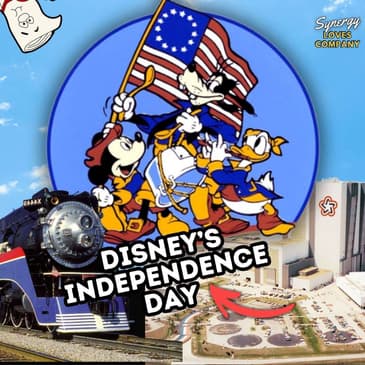
From the tracks of the American Freedom Train to the catchy tunes of Schoolhouse Rock and the massive scale of America on Parade, Disney didn't just join the Bicentennial—they touched more celebrations than you know, and shaped how we Celebrate the Fourth of July.
In 1976, America was a mess. Between the fallout of Vietnam, the Watergate scandal, and a crushing energy crisis, the country wasn’t exactly in a party mood for its 200th birthday. But while the federal government’s official plans were falling apart, Disney was quietly building a celebration that would define the Bicentennial for millions.
In this episode, we explore how Disney Connects to the Bicentennial—from the planning of Liberty Square to the massive "America on Parade" that ran simultaneously on both coasts. We’ll look at the "Disney DNA" in Schoolhouse Rock, the moving walkways of the American Freedom Train, and how a 1976 science expo at Kennedy Space Center paved the way for EPCOT’s Horizons.
Plus, we look ahead to America 250 to see how Disney is using its 1976 playbook to celebrate the nation’s next big milestone.
In this episode, we discuss:
- The Bicentennial Crisis:Why the official World’s Fair plan failed and how grassroots "Bicentennial Communities" took over.
- Liberty Square’s Secret History: Why Disney’s Colonial land was actually a decade in the making.
- The Freedom Train: The Disney legends who helped a 26-car steam locomotive bring history to 48 states.
- Schoolhouse Rock: How Michael Eisner and the Bicentennial "History Rock" series created a Saturday morning legacy.
- Third Century America: The forgotten NASA expo that inspired one of EPCOT’s most beloved pavilions, Horizons.
- America on Parade: The logistics of running the same massive parade in two states at the exact same time.
Chapters:
0:00 – Setting the Scene: America in 1976
0:31 – Origins of the Bicentennial Celebration
1:30 – Shifting the Bicentennial: From One Big Fair to Community Events
3:36 – Local Celebrations and Disney’s Early Involvement
4:09 – Liberty Square: Disney's Revolutionary Space
5:57 – The Liberty Bell in Liberty Square
7:32 – Bicentennial Pop Culture: Schoolhouse Rock and The Freedom Train
12:17 – Third Century America at Kennedy Space Center
14:00 – Disney’s Evolving Vision: From EPCOT to Horizons
15:43 – America on Parade: Disney’s Bicentennial Spectacle
20:26 – America 250: Disney’s New Nationwide Celebration
Subscribe for more Disney connections:
https://www.youtube.com/@SynergyLovesCompany?sub_confirmation=1
Podcast:
Listen to Synergy Loves Company → https://synergylovescompany.com
Support the Show:
Shop official Synergy Loves Company merch → https://shop.synergylovescompany.com
Affiliate Disclosure: Some links above may be affiliate links. If you click and purchase, I may receive a small commission at no extra cost to you. Thank you for supporting the channel!
Connect with Me:
Instagram → https://www.instagram.com/synergylovescompany
Bluesky → https://bsky.app/profile/erichsynergy.bsky.social
Facebook → https://www.facebook.com/synergylovescompany
Credits / Resources:
• Music licensed via Melod.ie
• Synergy Loves Company is not affiliated with The Walt Disney Company or any of its subsidiaries.
• Images and clips are used under fair use for commentary, criticism, and education.
This podcast is powered by Pinecast.
00:00 --> 22:28 The country is divided. No one can agree on anything. There's a war going on that a lot of people don't think we should be in. And the price of gas keeps climbing. The economy isn't doing anyone any favors. And America is supposed to celebrate a major milestone birthday. Do Americans even want to celebrate right now? Sounds familiar, right? But we're not actually talking about today. We're talking about 1976, the bicentennial. 200 years of America. And 50 years ago, right on the heels of Vietnam, Watergate, gas lines around the block, and a president who resigned in disgrace, the country had spent a full decade getting beaten up. And now it was supposed to throw a party. But what kind of a party? And if America was going to celebrate, you know, that Disney was going to be involved. Hey, this is Synergy Loves Company, where we explore how Disney connects to everything. I'm Eric, and today we're looking at 1976America and how Disney helped celebrate the bicentennial. Planning for the Bicentennial actually started in 1966, 10 years before the actual bicentennial celebration. President Johnson put together the American Revolution Bicentennial Commission, a mix of elected officials, business leaders, and public figures. And the original vision was basically a repeat of the 1876 Centennial Fair, which was the World's Fair in Philadelphia, one massive event that the whole country would get to attend if. If they could afford to go there. You might remember the centennial from that scene in Epcot's American Adventure, where that's the event they're at in the show. Then in the 70s, Nixon got elected and. And the commission changed. Presidents seemed to change, that kind of thing. New appointments went to political allies. His focus shifted towards using the Bicentennial as a showcase for American power rather than a reflective celebration. But then the Watergate scandal happened, and suddenly the Commission Running America's 200th birthday party was tangled up in corruption investigations from the House Judiciary Committee and. And the Government Accountability Office. It was not a great look. So the people took over the bicentennial celebration. Grassroots groups, local communities, activists and historians, they all pushed back and agreed. This celebration belongs to everyone. Not one city, not one administration. And a group called the People's Bicentennial Commission basically told Americans to ignore that official plan and. And find their own way to mark the anniversary. And that really caught on like a revolution. By 1973, the Bicentennial Commission got the message, like the government's Bicentennial Commission, and they scrapped that single world's fair model and pivoted to something called Bicentennial communities. And it kind of worked like this. Local organizations would plan their own events and get official recognition for them. The Bicentennial celebration could be everywhere, all at once. When the Bicentennial finally arrived, over 12 events across different communities had been recognized as official. There were parades, fireworks. Towns did things like restoring old railroad stations. Historians launched oral history projects. Tall ships sailed into New York harbor, their old Conestoga wagons tracing pioneer routes. Alex Haley published Roots and called it a gift for the Bicentennial for everyone. Everyone could celebrate the Bicentennial the way they wanted to. And it seemed like everyone in the country participated in at least one Bicentennial celebration. And so, like we said, Disney had to get involved. The company had just opened Walt Disney World in 1971, a vacation kingdom with a theme park and resorts all connected by a monorail and enough space for expansion in the future. Ever since they had been planning this project, Disney had been preparing to support the Bicentennial with a physical space that would revive one of Walt's old plans and tell the story of America's beginnings. Liberty Square opened with Walt Disney World on October 1, 1971, day one. And one of the reasons it existed was because the bicentennial was coming. Walt Disney and his imagineers originally planned out something called Liberty street and as an addition to Disneyland in Anaheim. And it would be right off Main Street. It even had concept art and a preview in Disneyland. But it never actually got built. It got put on the shelf. And when the Magic Kingdom was being designed in the late 60s, they took that idea back off the shelf. And with 1976 approaching, he would be pretty strategic to tap into that colonial themed town. The details they put into Liberty Square are what Disney is known for. The architecture was New England colonial, historical, and it moved through time as you moved through the land. The Liberty Tree in the center is a real 100-year-old Southern live oak that was transplanted from another location on the property, like eight miles away. It's a real living tree, and it works kinda as the land's mini weenie, just like a real colonial town would have at its center. And the hall of Presidents finally achieved Walt's goal of putting audio animatronics of every US President in one attraction. Lincoln was just the prototype. And you might also know that Liberty Square has a replica of the Liberty Bell. So let's take a minute and talk about Disney's Liberty Bell, because people usually assume it was there from the beginning or that it was installed as part of the Bicentennial. Celebration. But those are not actually the case. Disney didn't have a Liberty Bell at all until 1987 for the Constitution's bicentennial. Disney celebrated that big time too. That's when we got Bicentennial Ben, the Walk Around Bison character. Anyway, in 1987, they borrowed a replica Liberty Bell from a cemetery owner named Foy Bryant in Fair Oaks, California. Bryant had purchased his bell in 1975 from the Packard Bell Foundry in France and spent the actual bicentennial year bringing it to schools and parades so that kids who couldn't get to Philadelphia could still get a chance to see the Liberty Bell up close. The bell was super popular for Disney, so they extended the loan. They wanted to keep that bell longer. It helped finish the look of Liberty Square. Then when it went back, they commissioned their own permanent bell directly from Picard. And Disney got their hands on it in 1989. Brian's original bell went back to California and is in the Court of Liberty at Mount Vernon Memorial park today. But that 1989 bell, that's the one you can still see in Liberty Square today. Okay, let's get back to the 70s. So there were tons of little celebrations and commemorations everywhere. And a lot of them, even though they're not directly Disney, have some deep Disney connections. And this next one wasn't exactly Disney at the time, but it has a lot of Disney DNA. And it actually is Disney today, like retroactively. Schoolhouse Rock was a Saturday morning ABC mainstay years before Disney got their hands on abc. But the guy who greenlit it was a young ABC programming executive named Michael Eisner. Yep, that same Michael Eisner who became the CEO of the Walt Disney Company in 1984. Schoolhouse Rock did a special bicentennial edition called History Rock. And it introduced some of the most iconic Schoolhouse Rock hits and taught us civics along the way. The shot heard round the world, fireworks, no more kings and you know you love it. I'm just a bill. And these were three minute animated shorts with catchy songs that ran between Saturday morning cartoons. And like I said, Schoolhouse Rock is now a Disney owned property. They got their hands on it with the capital City's ABC merger in the 90s that Michael Eisner pulled off. And you can watch it today on Disney. So that was a bicentennial celebration for your TV airwaves. But let's get to another Disney adjacent celebration that crisscrossed the country on train tracks. The Freedom Train. Walt would have loved this. The American Freedom train was a 26 car steam locomotive painted red, white and blue that spent two years traveling to 138 cities across 48 states. I mean, they couldn't really bring it to Hawaii. And Alaska was kind of far away, too. It was kind of like a museum of American history on wheels traveling across the country. Walt Disney actually had a similar idea for a train car exhibit of miniatures he would have called Disneylandia years before he would transform that idea into Disneyland. The Freedom Train, though, had some pretty cool stuff. George Washington's copy of the Constitution with his handwritten margin notes. Benjamin Franklin's draft of the Articles of Confederation. Moon rocks from NASA, Jesse Owens track gear. Dr. Martin Luther King Jr's pulpit. But the coolest thing, in my opinion, is how you would experience the train cars. Visitors moved through the exhibit. Cars of audio, narrated displays on a Goodyear moving walkway, just like those Goodyear speed ramps at the end of Disney rides. Like Walt Disney World's Space Mountain when it was sponsored by Goodyear, but also still at Pirates of the Caribbean and the entrance up to the People Mover. Okay, okay, I know that's not Disney enough on its own, but it's not for lack of trying. The people behind the American Freedom Train actually reached out to Disney. Walt Disney was famously a train guy, and they were hoping that the company might want to help out. And because it was a train, when Disney got that call, they forwarded it to Ward Kimball, one of Walt's original nine Old Men animators and the train nut who helped turn Walt onto building his own trains. Even though Disney wasn't able to help, they were working on their own bicentennial celebration. And we'll get to that in a minute. Ward Kimball put the train people in touch with designer Barry Howard, who had worked on the California State Railroad Museum, and this recommendation worked out. And then Kimball followed the project, popping in and out where he could lend a hand, and was recognized for his contributions by the American Freedom train Foundation. Over 7 million people actually boarded the Freedom Train, and millions more watched it as it passed through their towns. The train didn't need to stop for you to be a part of it. It just had to roll through. And suddenly the bicentennial was there on the train tracks that you're stopped at right in front of you. But when the train actually pulled into a station, there would usually be a whole production waiting. Performances, local ceremonies, celebrations. And when it arrived In Anaheim on January 9, 1976, you know Disney was there. Unfortunately, the train couldn't come all the way to Disney, but it did show up at Angel Stadium. And Mickey was one of the celebrity guests there to greet it. Let's crisscross the country and go back to Florida, but not to Walt Disney World yet. I know, I know we're going to get there, but let's go a little bit further first, like an hour east of Walt Disney World to the Kennedy Space Center. On Memorial day weekend in 1976, the federal government opened the only officially funded bicentennial exhibition in the country, and they called it third Century America. The space center was the host site for an exhibition about where science and technology would take us over the next hundred years, the third century federal agencies and technology companies set up an expo of the future. Fifteen geodesic domes went up outside in a pavilion around the space center building. Geodesic domes. Future technology for the world. Hmm. Third Century America was a little different from everything happening around the bicentennial. Most of it, like the Freedom Train, looked backwards at the history. But 3rd century pointed straight at what was coming down the line. It was a bicentennial expo that was about the next century, the tricentennial, and it was built with the idea that American ingenuity would help to keep solving problems into the future. The people who visited loved it, but the run only lasted a hundred or so days. NASA needed the vehicle assembly building back to get back to work on the space shuttles, and the exhibition closed September 7th. It was the summer season fair only, probably taking advantage of the Disney World summer vacationers who took a day away from Disney to explore the rest of nearby Florida. Half a million people made it through before it closed, and that was just that summer. Okay, let's get Disney with it, though. Walt Disney World was right down the road, and it was already doing that Disneyland theme park thing, and it was already doing the vacation kingdom thing, but it wasn't yet doing Walt's Epcot thing. And during this period of the 70s, the imagineers were trying to figure out what their EPCOT would be without Walt. They weren't ready for the city of the future. They were coming up with this more like permanent World's fair idea that looked forward to the future, especially at technology and science. Kind of like, come on. Disney had to be watching Third Century America. The belief that the technology and human creativity would build a better world. That was what Walt was thinking with his Epcot city, and that went into the DNA of Epcot's future world. But wait, there's more. During the future world's development, Disney built out a pavilion concept called Century 3. The pavilion looked forward to where humanity was headed in its next hundred years. Which is pretty much the same thing that that Kennedy Space center exhibition did. Disney's Century 3 evolved through development and eventually became Horizons. The Epcot pavilion that opened in 1983 and ran till 1999 that everyone still loves in hindsight, more than they loved it when was around. Thanks Martin's vids. The whole ride was a tour of the possibilities of the future with the same forward looking optimism that third century America had. Okay, now it's time. Let's get to Disney's big bicentennial celebration. America on Parade was announced jointly with the American Revolution Bicentennial Administration at the State department in Washington D.C. it was a joint effort. Disney was embedded in the bicentennial. This was an official partnership between Disney and the agency organizing the entire national celebration. Disney President of Entertainment Bob Yanni would architect the whole experience. And they were going to do it at both Disneyland and Disney World. The biggest part of the celebration at the Disney parks was the the parade. I mean it was called America on Parade. There had to be a parade. And it ran from June 1975 through September 1976, over 1200 performances. There was a daytime and a nighttime run every day. And Walt Disney World and Disneyland ran it at the same time. Which meant every float, every costume, everything needed two copies other than permanent attractions and rides and stuff like that. This was the first time Disney opened two versions of the same entertainment experience at both parks on both coasts. The parade opened with Mickey, Donald and Goofy recreating Archibald Willard's famous spirit of 76 painting. And that image became the logo for the America on Parade festivities. And they put it on everything. Books, view master reels, puzzles, clothes, hats, mugs, trivets. So you could put your pot on there and not burn your table. But then there were these parade floats that came down the street. America on Parade depicting great moments in American history like Benjamin Franklin's kite, Betsy Ross making the flag, the invention of flight, the first Thanksgiving, the Salem witch trials and a giant sandwich. I mean, we do like to eat. The floats were populated with the people of America. These giant nightmare fuel. 8 foot costumed figures with oversized heads representing different people, occupations and groups from American history. These types of characters would come back again in the form of the people of the world at Epcot's World showcase later in 82. The music for the parade was also something to behold. In classic Disney style, the Sherman brothers wrote an original song called the Glorious Fourth. And Bob Johnny wanted a band organ to play the music for the parade. But you couldn't just go to a music shop and buy a band organ. So they found one in Missouri, a fully restored 1890 band organ called the Sadie Mae. And it used one of those like punched hole player piano book type mechanisms. But just like the band organ, you can't just go to a music shop and like get one of those punch card books. There's only one guy in the world who could make them and he was in Belgium. So Disney sent him the arrangements of the music, he punched the holes and Sadie Mae got that music and recorded in a studio in Nashville, Tennessee. And then those recordings were sent to la where studio musicians added in a Moog synthesizer because it was the 70s. And that's the kind of effort and attention to detail that Bob Yanni put into his productions. He wanted them to be perfect. The parade usually ended with a high school marching band representing their home state. And then after the nighttime run of the parade, there were fireworks. Come on, it's Disney. There have to be fireworks. Bob Yanni beefed up the Disney fireworks at both parks for the celebration. And he was also asked to bring a Disney style fireworks show to Washington D.C. for the 4th. Millions of people saw America on parade in person and even more caught it on TV during a strange America on Parade TV special starring Red Skelton. That's actually in some ways more about Red Skelton than Disney. So that's what Disney was doing all like 50 years ago to celebrate America's birthday. And today we're in the middle of America 250 and Disney is kind of doing it again. In October of 2025, Disney announced a company wide initiative called Disney Celebrates America. But it kicks Into High gear July 4th weekend, 2026. Earlier this year, Disney entered the 137th Rose Parade in Pasadena with a Disney Celebrates America float. In May of 2026, Disney hosted LA Fleet Week at Disneyland. Over 100 sailors, Marines and Coast Guardsmen spent a full day at Navy Band performing a flag retreat on Main Street. And the park even got a flyover at the parks for everyone. Soarin Across America opens at both Disney's California Adventure and Epcot. It's an updated version of the Soarin attraction, but instead of the world or California, we'll get to see locations all around the United States. But if you're like me and you can't get to the parks and you're going to be stuck at home in your home, Disney is hosting a 24 hour broadcast across Disney. Hulu, ABC, ESPN, Disney Channel, Freeform FX, National Geographic, like all of their stations, and it's anchored by David Muir covering America 250 events nationwide. That same coast to coast kind of thing that happened with the Bicentennial and it ends with fireworks from both Walt Disney World and Disneyland simultaneously. Kind of like America on parade. So whether it was the bicentennial 50 years ago or America 250 this year, Disney loves throwing a party for the birthday of America. A party for the people. If you ever got to experience any Disney fourth of July celebrations, I heard they're like crazy like wall to wall people. Let me know how you liked it down in the comments. Or let me know how you're going to celebrate Independence Day in your own Disney style this year. And while you're down there, make sure you like the this video and subscribe to Synergy Loves Company. Then do me a favor and tell a Disney friend of yours all about the channel. They might like it too. Watch this video for more about park celebrations. And until next time, remember to keep discovering the magic in everything.