
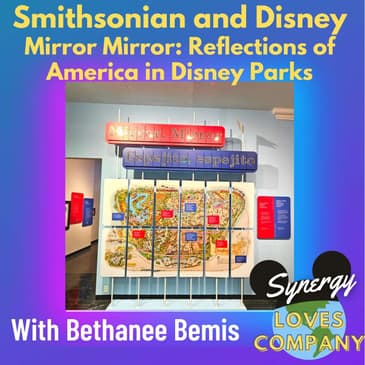
Join Eric and his special guest, Smithsonian Museum Specialist, Bethanee Bemis, as they explore Mirror Mirror: Reflections of America in the Disney Parks, an Exhibit about the Disney Park’s influence on the American Narrative at the Smithsonian National Museum of American History. As the driving force behind the exhibit, Bethanee shares what goes into making a Museum Exhibit and Some of her favorite items in the collection. In addition to the Exhibit, Bethanee has also authored a book that Dives deeper into the topic of Disney and the American Narrative.
To find out more about Bethanee Bemis and her book and Exhibit: Museum Exhibit: https://americanhistory.si.edu/mirror-mirror Book: https://a.co/d/aWhAK7d Instagram: https://www.instagram.com/bethaneebemis Twitter: https://twitter.com/bbemisdalessio
Thanks for listening to Synergy Loves Company: How Disney Connects to Everything.
https://www.synergylovescompany.com
Youtube: https://www.youtube.com/@synergylovescompany Twitter: https://twitter.com/EricHSynergy Facebook: https://www.facebook.com/synergylovescompany Instagram and Threads :https://www.instagram.com/synergylovescompany/ Bsky.social: https://bsky.app/profile/erichsynergy.bsky.social
00:04 --> 03:05 Synergy loves company. We have this coterie of rich franchises, the company now that people want to engage with. I came here to try and continue what Walt Disney and his associates set in motion 50 years ago, which is to experiment with every new and innovative kind of entertainment possible. It's what we hope to do here, to really develop something that just more than an entertainment enterprise. It's something that contributes many other ways. Hey, this is Synergy Loves Company, where we explore how Disney connects to everything. I'm Eric H synergy, and I have a story for you. It's a story that will resonate with Disney fans just like you. A long time ago, a man pulled himself up by his bootstraps to establish a lasting legacy. He made a name for himself. He conceived of an idea for an establishment where people could share information and learn about the world around them. He gave it a name, and he even picked out the place where it should go. However, he wasn't around to see it through. He had passed away. And the responsibility of bringing this idea to life fell to those who inherited his plan. They didn't know exactly what to do with the idea, so they did the best that they could. They named the place after him. They built a magnificent, iconic castle. And they surrounded the castle with various spaces, showcasing works of art, wonders of technology, and treasures from all corners of the globe. Today, millions of people visit this place, and it continues to expand and thrive. If it sounds a little bit like Walt Disney's Epcot story, it's not. It's the story of James Smithson from England, who willed his entire estate to the United States with the condition that it would be used to create the Smithsonian Institution, an establishment for the increase in diffusion of knowledge in Washington, DC. And in 1846, the Smithsonian Institution opened and has continued diffusing knowledge in the United States for over 175 years. So on the show today, we're going to look at some of the connections between these two distinctly American institutions, the Smithsonian and Disney. So let's get to it, because keeping me company today is a Disney fan who just happens to work as a museum specialist at the Smithsonian. Bethany Bemis. Welcome to the show, Bethany.
03:05 --> 03:08 Hi, Eric. Thank you so much for having me.
03:08 --> 03:29 Yeah, so I kind of got this idea when I actually visited the Smithsonian this past summer and saw your exhibit, which we'll definitely get into very soon because it's very Disney and it's at the Smithsonian. But before we get started, I think my first question for you is, what exactly does a museum specialist.
03:31 --> 03:58 Know? That's a good question. And it's different every day. But I like to define it as sort of the physical and intellectual care of the collections. So I am a museum specialist in political history. We have these great political history collections. Presidents, first ladies, those are kind of the famous ones, and I get to work with those and keep them safe and also kind of steward and keep their stories.
04:01 --> 04:20 Storytelling, of course, goes along with our Disney connection here. And of course, you're also a big Disney fan. So let's get to the Disney part here with this one. Disney is such a big topic. How would you describe your Disney fandom? What kind of Disney fan are you?
04:21 --> 04:52 So, at my core, I'm really just a Walt Disney World fan. I grew up I live on the East Coast. I grew up in Maryland, and we would drive down to Disney World every couple of years. It was a place that my mother really loved, and she passed that down to so, you know, I know the other content. I watch the movies, although I don't keep up with them as much as people think that I might when they know I'm a Disney person. But at the end of the day, it's always going to be Disney World for me.
04:52 --> 05:11 Nice. I think that's one of those things too, because it is so big as Disney fans, sometimes people do assume we're into one aspect that maybe we're not, because it is. I mean, like a D 23 Expo has so many facets to it, like a Comic Con. There's. Shades of Disney fandom. Right?
05:11 --> 05:14 Yeah. You can only handle so much right at one.
05:14 --> 05:15 Right?
05:15 --> 05:17 Got to really pick your niche.
05:17 --> 06:19 Exactly. Niches within niches. Right. So this past summer, like I did say, I did get to visit Washington, DC. And I really enjoyed really, the National Mall, the Smithsonian, all of it there's, where that majestic, iconic castle, the Smithsonian Castle is, and all the museums surrounding it. And specifically, I think my family and I had the best time at the Museum of American History, which is I know where you're a museum specialist and where we can visit your exhibit, mirror, Mirror Reflections of America in Disney Parks. So let's talk a little bit about the exhibit. Well, actually, a lot of it about the exhibit because I want to ask you a lot of questions about it, of course. So before we get into the details of it, you said your museum specialty is in political history. So how do you get from political history into Disney history for a museum exhibit?
06:19 --> 07:44 So it comes directly from an exhibit that we were doing at the Museum on American Democracy, and there's a section on it. You may have visited it when you were there. There's a section on it about the national narrative, which is essentially the American story. And it asked, who gets to tell the American story? Do we all need to believe the same one? How do we disseminate it? And we're putting it together. And I was like, well, Disney tells the American story. Obviously. It was obvious to me right then it was Disney that told the American story. And then when I started really thinking about it and looking into know, it's not a new idea, right. I didn't come up with that idea. A lot of academics have looked into that. And I was really interested in not just the fact that Disney did tell this story, but how they came to be so important in that story, and then how looking forward Disney and the fans work together to make that know, being a Disney fan myself, I think it's really important to get that sort of aspect in. I think in academia there's a bit of a tendency to look at Disney corporate as this sort of know, bad monolith. Right. But really I think that the heart of the story is the fans and how they work with the company to create the future they want to.
07:46 --> 08:45 Definitely. That does show in the exhibit, for sure. I know it resonated with me in that way, in that it is kind of a communal story of we're we're part of America and this is part of our so definitely. Definitely. Yes. And I did get to visit the Democracy exhibit also. So that kind of helps me connect those together, which is pretty awesome. So still kind of thinking about the exhibit. So, like, as Disney Parks fans, because you said that's kind of your Walt Disney world, being your fandom. A lot of times we put one Imagineer as kind of like the symbol of a project. Like, for instance, Joe Rhodey is responsible for Animal Kingdom, but in reality it's a bunch of people that come together to make that happen. So what kind of Imagineering style teamwork goes into making a mirror mirrors type exhibit?
08:45 --> 09:47 Oh, I love that question. The exhibit itself, as exhibits go at the museum, is considered rather small. It's about 1000 sqft. But it still took a team of, I would say at least over 40 people to put the exhibit together. So there's like a core team, I'm sure, like Imagineering that sort of hammers out the idea. Right. And I am sort of the face of it because I sort of originated the idea, but by no means, you know, did I do everything by myself. And there's an editor and there's an educator, and I was the curator. There's a project manager that really get the ball rolling. And then we have a designer, because I can't design worth anything, who helps with all the visual aspects of it. And then we have a really great team of collection specialists and shop specialists who actually build out the entire exhibit. We did all of it in house, so everyone at the museum really pitched in.
09:47 --> 10:16 No, that's really cool to hear because I think sometimes visiting a museum or visiting a space like that, or even sometimes in the Disney Parks, we don't think about all of the work that went into putting it together. And you just kind of see it there. You go, oh, this is cool. And you take for granted that it was a team effort and one of those cool things. So you get to be the Joe Rody of the situation here. You get to be the one with division.
10:16 --> 10:22 I'd love to be compared to Joe Rody. Yes, I will be the Joe Rody. Yeah, that's not a bad guy to be, right?
10:22 --> 12:09 Exactly. So one thing too, when I was actually going through and I asked my family have, it was me, my wife and our two kids who visited the museums this summer. And I asked them, what did they kind of enjoy about the exhibit. Also, and one thing my wife pointed out was for us as Disney fans, it was like the one spot in the museum where we felt we slowed down and snapped into a place that was for us. And I started to think about it. And usually when I go to a museum, I'm a librarian. I love to learn about history. I love to learn. I'm always learning. I'm researching. It's part of being a librarian. And I usually feel like I'm learning about something else. But with Mirror mirror, it was different. It was one of the first times I felt like seen in a museum exhibit. And I know there's some times when you could literally see yourself because there are a lot of mirrors in the exhibit, like the mouse ear one and all that. I tried to get pictures of my kids with the mouse ears and I was too tall to get it lined up right. Well, it's perfect height for them. I should have had them take their own selfies, but with me taller than them trying to get in there when they were standing there, it was but it was a mirror into my world. As a Disney fan, a lot of the fan created artifacts and things like that. How much was that the intention of the exhibit? Because there is a lot of history in it too. But how did you try to find that balance? Was that the intention?
12:10 --> 13:05 That absolutely was the intention. It makes my heart happy that you felt seen there, because I wanted this community that I think when we were thinking up the exhibit, there was for some reason this really big pushback against Disney adults and this question of why are people doing this? And I was really hoping that people who came as Disney that there'd be something for Disney fans, but also people who weren't associated with Disney, but for Disney fans in particular. I wanted them to see that just by participating in this fandom, they actually are doing something that is important. Right? I mean, they can enjoy it, that's great, have a lot of fun. But it does have meaning. Right. And I hope that people feel validated in that sense. Whereas some in the larger culture are dismissive. I think that it's really important for.
13:05 --> 13:58 Sure yeah, and I know it did. It definitely resonated with us. All the different fan made or fan embellished mouse ears and the different buttons that people made, signs people made, all those things are like, that's the history of us, the Disney fans, just making stuff, like making a podcast, just like making the things about Disney that we love. So I did appreciate that a lot. So I didn't mention it yet. But you do have a book that goes along with the museum. And I know we haven't gotten into some artifacts and things yet, but we'll get into those very soon. But with the book, I did find, and I bought mine at the museum gift shop down in the lobby, which I was excited to do because it was like I saw the exhibit and then I got a souvenir from it.
13:58 --> 14:01 So that was really disney fans love a gift shop. You have to right.
14:02 --> 14:31 We did go at the end. We exited kind of to the gift shop, of course, and it seemed like the best way to go deeper into the subject matter and bring the exhibit home with me. So in my mind, I saw it as the book, as kind of being that way I could continue my experience at home. But I'm curious, what came first, the book or the exhibit or how did you expect these two to work together?
14:31 --> 15:23 Yeah, well, the article that became the book came first, and as you know, doing research, being there's so much research, and then you get it in a publishable form, and you had to cut out all this stuff. So I got to still tell these stories. So then that became the book. And at the same time, I was thinking about the exhibit. But just like when you cut down for an article, you have to really narrow down to make an exhibit that resonates and that is visually clean. Right. Everything that I might want to cram in there, I got to cut out. So the book, to me, like you said, is really if this exhibit resonated with you or if you're really interested, there's so much more to learn about it. And here's kind of my short, quick take on what I think you should know.
15:24 --> 15:51 Yeah, no, and I will say the librarian and me loved your of course. And I know this comes with a lot of academic literature, but your extensive notes and bibliographies and too, I loved looking at the diversity of your sources because you had academic journals, but you had blog posts and you had podcast blog posts and different things like that. And it was pretty cool to see where it all came from. Too.
15:51 --> 16:02 Yeah. And I think that that's so important. Right. Like I said, I think the fan community is so important, and I think it's a really untapped resource for academics, although fan studies are really they're taking off.
16:05 --> 16:14 This one. I wasn't even planning on asking you, but I did see that you were getting involved with the Disnet, which I'm a fan of.
16:15 --> 17:04 They're awesome. And there's so much amazing stuff that I think is coming through the pipeline there and is really I don't want to say legitimizing because I don't think that the Disney fandom needs anybody to legitimize know we exist and we are who we are. But I think that Disnet is really taking a stand to say as academics and as Disney fans, we can do good academic work on Disney. We can also enjoy Disney. Those things don't have to know, diametrically opposed. And I think that we're going to get really great work out of people who really understand the fan community. Right. Yeah. Because I think too often people write about it who don't really don't want to be a part of it, so they don't understand it. Right. It'll be interesting to see how it comes.
17:05 --> 17:34 Definitely. So, yeah, I just had to mention it and ask about that because it's that growing Disnet community of scholars who are coming up with some great research. I love whenever I see them post something or share something online and get to try to find that article, read it. I know the journal is coming out, and I'm like, how much is it going to cost me to get a personal subscription to the Journal? Because this is the kind of thing I want. So I'll be definitely checking, keeping it really accessible.
17:34 --> 17:35 I mean, that's the whole thing, right?
17:35 --> 18:13 That's their thing, right? But yes, for sure. So that's really cool stuff. But let's get into some more really cool stuff because we talked about the exhibit kind of overall, but not some of the individual pieces of it. So I want to know what are those pieces in the and I know it's kind of like asking you to pick children or your favorite pets or whatever, but what are some of your favorites? And the list can be super long if you want it to be, but what are some of your favorite items on display in Mirror Mirror?
18:15 --> 19:32 If we walk through the exhibit, I mean, my most favorite thing isn't really an object. Right. I think in the exhibit we have about 100 photos that people sent to us, and that's got to be number one, right. I loved these photos that people shared with us and the stories they shared with us. And those are going online hopefully soon for everyone to be able to see, even if they can't come and to read the stories that you can't do. In the exhibit, we have Fess Parker's Cap from Davey Crockett, which I like because it has an actual little raccoon face and it's actually just really cute and also extremely weird. But it also really resonates with a certain subset of the population. Right. They come in. Oh my goodness. But next to it is a picture we actually borrowed from a collector in Virginia that was done by Mary Blair. So we got to bring in Mary Blair, which is kind of really know everyone loves Mary Blair, but I like bringing in sort of female artists. My most favorite object that's in the show probably is Bob Ger's T shirt from 2018, La Pride, because there's a really long story behind it, if you want.
19:32 --> 19:34 Sure, yeah, definitely.
19:34 --> 21:38 So I just saw because I follow all these Disney fan sites, I saw coverage of him when he was at the 2018 prime. I didn't know, I think, until then, that he identified as a gay man. And so I was like, wow, this is a really interesting story. So I Facebook messaged him, or I put a little comment on Facebook, and I was like, hey, I work at the Smithsonian and we would like your T shirt. And here's my email. And I don't think he would get back to me, but he emailed. He said, if you want my sweaty T shirt, you are absolutely welcome to have. So he sent it, and that's really sweet in itself. But then to sort of supplement that, I was able to do an oral history with him for research purposes. And he went into the story behind the T shirt, how he's closeted when he works at the Disney Park and works as an imagineer in the he's building the omnibus, which still is at Disneyland today. And this is during the time when, A, he's closeted, but B, there's all this sort of cultural turmoil. There's stonewall, there's La riots in 2018. He actually wore this T shirt while he was riding the omnibus. They brought it out for the parade. And he seen I've seen a lot of change in America. And he said, but not only I'm able to be myself now, but I'm celebrated for, you know, being able to sort of represent that sort of spectrum of really quick cultural change that's also so important for people's actual. Lives and personal stories with that one object, which we have next to a picture he gave us of the omnibus right after he built it. I think it's really impactful and really personal story and one that I really, really love. And the mouse ears. I love the mouse ears.
21:38 --> 22:17 Yeah, no, that is a big theme in the book, in the exhibit, too, of kind of how that narrative, that national narrative, that Disney helps us create changes over time to reflect what's happening in America. And I think what you just telling Bob Ger's story does a great job of illustrating that change. And that's that was a really great piece. Now, I do have to ask, when Bob Ger sent you the T shirt, is it now part of the Smithsonians collection, or is it on loan from him?
22:17 --> 22:21 No, it's part of the collection. Yep. Forever and ever.
22:22 --> 22:34 That's awesome. Yes. So it's there. It's in the collection and it'll get to live on for a long, long time and not stay in his otherwise it would have just stayed in his dresser for a while.
22:34 --> 22:45 Right, right. Or made its way to the local thrift shop. So I was really glad that we got to have it. And yeah, we'll have it. It'll go back into our storage after this exhibit is up.
22:46 --> 23:41 Yes. Oh, that is so cool. So that brings up a good point, because things go into storage at the Smithsonian. And I wanted to ask you a little bit about this, because I had read or heard that when you started the idea for this exhibit, you, of course, needed items to display. And you started to go through the databases of what the Smithsonian has that's Disney related, and you found tons and tons of stuff, not all of which could make it into the exhibit. Of course. Of course it would have to be parks related. It would have to be. But there's so many other Disney related items. So I wanted to ask, are there any items that you wouldn't mind sharing with us? Maybe they're on display or kind of in the back catalog of the Smithsonian that are some of your other favorite Disney items that aren't part of the exhibit?
23:41 --> 27:13 Yeah, well, the things that aren't part of the exhibit that if we had more space, of course, would have been amazing are we have one of the original Teacups from Disneyland and we have one of the original Dumbo Ride cars from Disneyland. Oh, that's awesome. They were donated for Disneyland's 50th anniversary. We have some sketches from Steamboat Willie that are really cool. Yeah. Pencil sketches. And I believe one of those is on display currently in the Entertainment Nation exhibit, which is across the floor from our Disney exhibit. But one of the sort of, I think really like illustrative stories of both the Smithsonian Anne and Disney is an object that's in the show. But I think as a librarian, you'll like this sort of this story. So there's a button actually in the same case as Bob Gur's t shirt and it's a Mickey Mouse button and it just says I danced Disneyland. And so when I was in our database and I was putting in keywords Mickey Mouse Disneyland, I came across this button and the only data that was publicly available on Know was button reading I dance Disneyland. And I was like, I have to know what this is. So looking at the context clues right, for this button and it's in storage with objects that are labeled gay rights protest. And I was well, you know, luckily, being a Disney historian, I do know that there was basically one sort of big gay rights protest at Disneyland. And that was when Andrew Exler, who necklaced by Crusader and his partner went and danced at the Tomorrowland Terrace in the 1980s. Together they were ejected from the park because there was a long standing rule from the 1950s against same sex dancing in the parks. And they went to sort of challenge this, and they took it to the courts, and eventually there was a ruling in their favor. But by that time, Disney had said, you know what? It's fine. We don't actually care. We're going to abolish this rule. So they got rid of it sort of simultaneously with this. But I thought this had to be tied to that somehow. Dancing, disneyland gay rights protests. So I looked up sort of the donor and their name, and I found that they were based in La, that they had a large Disneyland collection. They have I think it was at USC or one of the repositories in California. Their papers are there, and it said that they're in the finding aid, that there were pictures of them at Disneyland. And I wrote to them, and I was like, please, can you tell me about this? And they could not. But I emailed Andrew Exfsler, who I found online, and I said, what do you know about this button? And this guy? And he said, oh, yeah. A couple of years after we won the Right to Dance, we went back to Disneyland. We all danced, we celebrated, and then we went to one of those machines on Main Street where you used to be able to imprint your own button, and they all printed their own button that said, I danced at Disneyland. And so that was a story that I was able to reunite with its object and actually really fit. It was perfect for the show.
27:14 --> 27:15 Yeah.
27:15 --> 27:31 And it's also sort of illustrative of the there's millions of objects at the Smithsonian, and some of them are really well researched and understood, and some of them aren't. And there's all this potential for finding these great stories in these objects, and.
27:31 --> 27:42 You got to uncover that story, and now we have that story to go along with the object, which is pretty awesome. That is really cool, doing all that investigative research like that.
27:42 --> 27:43 I love that.
27:44 --> 28:38 Yeah, of course. No, that is so mean. You kind of mentioned Entertainment Nation, and I really enjoyed the Smithsonian Museum of American History, and I was like, it felt like the place to be for, of course, as an American, of course, but as kind of a pop culture fan, too. All the little pieces and things throughout all of it, just like the display cases throughout the hallways on the way to the cafeteria. There's fun little things all throughout the a great we had a great experience there. Out of all of the Smithsonian museums that we visited, I will say it was my favorite. And I'm not just saying that because it's you. It's true. It's true.
28:38 --> 28:40 I'll tell my boss, right?
28:40 --> 30:59 There you go. Ten out of ten would recommend so I want to kind of flip this story here real quick. And talk about instead of Disney at the Smithsonian. Let's talk about the Smithsonian in Disney. And this might let us know a little bit more about you as a museum specialist and your favorite parts of the job. So I have dug through my Disney research to find three Disney movies where the Smithsonian shows up. And I'm going to describe to you how the Smithsonian works in each one of these movies and how it fits into the story. And then I want to know if you had the chance to work on one of these projects, which one would you choose? So I'm going to give you three Disney movie Smithsonian situations. They need some museum specialists to help out here. Which one do you want to choose to work on? All right, so number one is in 2000, and one's Atlantis, the Lost Empire. Milo works at the Smithsonian and presents to the board the idea of trying to procure a journal that has instructions on how to find the lost city of Atlantis. So he's trying to get his hands on an item that's going to help them find Atlantis. Number two is in 1977, the rescuers Bernard and Bianca rescue Penny, and with her help, they retrieve the Devil's Eye, the largest diamond in the world from Madame Medusa. And at the end of the movie, the Devil's Eye is brought to the Smithsonian to be preserved and protected. So that would be you having to preserve our and take care of steward the diamond. And then number three is in 2000 and fourteen's, Captain America Winter Soldier Steve Rogers, keeping a low profile, visits an exhibit about himself, Captain America, and it focuses on his time during World War II and displays his uniform and other items like his motorcycle and early versions of his shield. So there we go. We've got three different parts. We've got one that's more about finding that object, one that's about taking care of preserving our objects, or one about creating that display.
31:00 --> 31:36 So I got to go with Milo and researching and finding the object. And I can see now, so having told that story about doing research into the object, I think I made it maybe gave that away. That I really love that sort of uniting a story with a physical object and the research that goes into that, I get such a thrill out of that. And so I think that would be super fun. They'd all be super fun for sure. But that would be if I had to choose one, that would be it.
31:36 --> 32:05 Gotcha if you had to no, that is no, that lets us know a little bit about and like, you did say you did. The was. I was convinced when I wrote these. I'm like, I think she's totally going for the Captain America one because it seems very political and military history like, which is true. That is true. But no, your story about getting those. Items and telling their stories does resonate with Milo, for sure.
32:05 --> 32:09 Also, the glasses, like, you got to right.
32:09 --> 32:32 I fit exactly. I love it. So, yes, I really just have one more big question for you, and that is, what is coming next? I know Mirror Mirror is not done by any means. We still got a good long run. It's got about halfway through its run, right.
32:32 --> 32:38 It goes until next, at least April of 2024. So you still have time to go see it.
32:38 --> 32:46 Yeah, I'm hoping that maybe it will get extended, because that would be cool, because I like to tell people, hey, if you're going go there, for sure, yeah.
32:46 --> 32:47 Come look me up.
32:47 --> 32:57 Right? But what does happen next for you? Is there anything you can talk about that's coming next? I know, of course, some things you might not be able to talk about.
32:57 --> 34:14 You know, I have a lot of you know, one of my passions is sort of Disney and the Presidents. So I'm always looking to do research into Disney and the presidents. One of the things that sort of the history community is looking towards currently is 2026 is the 250th anniversary of the US. Right. 1776. 2026. And I'm really interested in how the Smithsonian and Disney could possibly work together. Hint anyone who's listening to this podcast who can help me do that, there's no actual planning. This is just me, like, thinking there's that it'd be a great idea. If you look back at the history of Disney in 1976, when the country celebrating the Bicentennial, they have a huge presence, right. Bicoastal. America on parade. They're actually and this is one of my favorite Disney facts, they're actually listed as an official partner with the government celebrating the Bicentennial. So I would be really interested to see how maybe I could help the Disney parks or the Disney parks could help the Smithsonian make this celebration in the so that's my sort of big dream, right?
34:14 --> 34:16 It's in blue sky right now.
34:16 --> 34:21 That's right. It's in blue sky. But I need some imagineering to help me, right?
34:21 --> 34:43 Oh, that would be so cool. Yes. America on Parade is one of those. As someone who didn't get to experience it, of course, being a child of the always hear the stories about America on Parade, and it seems like a wild and crazy awesome parade and its celebration and everything. So that would be very cool to revisit it. For sure.
34:43 --> 34:47 Let's update it for 100 years later. 50 years later.
34:48 --> 34:48 Yeah, sure.
34:48 --> 34:49 We could do something amazing.
34:50 --> 35:12 That would be awesome. All right, so thank you, Bethany, so much for coming on. Synergy loves company to talk about mirror. Mirror and the Smithsonian and Disney. Where could we find you online? More information about your book or more information about the exhibit online so we could plan our next visit to see it?
35:12 --> 35:38 Absolutely. You can find all things American history at americanhistory. Si.edu which is also hopefully in the coming weeks, where our website will be hosted. I'll let Eric know. So yeah, put that on social media. I am also on Twitter at Bbmis Alessio. And I'm on Instagram at Bethany Beam Miss. And that's where my Disney Parks academic content goes.
35:38 --> 35:41 Nice. Where it all right.
35:41 --> 35:42 Yes. Yes.
35:42 --> 36:36 Awesome sauce. So, yes. And I have to throw it out there as I keep holding the book up here. If you're watching on YouTube and you see me holding the book, it's a great read. I definitely recommend for anyone out there who's interested in the Disney Parks. It was a good overview of its connections. The show. Synergy loves company. My goal is how Disney connects to everything. And I was like, we're going to talk about the Smithsonian in the exhibit, but really, each one of your chapters, I could be know frontierland in America. And it's there's so many connections to Disney and America and the American experience, and it really does a great job of kind of summing up that experience that we have as Americans. So definitely recommend your book to anyone listening.
36:36 --> 36:46 Thank you so much. I'm sorry that the print is so small. So hopefully if I could redo the book, that's one thing that I would do. The print is really small, but the content is great.
36:46 --> 36:55 Yes, for sure. Definitely. So no. Thank you again so much for coming to talk today about all of this. I had a lot of fun.
36:56 --> 36:56 Me too.
36:57 --> 37:06 And it would be yeah, I hope we get to see your America on Parade idea at some point in some way, shape, or form. It's a great idea.
37:07 --> 37:11 Yeah. From your mouth to God's ears, right? Or to Bob. Iger's ears.
37:11 --> 37:29 Bob. Iger should yeah, should be listening. I don't think he listens to this show. But if you do, give me some sort of message. Bob online somehow or in an interview. Right? Secret message. The problem is I don't know what the secret message is. But he might be no.
37:30 --> 37:31 Never know.
37:31 --> 38:20 All right. But yeah. So everyone listening out there, make sure you do go check out all of Bethany's stuff. It was great. And thank you so much for listening to this episode of Synergy Loves Company. If you want to get in touch with me on all the socials, you can find me on Instagram and Threads at Synergylovescompany and I'm still on Twitter. As long as it's free at Eric H. Synergy, but also on Blue Sky at Eric H. Synergy as well. And if you're enjoying Synergy Loves Company, don't keep it to yourself. Share it with a friend who loves Disney just as much as you do. Just tell them to visit Synergylovescompany.com because sharing the show is the number one way that you can support the show. And your support means the world to me. So thanks for exploring Disney's connections with me. And until next time, keep discovering the magic in everything.