
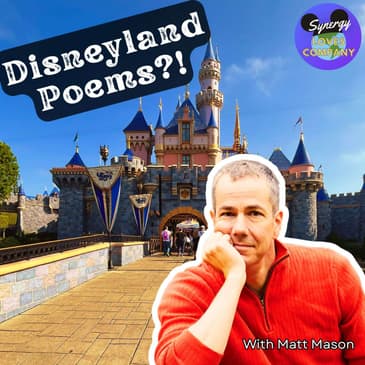
Disneyland, Poetry, and Churros: Finding Magic in Midlife ✨📖 Why does Disneyland pull us back—even as adults? In this episode, acclaimed poet Matt Mason joins Eric to explore how Disney parks inspire nostalgia, creativity, and surprising discoveries about ourselves, all through the lens of heartfelt poetry (and a love of churros). In this episode of Synergy Loves Company, we uncover what Disneyland really means beyond rides and snacks. Matt shares poems from his book “At the Corner of Fantasy and Main: Disneyland, Midlife, and Churros,” reveals how Disney inspired his creativity, and gets real about parenting, loss, and midlife—mixed with plenty of theme park joy. Whether you’re a Disney fan, poetry lover, nostalgic adult, or just craving a churro, don’t miss this unique journey through memory and magic.
📚 Get Matt Mason’s Book: https://amzn.to/45V270h (affiliate Link) Follow Matt: midverse.com Old Mill Press: https://theoldmillpress.com/ 🏰 Poems Featured in this episode:
- “What You Find at Disneyland Is”
- “The Web’s Real Peril”
- “At the Corner of Fantasy & Main”
- “Certainty”
- “Song Of Your Churro”
🎠 What You’ll Discover in This Episode:
- Why Disneyland is so powerful for adults (it’s more than nostalgia)
- How writing poetry helps process life, love, and loss
- The secret spot in Disneyland that sparks Matt’s creativity
- Planning your dream trip as a non-local Disney fan
- The unrivaled importance of… churros!
- How Disney podcasts, family trips, and personal memories intertwine
- 📚 Get Matt Mason’s Book: https://amzn.to/45V270h (affiliate Link) Follow Matt: midverse.com
📌 Follow Synergy Loves Company YouTube → https://www.youtube.com/@synergylovescompany Instagram → https://www.instagram.com/synergylovescompany/ Bsky → https://bsky.app/profile/erichsynergy.bsky.social
00:03 --> 00:05 Synergy loves company.
00:10 --> 00:14 We have this coterie of rich franchises.
00:14 --> 00:17 The company now that people want to engage with.
00:21 --> 00:32 I came here to try and continue what Walt Disney and his associates set in motion 50 years ago, which is to experiment with every new and innovative.
00:32 --> 00:45 Kind of entertainment possible. It's what they hope to do here, to really develop something that.
00:46 --> 00:49 Well, just more than an entertainment enterprise.
00:49 --> 00:53 It'S something that contributes many other ways.
01:01 --> 03:02 What you find at Disneyland is that when you come here on a trip by yourself and investigate why you can't stop thinking about the place and had thought maybe it was the park itself and Walt and all his stories is that you were wrong. And you're here because of you. And all the stories you've been part of on trips made here in past years to this cheerful once upon an orange grove. And it's like pulling out boxes from the basement and trying to fit into clothes from different ages of your life. And you can't with them small or faded or so brittle they splinter apart like straw or just out of fashion, because you can't be 4 or 25 or 46 ever again. You have to walk with one stiff elbow, the toe and heels that hurt, all these small pains that now take ages to soothe. You can't change any of this, except maybe that gut. But, man, you've come to exactly the wrong place for that. When there are churro carts, peanut butter dipped in chocolate, a thousand sweet things shaped like Mickey Mouse's head, there is a legendary sand you find to be ham and cheese wedged inside of something more funnel cake than bread. You came here to ride Space Mountain and find answers. But the answers aren't on roller coasters. They're in the rhythm of your body's aches. As you hike up Disneyland Drive, thinking about trips with your daughters, wife, parents, friends, you find yourself walking without here in the middle of your life, halfway to the next. Don't you dare waste a breath.
03:06 --> 03:58 Hey, this is Synergy Loves Company, where we explore how Disney connects to everything so you can feel connected to Disney, even when you can't be at the theme parks. I'm Eric, and you just heard Matt Mason reading his poem. What you find at Disneyland is from the book at the Corner of Fantasy in Maine. Disneyland Mid Life in Churros. There's something magical about the way he captures not just the sights and sounds of Disneyland, but the feelings, the memories and the little moments that make it so unforgettable and how it fits into the larger picture of our own lives. So keeping me company Today is Matt Mason himself, the author of this warm, surprising, and deeply personal book. Matt, welcome to Synergy Loves Company.
03:58 --> 04:00 Hey, it's a pleasure. Thanks for having me.
04:01 --> 04:35 All right. Yeah. I'm so happy you're here because as I was kind of telling you before we got recording, this book kind of hit me at a good time in my life in that it's about Disneyland midlife in churros. I'm just entering early midlife. So I kind of want to ask you right off the bat, because that really struck me. It's a unique combination. And so Disneyland, midlife poetry, what brought all of that together for you? Like, what's. How do those even connect?
04:36 --> 05:47 You know, when it started, I had no idea. I just knew that it was happening. Basically. I woke up one day thinking about Disneyland. And, you know, I've been in my life. I was there when I was a kid. One of the first places I went with my parents was there around college. I'm from Nebraska. I was the Nebraska. Nebraska state poet. So most of my life has been here, though. I lived in California for about six years up in the Bay Area for college and grad school. So these different parts of my life intersect there, but that's kind of it, as far as I knew. And then suddenly I'm thinking about Disneyland and can't stop thinking about Disneyland. And so started writing poems. Eventually, after doing a lot of research, you know, watching on YouTube the opening day live broadcast, which if anybody out there hasn't watched that, you've got to. It is wild and bizarre and fun and reckless and also nostalgic with everything.
05:47 --> 05:47 But.
05:48 --> 06:00 So I'm doing a lot of research, wasn't writing any poems because I didn't know why this was happening. And it's through the process of writing the book that I figured that out, though.
06:01 --> 06:44 Yeah. So it seems like it all comes together. And I love that you mentioned you're from Nebraska. You're not one of these, like, park local type people. And that's like, me. I'm in the Midwest as well. And it's like, I don't go to the parks often. So, like, how can I. I mean, I do this podcast in this show. That's how what I do. So we do these things, right? We do these things to help us feel connected to Disney. And so, like, was it easy to make Disney, like, connect to Disney through poetry? Was that something that came easy and natural as a, like, Disney fan, rediscovering your. Your love for Disney?
06:45 --> 08:22 It really did. I mean, partly because of the. Kind of. Just this powerful, whatever it was, which felt like a, you know, it felt like a bad midlife crisis episode of a TV show. But I, you know, I tried to hide it from my wife and all, but she's a writer, too, so she's. She. She gets in the car and I'm switching away from podcasts, which have titles that show on the radio that are clearly Disneyland related. So after a bit of this, she's, okay, so what are you writing? And I'm like, I'm not writing anything. I don't know what's going on. And she's like, you're a poet and you're doing research. Write some poems. And that's how it all started, really, with my wife and started writing. At first, it's. I write a poem about space mountain, write a poem about different attractions. But then the more I wrote, the more it started to make sense. This is a place where it's maybe the first vacation. I remember being there with my parents and the rest of my family. It's a place after my mom passed away, we used a little bit. We got some inheritance and used a little bit of that to go to Disneyland for the first time with my wife and my two daughters. So all these things kind of were rolling and connect, and the hub of it all ended up being Disneyland.
08:22 --> 08:41 But I got to ask about your wife because you said she's the one who saw you trying to kind of do all this Disney stuff but not turn it into poetry yet and gave you that push. I got to ask, is she. Has she come around to the Disney part? She came around to the poetry part. You said she's a poet also. Is she a Disney fan, too?
08:42 --> 08:53 Not really. I mean, we've gone to the park a few times, but not really. Not the same way. I am for sure at this point.
08:54 --> 09:06 Right. It's not the same way. She might have her own way, but yeah, at least she encourages the. Or maybe not encourages, but the humors, the fandom. Right?
09:07 --> 09:15 Yeah, definitely. I mean, she is the one who got things rolling and really got me writing. So I appreciate that a lot.
09:16 --> 09:52 Yeah. Let's get into the Disney fandom and your Disney fandom here for a little bit. So, like, Disney is for a lot of us, and you already kind of got into it a little. Is that nostalgic place, that place we visited when we were young, but we kind of find ourselves drawn back to it. There's new things to discover there. In your poems, you definitely balance both. Like, what it is to be that kind of adult midlife Disney fan. But also the nostalgia and the thinking back to your childhood. What do you think it is about Disneyland specifically that pulls you back as an adult?
09:54 --> 10:39 A big part is that it is the same place as when I went for the first time in 1973. The castle, the main street and then the lands are not exactly the same. But there's so much there that hasn't changed or doesn't appear to have changed. And it is just. It was the same in 1973 as it was in 1985, as it was in 1994 and 2015. It all connects. So. And it's fun. I mean, and the churros are good.
10:39 --> 11:22 So the churros, of course, the churros. We'll get. We'll get to those. We'll get to those later. I gotta ask you about those churros later for sure. So I think too, like spouting out like the. The different. Like it is the same. It's the incremental changes don't change it totally. It is the same and it is that original park, Disneyland. And I think that's where I kind of want to ask you next. Disneyland is what you wrote about, not Disney's California Adventure, not Walt Disney World or Tokyo Disneyland or sea or any of the parks around the globe. Why is it Disneyland for you that you wanted to capture in poetry?
11:22 --> 12:26 Yeah, that's what. When I was writing, like I said, I didn't have a plan necessarily other than to write poems and see what was going on inside of me by writing these poems. And so there were a few Disney California Adventure poems, but those. I really think the focus is Disneyland. That's since the first few times I was there were only Disneyland existed in California. At least that's what I wanted to focus on. And I think the DCA poems just kind of distracted. There is a poem about Paris Euro Disney at the time. And that fit somehow. And I didn't think distracted, but otherwise I've only been to World once and that was last year. And haven't been to any of the parks in Asia though I dream about Tokyo Disneyland and DisneySea but someday.
12:27 --> 13:13 So it's interesting that you say you've just recently went to Walt Disney World, which I'm excited for you. That's awesome. Having a trip recently. We for the first time kind of did the opposite. Having gone to Walt Disney World most of my life. We for the first time, about a year and a half ago went to Disneyland. And Disneyland kind of comes with this history package of, you know, like, as a Disney fan, we all read the books and do the research and know, like, the reverence that we have for Disneyland. So, like, I had that built in when I went. But for you, going to Walt Disney World for the first time, how did you find it compared to, like, Disneyland being your home park resort?
13:14 --> 14:09 You know, for me, it's a huge difference. It's kind of like being in a dream because, you know, you're walking through. Through. It's like, oh, familiar things. And then why is that there? It's. It's a different reality of something that I have experience with. But ultimately, Disneyland is where my memories are from when I was a kid, when I was a young adult, all this. So it's Is not as much I didn't have that natural reaction of, like, in Disneyland, all I have to do is get through security or walking towards security and the music plays and suddenly I can feel that in my chest. And I didn't get the same thing at Disney World because it's just different personal experiences. But I bet if I went enough, that would change. So who knows?
14:11 --> 14:26 Yeah, I can agree with you in the same sense. From going from the Magic Kingdom to Disneyland. And you can see, see those. Those kind of like the symmetry, but it's like an off symmetry. Yes. Yeah. Yeah.
14:26 --> 14:44 And that's why it really strikes me like a dream, especially like that, you know, Disneyland Paris, especially, it is very dreamlike in that some things are right, some things are so very wrong, and you just have to accept it and walk as if it's all normal because.
14:44 --> 15:21 It'S normal for somebody. For us as the person visiting. Yeah. Well, let's go back into kind of that. I like that as a dream, though, that I really. That resonates. It feels like a dream. But let's go back to your home park, Disneyland, and you write about different attractions, different locations all around the park. Is there like a personal corner of the park that feels. That feels the most poetic to you or the most. That resonates with you? That was the spot maybe that kept pulling you back while thinking about this book?
15:22 --> 17:32 Yeah. For me, it was right outside of Jolly Holiday, which is on the Hub, a little bakery cafe just short of Adventureland and Frontierland. When I was writing the book, I made a few trips. I didn't know I was going to write a book at the time, but I was there in late January, early February, and it was just there for a few days with my family. And I changed my pass to an annual Pass kind of on the fly. And this was 2018. That annual pass was like a few hundred dollars. It was amazing. Or maybe like 5 or 600. But it was still right before the rates went up, as they ramped up for Galaxy's Edge. So I had an annual pass. I went in May and I was there for almost two full weeks. And that's where I really was working on writing poems, editing poems, and then taking a break and eating a churro and writing Space Mountain. So if you're going to have an office, this is the greatest office I've ever had. And my cubicle was basically jolly holiday. There was a little table outside on the top level with my back to the pre show for the Tiki Room. It was. I love that space because people aren't sitting there at 8am Usually everybody's rushing to get to the ride, they want to rope drop. And my rope drop was just sit there and watch everybody else. So doing writing, watching people chatting with the waiters and the bus people, the cast members. I love that spot just overlooking the hub and everything. That's my spot. That's my place.
17:34 --> 17:37 That really is like the heart of the park, for sure. Yeah.
17:38 --> 17:38 Yeah.
17:39 --> 17:40 Nice.
17:40 --> 17:43 So, yeah, it's a fun place to base out of. So.
17:44 --> 18:12 So that's your. Your favorite part. Like your favorite place in the park. But now I want to go back home to. When you're at home in the book you write about kind of like that mania of planning a trip, like the wanting to look for flights and look for deals and all that kind of stuff was planning on spreadsheet kind of obsession. Right. Is that, is that a big part of your fandom? Is that like a big ritual in your Disney fandom?
18:13 --> 19:43 I mean, it is. I mean, I've got ways of doing it now, you know. Yeah, I'm gaming my Visa card to get airline miles and, you know, checking Priceline and Hotwire and anybody else over and over and you know, you book that refundable room, but you keep. Yeah, because I'm a poet. I'm on a budget and it always works out. And so. But yeah, it is a big part. The planning, I think, is a lot of fun, planning the trip, trying to figure out who can go with me or who can't and all that. Because it is a big. I mean, I mean, you know, traveling from the Midwest is a little bit of an expedition, but it's kind of fun because I know how to do it or I know how I've done it. And there are ways that I like to do it and it's exciting to see what it ends up. You know, last time I went was earlier this year and I've never stayed at the Howard Johnson and everybody talks about it with its great water park and everything. And finally, like for whatever reason, they had this amazingly low rate and I finally got to stay there. I mean, I would love to stay in the main hotels and I've stayed at each of them once in my adult life, but for the most part I'm not doing that.
19:45 --> 19:47 It's a splurge for sure.
19:47 --> 21:23 Oh my gosh, it's like four times the cost of the hotel I end up getting. So get to spend a little bit more time the way I'm doing it now, right? You have Google flights updates, Airfare watchdog, the Hopper app. You have been going to disneyland.disney.go.com every day to check for subtle differences in price. It is more art than science. Balancing the shades of airline miles, the mystery 2.5 star hotel. You can book for this low, low price. This whole thing is not affordable. You have kids to take out of school so you can take advantage of January and its lower crowd days. You hide what you're working on from your wife. Act busy. Click away from mousesavers.com when you hear her approach. No hun, just immersed in this buzzfeed article about emojis. Nothing to see here. Move along. Please move along because you've booked the flight home but not the flight there. So much depends upon the web's real peril. Crazed with shamed shoppers behind the White Kingdom.
21:29 --> 21:42 So is. Is that. Would you would. What's your favorite part of that kind of fandom? Do you love the, the planning? Do you? Or do you have like a different part that kind of is stronger than planning?
21:42 --> 22:23 I don't know if I'd say I love the planning, but I really do like it. Figuring that out, it's like a game that I'm trying to win. And then in the park, I really love being the leader of things with my wife, with my daughters. And I've done it the first time I went with my whole family. I think they probably all wanted to kill me. Around a day and a half in, it's like, okay, we have to. Let's try to stay on central time so that we can make it there at rope drop easily. And it's like, oh gosh, I've learned lessons and I do much better now.
22:24 --> 22:30 Well, I mean, yeah, you did say you, you then became the guy who can Chill at the jolly holiday and.
22:30 --> 22:32 Just enjoy the crowds.
22:33 --> 22:36 So, like, you got both sides. I love it. I love it. Both.
22:37 --> 22:46 Yes, yes. I try to keep the mania tamped down now. So, yeah, let's.
22:46 --> 23:31 Let's get into talking some poetry now. Like, we talked a little bit about, like, where you wrote it. But. But. So first question, and this is kind of, I think, a Disneyland question in at its heart. But in your book, you kind of weave some, like, you know, inspiration from poets like Keats, William Blake, William Carlos Williams. You bring these in and they're kind of like high art. And then you kind of also talk, you know, churros and, like, kind of the fun of Disneyland and that, like pop culture. How did you approach blending high art and pop culture together in your book? Was it something you thought about or something that happened naturally? How did that kind of play out for you?
23:31 --> 25:38 Yeah, oh, yeah, it was very much on purpose. You know, in the book, there are some, you know, there's a kind of a broken sonnet and a broken villanelle. You know, I'm working in form. Most of it's free verse. And I really want to bring in my poetic influences. But I also believe that poetry has been. It struggled for the past 110 years because it suddenly became something that was supposed to be SM people or really complicated or, you know, we're not supposed to understand. It's just a poem. And I really want to bring it back to poetry. Before that time, before World War I was a. Was a form of entertainment. It was a form of recording history, of telling myths and stories and all that. And those are the poems I love most. And I really want to write poems that bring poetry back into something that's understandable and entertaining and funny and weird and don't make you want to, like, punch a book, which, when I was in high school, that's kind of where I was with most poetry. And. Yeah. And so I loved writing this book about Disneyland and just telling stories, because that's what I think, that's what poetry is at its heart. And we need to work harder to help people to see that and not see poetry as that thing that we hated in high school. So, I mean, I did hate it in high school. I've come back. A lot of those poets are poets like Keats and Blake, who now I love, now that I've kind of got a better understanding of poetry and what it should be. But, yeah, poetry should be fun. I think William Carlos Williams said, if it ain't a pleasure, it ain't a poem. And I really go back to that all the time.
25:39 --> 25:57 So that just makes me think. So you kind of had a. Like, poetry wasn't always part of your life. You had a time where it wasn't. Maybe it wasn't your thing. And so how did you come into poetry, if I could ask that question?
25:58 --> 28:16 Well, it was around that same time. I mean, I was very resistant to poetry when I was in high school. But still at that same time, I started writing things. Maybe just thought of them in the shape of a poem because it's high school. Anybody that age has a lot going on mentally, sociologically, hormonally, all of it. And what I found was that when I sat down to write these poems, it helped me at least release something, figure things out a little bit. And that's what I do to this day. So even though I thought I hated poetry, I found that if I wrote it, it helped me. It helped me figure things out. And I kept a. Kept doing it to this day. Eventually figured out, oh, I do like these other poets and they can teach me a whole lot. Not all of those poets. Some of them, you know. Ezra Pound. No, I will never enjoy Ezra Pound, I think, but, you know, most of them, Keats. Even with the beginning of Ode on a Grecian Urn, which has the worst opening of any poem ever, but the best closing of any poem ever, what do you do? We figure it out. You've got the castle's shadow, not the castle, got mallards looking for a moat. Photographers with poses to pick from as horse drawn streetcars clop by. You've got donuts different every week. Sometimes a lemonade maple bar, sometimes pineapple and pink. At the place where lands transition from Photo Supply Co to Bibbidi Bobbidi Boutique, where you're never quite sure the pinpoint the borderline between where dust needs sweeping up and where it makes you fly. All you know is that somewhere nearby someone always has the particular magic that turns three bucks into coffee and a paper cup.
28:18 --> 28:49 The title poem, on the corner of Fantasy in Maine has a line where you talk about the borderline between where dust needs sweeping up and where it makes you fly. Which I like. Disney fan. I get the reference. I get both references, really, with the amount of custodial castmates out there sweeping up after us. But how do you get capture Disneyland in language, poetic language, without losing its magic? Like balancing the real Disney and magical Disney.
28:49 --> 29:55 Yeah, definitely. Because I think so much. I grew up watching Wonderful World of Disney or whatever the name of the show was on Sunday nights. And it is that every week was a different thing. There might be a nature documentary one week and then some fantastical tall tales the next. Donald Duck and Gorill, who knows? And so I think for me, that's a big part of what Disney is. There's really very little difference between the magic and the practical and just finding the right words. I really don't believe poetry is a lofty use of language. I think it's finding the language in what you're talking about. So it's finding the words that connect with the custodial, that connect with the part that are in use, and just use the language of Disneyland mixed with my own language to try to bring it to life.
29:55 --> 30:39 No, it definitely did bring it to life for me, too. And there's kind of a series of poems, too, that run through the book that are, like, these in between crossroads poems. These, like, at the corner of poems. And so we talked about the one, the title. But, like, really kind of all of those places where lands meet, you seem to have a poem for. And every time I was, like, reading, I would see one coming up. I would, like, know it's coming on the next page or something. I'd be, like, excited because I'm like this. I know. Like, I can put myself in that corner. But so for those. Those poems, did you actually go to those places to write them?
30:40 --> 32:08 You know, they just. They. They worked. I'm really proud of how those came out because those are. I mean, this. This book, all these poems are written for Disney fans. They're not written for PhDs in English studying poetry. They're really written for the Disney fans who I know will know the details. Like, if I'm writing about the corner between, you know, fantasy and Tomorrow Tomorrowland, they're gonna know that, you know, okay, there's a. The turkey leg stand there. The little place that goes out where the boats used to be. The Matterhorn. You know, they're gonna know all these spots. So I had a lot of fun finding these physical locations. And there are a lot of poems that ended up not working for different spots. But it's just fun to think of what these details are, because that's a big part of what brings a poem to life, is finding the right details and looking at these spots that people will be able to identify and think, oh, what's there? And then it's tough, too, though, because at the Corner of Fantasy in Maine, lists where they have a different kind of donut every week. And there Used to be a cart there. And I don't think it's been there in, like, five years. But, yeah, everything changes, but people will get it.
32:10 --> 33:12 Yeah. No, I mean, and then we talked about that earlier, those incremental changes. But in a way, that poem talking about the cart changing, that can spark nostalgia again in a new way, like, for sure. So I really enjoyed those. And like you said, they're written for Disney fans, so I felt like this was written for me, of course, as a Disney fan. But also, like I mentioned, I'm going into my early stages of midlife here. I'll call it entering my 40s. And I want to talk. I want. Let's talk some midlife, because. All right, the book connects Disneyland. We talked about nostalgia. We talked about, like, you know, all those kind of emotions. But you even do get into grief with some poems, like the ones about your parents. And I just wondered if revisiting those memories through kind of the Disneyland lens, like, helped you process them or, like, see your family memories in a different light.
33:12 --> 34:22 Yes, definitely. My dad died when I was in college, but my mom passed away just a couple years before I started writing these poems. And I think as we all come to middle age, we start dealing with where we're at and also where the people who aren't with us anymore, how do we deal with that? And it is just. There's a lot going on. And thinking back to those times, what. I mean, the memories I have of my parents at Disneyland are tiny because I think the first time I was there, I was four years old, but I have images, and we have really old photographs, but not many, because in those days, you had to pay to get them all developed. You couldn't just delete 500 of them. And, I mean, you can, but that's costly, right?
34:23 --> 34:23 So.
34:23 --> 35:07 Yeah, but I think the way midlife was hitting me as this book came about was really processing a lot about where I am in life. And a lot of that had to do with my parents. And it ended up. I'm glad it was focused on Disneyland because that's a really joyful kind of place to try to process this and to think of the memories we had there. And I missed them tremendously, but they also brought me to places like Disneyland. You know, I had so many great experiences because of them. So there's a fair amount of sorrow, but a fair amount of celebration, too.
35:07 --> 35:32 No, thanks for. Yeah, thanks for sharing that, for sure. Let's go and flip it now, too. Because you are a parent and so experiencing the park, you know, versus you going with your parents at 4 and remembering a little now, seeing it as a parent through your daughter's eyes. Like, how has your perspective on Disneyland changed because of that?
35:34 --> 37:31 Quite a bit. I mean, it's amazing to be there as the parent when I was there as the kid before and just feel like, hey, I'm doing what my parents did. But it was also fantastic because in the year 2018, when I had this annual pass and a ridiculous amount of Southwest Airlines miles, thank you, credit cards. But I took two trips during the summer where I took one daughter with me. There were seven and 10, and we'd never done trips with just one parent and one kid. And to be able to do two trips where I took just one daughter with me was amazing. It was two of the greatest trips of my life. And they were just short there with the daughter and seeing what she wants to see and experience. One of the days was over 4-28-18, which set record heat in Anaheim. But we really enjoyed it in this, like 111 or more temperature. But it was. They were a blast. And then once with. And the other trip with my other daughter, my younger daughter, we were out there at the parks. But there was also one of the podcasts I was listening to was doing a live event up at Griffith Park. So we spent one day up at Griffith park, just, you know, Bob Gurr was there and all this stuff. And so just having these great experiences with each daughter has been really special. And I just feel so lucky to be able to do some of the things my parents did, but also unique things.
37:33 --> 37:49 But you said something that made me think, I gotta ask you about this because actually we'll tie it into midlife too, because I feel like it is one of those Disney adult midlife kind of things, and that is Disney podcasts. But what are some of your favorite Disney podcasts?
37:50 --> 41:24 You know, at the time, I got a ton from Moustalgia, which was, you know, they had the four original hosts, but they would have such great interviews and, you know, in listening to podcasts like them, you know, really getting the Disney language. Because, you know, I'm just. I went a few times, but, you know, as I'm writing the poems, you know, sometimes I would go, oh, I'm not. You know, it's audio animatronic, not animatronic. You know, just the little things that I knew if I publish a book of poems, the Disney fans who know this stuff inside and out are going to have my head. But So I was listening to them. I was listening to some DL weekly. In the Pandemic, the Skull Rock podcast came along. And so many of these, I mean, it's because of these podcasts that, that I even found my publisher because at the time when I finished this book, what I had was a book of Disneyland poems. And good luck getting that published, no matter how good it is, because Disney publishers are not going to be interested in poetry. Poetry publishers are not going to be interested in Disneyland. So I tried a few places and I kind of realized that this is a book that may never get published until. And I don't know which podcast it was on. It might have been Moustalgia, it might have been somebody else. But there was an interview with Dave Bossert, who's the editor. He was a former Disney animator, but was editor of the Old Mill Press. And I thought, oh, that's interesting. And I like how they publish these beautiful Disneyland coffee table books essentially, and history books. But I looked at the website of the press and they had two random poetry titles. So I sent a note to Dave and I don't know if I ever would have thought of or found that press for this if, if it weren't for podcasts. So good job you, Synergy loves company. Everybody else, I'm, you know, a huge fan and even, you know, I, I think people thought when I finished the book I would stop listening to podcasts and I probably listen to more now, you know, and. Oh, it could have been connecting with Walt. No, I think it was nostalgia. I don't know. There's so many podcasts that I still subscribe to that have been just wonderful. I mean, it, it's great stories is one of the main things. Great history, great stories and just a lot of joy. So it's, it's good stuff. Well, mostly I did focus on Disneyland podcasts and there are at least less of those. But since I, after the book was done, I've been branching out and listening to more and that's how I came across. You came across so many others that talk about Disney books or just general Disney things, but I still, I think at the heart I end up back at mostly land centered podcasts.
41:25 --> 41:32 Yeah, no, of course, that's your home park. That's definitely where, where you should be. Right?
41:34 --> 42:16 You were in Disneyland months ago. Haven't deleted the app yet. Check now and then for the wait time on Big Thunder Mountain Railroad. Even though you're in line at McDonald's, you know, Omaha, you could be in the Haunted Mansion in 13 minutes if you weren't. You wonder about your arteries. You pay for a Quarter Pounder, ponder the inevitables of death and taxes. And the line for Peter Pan's flight is 40 minutes long.
42:18 --> 42:42 So we're talking about all this Disney fandom stuff, but, like, your book really does suggest that Disneyland is more than just, you know, the rides and the snacks and the planning and the podcast. It's that connection, that memory, that meaning. So what do you hope readers who are maybe not the Disney fans like us can take away from this book?
42:42 --> 43:47 Yeah, I think any reader can take away a certain amount from this. Cause essentially, it's set in Disneyland, and there's a lot of fun exploring different aspects of the park, but it is essentially about how we grow older, how we change, and how people in our life that were there before are gone, and how life is more than just work, that we have to find the joy. We have to find the places we connect with and that. That our memories carry us to. I think that's absolutely important. And I got. You know, as I'm writing this book, I'm very caught up in work. I was running a nonprofit, which was a wonderful nonprofit, doing great work, but it kind of occupied my life and pulled me away from my family. And essentially, the book is about connecting with Disneyland. Yes. But even more, it's about just connecting with your family and finding the places of joy in life.
43:48 --> 44:09 I love that because. Yeah, like, so my show, Synergy Loves Company. Of course, it's how Disney connects to everything, but it's like, truthfully, it's really about how we connect to Disney and what that means to us. So that connection is something more. It's not Disney, like you said, it's family. Those memories, those moments.
44:10 --> 44:48 Yeah. And it was fun. I mean, as. I mean, that's how I figured things out, too, is by writing poems. And by writing the poems really figured out so much about what was going on in my life at the time and, you know, probably still. And I think that's why poetry and the arts have been with us as long as human culture has been with us for thousands of years. Because I think by writing poems, by painting a painting, by making music or dancing, we process the world around us and we figure things out. And so it's all important stuff.
44:48 --> 45:34 And speaking of more important stuff, now I'm going to get into talking about churros. We got to talk about churros. But they are important stuff. I said we were going to do it. I said we were going to do it. I gotta ask. So through this whole book, it's in the title. It's, you know, at the corner of fantasy in Maine, Disneyland, midlife and churros. So your title ends with churros. We got to talk about churros before we wrap up today. So it's not just the title though. Churros are dusted through this book like cinnamon sugar. They're all over the place. Why, why churros? Why not a Mickey pretzel? Why not a, you know, why not a Mickey bar? None of your. You didn't pick a Mickey shaped food. What, what, what is it about churros?
45:34 --> 46:25 Yeah, you know, they just. Whenever I was there, those were what I would always come to. Whenever it's like it's snack time. It's like my heart would leap up for a churro. I mean, dole whips are very good too. And the Mickey bars, they're wonderful. I'm not a big pretzel guy, so that, you know, and the popcorns, I mean, there's so many different things. But for me, at the heart, my number one snack is always, was always the churro. So when there was a place in a poem for a food to come in, it was usually a churro. I would mix it up occasionally, just, you know, gotta, gotta use that diversity and of language and all with poetry. But gotta come back to churros.
46:25 --> 46:27 Always with the churros.
46:30 --> 47:30 And that's one thing too, is going through the book. I mean, for me, the churros weren't there until the 80s, so I don't have childhood memories of churros. And I know you Disney World goers have a little bit of a different relationship with the churros because it's not quite the same. Who knows, California water, whatever it is. But just the Disneyland churro is magnificent. Life would hold more joy were a churro in your hand. No, a churro in your hand. But a bite in your mouth too. A crunch, a star on your tongue. Sugar, cinnamon. The rest then in your hand to punctuate, exclamation mark there. To sing its own acclaim.
47:32 --> 47:53 No, that's, that's great. The churros. I see it. I see it. Churros. I might be more of a Mickey Pretzel. Many a time a Mickey Pretzel with that weird plastic cheese has gotten us through the day. So I have a special, I have a special allegiance. But no, I enjoy churro.
47:53 --> 47:57 The plastic cheese is in its own way horrifying yet wonderful.
47:57 --> 48:03 So indeed, maybe in the follow up, some plastic Cheese. Poetry.
48:03 --> 48:09 No good. Maybe the Disney World version. True. Because I could still do that.
48:12 --> 48:38 All right, well, Matt, thank you so much for. For sharing the book with me, with our audience. Like, it's really great whether you're in midlife, whether you're just a Disney fan. I think all around, it does capture Disneyland really well. And I. And I thank you for just putting it out in the world. Yeah. Thank you so much. And thanks for coming on the show to talk about it. Where can we find you out in the Internet world? Where can we find your book? Book?
48:39 --> 49:32 Oh, you can find the book anywhere books are sold if you can go to the press, because it's always better than Amazon. But if you've just got Amazon, go get it. But you can order it through your local independent bookstores. The press is theoldmillpress.com and they've got the book. Anywhere is good. If you want to find me, I've got a website@midverse.com and I travel, so bring me out to wherever you are. Schools, libraries, colleges, businesses. I love traveling as state poet. My project was to bring a poetry event to every county in Nebraska, and I did all 93 counties in my term. I've traveled around the country. I've done international work for the state Department teaching poetry. So, you know, never know. I might be in your neighborhood soon.
49:32 --> 49:37 So that is awesome. All 93 counties.
49:37 --> 49:49 Yes. It was so much fun. It was a little tough because someone threw a pandemic in at the beginning of my term, but I got it right before the end. It got to the 93rd county.
49:51 --> 49:55 That's awesome. All right. Well, yeah. Once again, thanks for coming on the show.
49:56 --> 49:57 Of course. Thank you, Eric.
49:57 --> 50:45 Don't forget to check out Matt's book at the corner of Fantasy and Maine. Disneyland, Midlife and Churros. For all the great poems you heard here today and so many more, make sure to click subscribe on this show so you don't miss any Synergy Loves Company or how Disney connects to everything like poetry. And remember, sometimes the most magical Disney experiences happen all around you. You just need to know where to look. So until next time, keep discovering the magic in everything. Sam.