
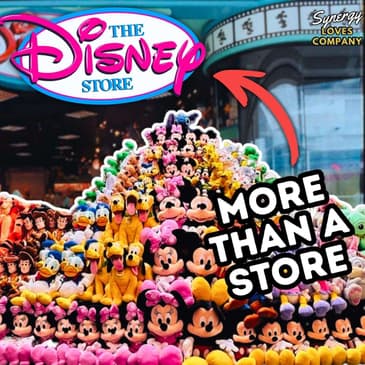
The Disney Store wasn't just a place to buy plush toys—it was a billion-dollar Imagineering experiment that changed the American mall forever. From the "Mountain of Plush" to the "Opening Key" ceremony, discover how Michael Eisner and Steve Jobs used theme park secrets to trigger a retail revolution.
In the late 1980s, the Walt Disney Company was at a crossroads. They had the movies and the theme parks, but they hadn't yet mastered the "third place" between home and vacation. That all changed on March 28, 1987, at the Glendale Galleria.
In this episode of Synergy Loves Company, we explore:
- The Glendale Gambit: Why Disney took a massive gamble on a suburban mall just 5 miles from Burbank.
- Retail-tainment: How Disney used Imagineering principles like "The Weenie" and "Visual Abundance" to outperform every other retailer in America.
- The Global Expansion: How the Disney Store conquered London and Japan by adapting the "American Mall Dream."
- The Apple Connection: How Steve Jobs helped reboot the stores with his "Imagination Park" concept.
- The Rise and Fall: Why 749 stores eventually dwindled to a handful of Target shop-in-shops.
Subscribe for more Disney connections: https://www.youtube.com/@SynergyLovesCompany?sub_confirmation=1
Podcast: Listen to Synergy Loves Company → https://synergylovescompany.com/https://synergylovescompany.com
Support the Show: Shop official Synergy Loves Company merch → https://shop.synergylovescompany.com/https://shop.synergylovescompany.com Affiliate Disclosure: Some links above may be affiliate links. If you click and purchase, I may receive a small commission at no extra cost to you. Thank you for supporting the channel!
Connect with Me: Instagram → https://www.instagram.com/synergylovescompany
Bluesky → https://bsky.app/profile/erichsynergy.bsky.social
Facebook → https://www.facebook.com/synergylovescompany
Credits / Resources: • Music licensed via Melod.ie
• Synergy Loves Company is not affiliated with The Walt Disney Company or any of its subsidiaries
This podcast is powered by Pinecast.
00:00 --> 20:30 It's the late 80s, and you're hanging out at the mall. You just finished some orange chicken at the food court, you tossed your last penny into the fountain, and now you're headed to Sam Goody to blow your last bit of cash on a totally rad cassette tape. The whole place smells like a mix of Cinnabon and cheap perfume. But that's when you see it. Tucked right between the Gap in the Sunglass Hut, it's a storefront that looks like it was teleported straight from Toontown. There's an animated wind dancing characters, a film strip portal for a door, and a literal mountain of plush toys waiting inside. This was not just another shop. It was a massive spatial entertainment experiment. When the very first Disney Store opened its doors at the Glendale Galleria on March 28, 1987, it triggered a retail revolution. The company didn't just want to sell you a T shirt. They used imagineering secrets to invent an era we now call real retailtainment. And in the process, they defined exactly what peak mall culture felt like. Hey, this is Synergy Loves Company, where we explore how Disney connects to everything. I'm Eric, and today we're heading to the mall to unpack the history of the Disney Store. To understand why that store in Glendale was such a big gamble, we have to rewind to the mid-80s and meet Michael Eisner and Frank Wells. These two had just taken over the company, and they were pushing toward a wild, aggressive vision they would come to call the Disney Decade. They wanted the brand to be everywhere at once, but they kind of hit a roadblock. Back then, if you wanted official Disney gear, you really only had two choices. You either traveled all the way to Disneyland or Walt Disney World, or you searched for some scattered, inconsistent licensed goods at local department stores. In the early 80s, Disney had launched their lucrative home video division that sold tons of VHS tape, and that proved that the demand was there. But the magic was basically trapped inside the park gates or at the theater, which meant that the brand wasn't always a part of your everyday life. But that's when we meet a guy named Steve Burke. He worked in business development for Disney, and he came up with a simple but brilliant idea. He wondered what would happen if they took the shopping experience from the emporium on Main street and dropped it right into a suburban mall. Eisner and Wells loved the concept, but they were still pretty nervous about the whole thing. They honestly didn't know if families would care about Disney or if there wasn't some Sort of thrilling theme park attraction waiting at the end of the transaction. But to play it safe, they set up the post perfect test lab at the Glendale Galleria. They chose this specific spot because it sits only five miles away from Disney headquarters in Burbank, allowing the executives to keep a very close eye on the store's progress. When the doors finally open on March 28, 1987, the response was immediate and totally insane. Steve Burke arrived that morning as a total nervous wreck because he was worried that no one would even show up. Instead, he he found a massive crowd already lined up two hours before the mall even opened. And that line basically never stopped. The store proved the concept worked almost instantly. It was pulling in over $1 in revenue for every square foot of space, which was triple the industry average for specialty retailers at the time. The realization was stunningly simple. Families didn't want to wait for a once a year vacation to feel the magic. They wanted it locally, in their own backyard. And the mall was the perfect middle ground. Once the data came in, the green light was given, and the experiment was the beginning of a retail empire. The mission became clear. But Burke and his team weren't interested in just building more retail shops. They were building more shows. This is where the actual imagineering magic was imported directly into your local mall. You didn't just walk into some store. You stepped through a film strip portal that served as your admission ticket to the entire experience. The first thing you saw was that mountain of plush, which was no accident because it was based on the visual abundance theory lifted straight from the parks. This was a towering, colorful avalanche of stuffed Mickeys and minis designed to over overwhelm you with joy. The second you cross the threshold, it screamed that you are in Disney territory now. And it acted as the weenie, just like Cinderella castle to bring you further into the store. There was one part of the layout that made retail consultants scratch their heads in confusion. Disney willingly sacrificed their best selling space for pure entertainment by putting a giant video screen at the back of the store just to play sing alongs and cartoons. All the Disney sights and sounds you could imagine. They even had an animated window in the front with no merchandise in it at all, Featuring only characters moving around. Executives admitted that other retailers always told them that they were out of their minds. But that was exactly the point. The Disney store was always meant to be much more than just a place to shop. The most important piece of the show wasn't the set, but the cast. And this is where the park DNA truly took Over. Employees weren't hired in the traditional sense. They were cast members cast for a role. Just like at the parks, they went through traditions classes to learn on stage and offstage vocabulary. And they were hired primarily if they were genuinely nice, cheerful people. There's a 1992 training video that's crazy. Crystal clear on this point. When a manager in it says that being nice isn't something you can learn in a book. They were told quite literally to the guests walking into the stores, that they were the Walt Disney Company representing the whole company. This philosophy culminated in a daily ritual called the opening ceremony. Over the years, there have been some variations on different openings of the store, but at the scheduled opening time, it basically worked like this. A cast member would pick a child waiting in the crowd and hand them a giant ornate key to unlock the store. The moment the lock clicked, Tinkerbell's flight would be triggered and she would fly across the ceiling and lights would come up all over the store. Projected fireworks went off, music played. It was a three minute magic act that happened before you could even think about buying a T shirt. Every single detail followed the Disney philosophy of plussing, making things little bit better and that world renowned customer service to create an emotional destination instead of a transactional one. It worked on a level much deeper than sales. Reportedly, at one store opening, a mother came up to an executive and she wanted to thank him. Her young daughter had autism and in her entire life, the mother had only seen her daughter's face light up with clear joyful recognition. Twice. The first time was on a trip to Walt Disney World. The second was right there that day inside the Disney Store. That was the real product they were selling. They weren't just moving plush toys. They were manufacturing those specific moments and building the entire store experience to make them happen. So the formula was proven and the emotional engine worked. Which meant one thing for Michael Eisner and Steve Burke. Scale. I mean scale at a speed that's honestly hard to wrap your head around today. From that single lab in Glendale back in 1987, the Disney Store empire exploded across the map. There were 78 stores by 1990, and that number jumped to 126 by 1992. And at absolute peak in 1997, there were 749 Disney stores worldwide. Let that number sink in for a second. 749 locations meant this wasn't just growth. It was a total suburban takeover. And it wasn't just in the USA. In November of 1990, they proved that magic could travel. When the first overseas Disney Store opened in London's Oxford street to absolutely immense crowds. And the real test came in 1992 with the first Japanese store where Disney tailored the concept, keeping that mountain of plush, of course, but elevating service to meet legendary local standards to create a Disney Store perfected for Japan. This global rollout proved the desire for a piece of Disney magic between vacations. It wasn't just an American quirk, but a universal impulse. The stores became much more than just places to buy stuff. I mean, of course you could buy stuff there, but they turned into the ultimate synergistic hub for the entire company and a physical version of Michael Eisner's Disney decade. This was the era of the Little Mermaid, Beauty and the Beast and the Lion King. And the Disney Store was your local headquarters for all that hype. Those video walls weren't just playing old cartoons for fun. They were trailers for the next big movie. You could walk in and buy advance tickets for a Disneyland trip, which turned the store into a weekly advertisement. You could walk in and around. Inside of it was a genius feedback loop where the movies drove you to the store and the store drove you right back to the movies and the parks. And this is where the industry had to invent a new word to describe what started happening here. Retailtainment. Disney had just proven with billion dollar revenue that entertainment wasn't just a cute add on to help drive sales. It was the core product. And the shopping was almost a byproduct of putting on a great show. They flipped the entire script and every other company with a cast of beloved characters looked at that $1 per square foot number and decided that they needed a piece of that. The first and most direct corporate response, 1991 when Warner Bros. Launched the Warner Bros. Studio store. And this wasn't exactly some cheap knockoff, but a full blown themed retail assault featuring Bugs Bunny, Daffy Duck, the whole Looney Tunes gang, DC Comics heroes, all sorts of Warner Brothers characters. The framework was instantly familiar with animated marquees and giant themed sculptures that emphasized the experience. They were looking at the Disney playbook and running the exact same play. For a kid in the 90s, this created the ultimate mall dilemma of whether to go left to the Disney Store or right to the Warner Bros. Store. It was a total pop culture crossroads, but you could just go to both. The wave didn't stop there because once the model was validated, everyone wanted in on the action. We saw the Nickelodeon store with its signature slime green, bright color aesthetic and game show energy. And Disney once again rolled out the ESPN store to bring sports entertainment into the mix. Even the Discovery Channel got into the game. The mall was no longer just a collection of generic shops, but was becoming a theme park of intellectual property, where each store acted as a mini land or a portal into a different world. Like the multiverse of shopping, the store itself became the attraction. And for kids in the 90s, this actually transformed the entire social function of the mall. It stopped being a place where your parents dragged you to buy school clothes and became the destination for your birthday party or where you met your friends on a Saturday afternoon. The Disney Store became the go to place in that community space. You'd see kids pressed up against the animated windows and families watching the sing along videos together on the wall. It was safe, it was bright, and it was charged with a very specific kind of Disney magic. And it wasn't just that Disney sold a mountain of Lion King plush, but that they used those principles of their theme parks to sell the very idea of the mall as an experience. They turned the act of buying a T shirt into its own little mini vacation. And in doing so, they taught every other retailer a crucial lesson in the battle for attention. The store that puts on the best show is the one that wins. The age of quiet, transactional shopping was over, and the age of this retail entertainment had officially begun, changing your local mall forever. So at this point, you have this huge wave of imitators like Warner Brothers and Nickelodeon. But the impact of the Disney Store went way deeper than just creating a new category of retail. It fundamentally rewrote the entire rulebook for what a shopping mall was even supposed to be. We have to zoom out for a second and look at the mall developers who own these giant properties for decades. Their strategy was simple because they anchored the mall with massive department stores like Sears or Macy's. And those were the big traffic drivers. Everything else in the middle of the building was kind of just filler. The Disney Store helped change that math overnight. Here was a relatively small shop within the mall that was generating insane foot traffic. More importantly, people spent a lot of time there. Families weren't just running in and out to grab one thing, but they were staying for a while because the kids were mesmerized by the windows and the video screen. Parents were browsing in a relaxed environment, and this store felt like a genuine event. Mall developers looked at those crowds consistently gathering at the Disney Store and had a major revelation. They realized the most valuable tenant wasn't necessarily the one with the biggest square footage. But the one that created the most compelling experience. And they began actively looking for chains that weren't just shops, but actual destinations you wanted to visit. And this philosophy began to influence the actual architecture and layout of malls in the 90s. Older malls were often designed very linear straight lines with anchor stores that each end. Sure, a mall built in the 70s might have a carpeted sunken conversation pit and some lush vegetation, but that was all for a calming vibe. But newer designs favored open atriums and winding pathways. And these layouts were designed to encourage exploration and surprise, almost like you were stumbling upon something wonderful. Just like those animated windows. The mall was being redesigned as an experience to be discovered, rather than just a utility to be used. When the Mall of America was built in the 90s, it had a full theme park with thrill rides in its center atrium. The mall was no longer just a shopping center, but an entertainment destination filled with attractions. You'd go there to meet friends, catch a movie at a multiplex, eat at the food court. The Disney Store helped shape that shift, and it proved that if you could become the third place between home and work, you owned the culture for a whole generation. The pinnacle of that third place was the mall at its peak. And at the heart of that peak was the Disney Store. But the breakneck expansion for Disney eventually hit a wall. And suddenly, owning 749 worldwide stores didn't look like a sign of strength anymore. It was a massive liability. When you have that many locations, the magic starts getting diluted. Operational costs were soaring while the novelty was wearing thin, proving that you can't just scale a un unique experience infinitely without losing what made it special in the first place. And by 2004, Disney made a stunning admission by deciding that maybe retail wasn't part of their core business after all. They sold the entire North American chain to the Children's Place in a licensing deal. That meant Disney no longer controlled the guest experience. And this plan backfired almost immediately. The Children's Place struggled to keep up with Disney's strict and expensive operating rules. And the magic faded fast in those stores. By 2008, the subsidiary under the Children's Place filed for bankruptcy, which forced Disney to buy their own stores back at a bargain price. Well, their retail empire, though, was crumbling from within. Disney had their stores back, but they were basically damaged goods. But that's where Steve Jobs enters the story. After that picture Pixar acquisition, Jobs joined the board and looked at these struggling store locations through the lens of his Apple retail success. You know those Apple stores he spearheaded A total reboot by reimagining the shops as imagination parks. The 2010 redesign was packed with tech and interaction. It featured magic mirrors where princesses appeared and interactive play tables surrounding a central castle. It was one last beautiful attempt to double down on the idea of retail entertainment. But it wasn't enough. The ultimate disruptor was on its way. The rise of Internet and online shopping sites like disneystore.com offered all the merchandise without the drive to the mall in the entire mall ecosystem the Disney Store helped build was dying off anyway because of the Internet. In 2021, mass closures after COVID 19 served as the final curtain. The brand they shuttered the original Glendale Lab store and nearly every other physical location to pivot towards digital sales and shop in a shop partnerships inside Target. We went from 749 stores down to just a handful. And then just like that, the physical store era was over. So what did this whole retail experiment actually change? The Disney Store did a lot more than just sell plastic toys and plush characters because it taught every other company a massive lesson about how people shop. It proved that customers aren't just looking for products, they're looking for a specific feeling. Those core ideas of show, service and creating a total environment became the blueprint for the next level shopping experience. And for an entire generation of kids, this was proof that Disney magic wasn't stuck behind a theme park gate and instead it was waiting for you every single weekend at the local mall. You can even say that it helped lead to the millions of millennial Disney adults out there today like this one. And that is the real revolution that the store started. If you want to hear more stories about how Disney connects to your everyday life, make sure you hit that subscribe button right now. For my 90s kids out watch this one next. Thanks for watching and remember to keep discovering the magic in everything.