
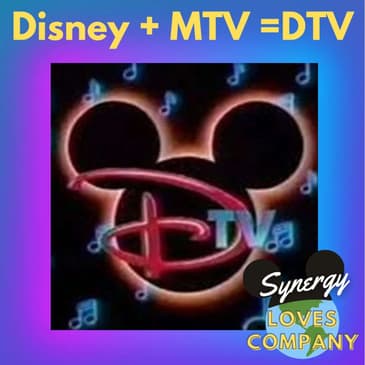
Eric looks back at one of the origins of his Disney obsession. DTV was Disney Channel’s answer to MTV in the 1980s. Each episode of the series featured Disney animation clips choreographed to popular music of the time. Eric explores the impact MTV had on Disney’s decision to make this series. He takes a look at the legacy of DTV in Disney History, and exposes some parallels between Walt Disney Productions in the early 1980s and the Walt Disney Company today. Eric also talks, probably too much about the Eurythmics!
Thanks for listening to Synergy Loves Company: How Disney Connects to Everything.
https://www.synergylovescompany.com
Donate to the show: https://ko-fi.com/synergylovescompany
Instagram and Threads:https://www.instagram.com/synergylovescompany/ Youtube: https://www.youtube.com/@synergylovescompany Twitter: https://twitter.com/EricHSynergy Facebook: https://www.facebook.com/synergylovescompany
00:05 --> 00:06 Synergy loves company.
00:10 --> 00:53 We have this coterie of rich franchises. The company now that people want to engage with. I came here to try and continue what Walt Disney and his associates set in motion 50 years ago, which is to experiment with every new and innovative kind of entertainment possible. It's what we hope to do here to really develop something that just, more than an entertainment enterprise, it's something that contributes many other ways.
01:00 --> 22:45 Hey, this is Synergy loves company, where we explore how Disney connects to everything. I'm Eric and thank you so much for taking the time out of your day to listen. Today I'm going to take a page out of the inside out playbook, dust off a core memory globe off the shelf, and reminisce. So why don't you join me? February 14, 1986, my first Valentine's Day. I was an infant and my older brother was two. My parents put a blank vhs tape into the VCR and set it to record NBC five Chicago at 07:00 p.m.. Central. They didn't know it at the time, but it was a decision that would begin to shape my Disney fandom for years to come. It also started my love of 1980s pop music. The tv special they recorded was Disney's DTV Valentine. It was fast paced, recycled Disney animation set to pop hits to make Disney themed music videos. This tv special was my education into the Disney universe. It was my introduction to classic Disney movies like Fantasia, lady and the Tramp, 101 Dalmatians in Bambi. But it wasn't just Disney's most famous stuff that I was introduced to. It was more obscure characters, also like Humphrey the Bear, the ice skating couple from melody times, once upon a wintertime, and so many from the old silly symphonies. You see, the rapid fire editing of DTV meant that the clips from sometimes 20 plus shorts and features were attached to just one song, like Disney character flashcards for my young brain to bank and rediscover later. But there were also the songs. Music is super important to Disney, and if you've been listening to Synergy Love's company for a while, you probably noticed I've done quite a few music related episodes. That's because Disney and music have always gone hand in hand. DTV Valentine was my first exposure into pop music, like Elvis Presley, Whitney Houston, Huey Lewis in the News, the Stray Cats, Lionel Ritchie and the Eurythmics. And that's probably why I love 80s music so much today. For instance, I can still remember as a kid hearing there must be an angel playing with my heart by the eurythmics set to the cherubs and centaurs of Fantasia's pastoral symphony. The powerful emotion in Annie Lennox's melodic voice and Dave Stewart's complex synthesizer sequence always stopped me in my tracks, not to mention a harmonica solo by the one and only Stevie Wonder. Chef's kiss. I still love that song. And as a kid, though, I didn't know who made the song. I didn't pay much attention to the artist listing before the video, and I didn't know what a urit, whatever that was. As time went on, I gravitated towards sounds that sounded like this, a good beat, easy to dance to, and tons of synthesizers. Years later, when I knew who the Eurythmics were, I happened upon this song again, and it all came flooding back. The fantasia cherubs, the Centaurs, the nostalgia. I could talk about the eurythmics all day, but that'll have to wait. Stick around for the end of the show. I'll do just that. But right now, we got to talk about this DTV thing. And to talk about DTV, we really got to talk about MTV. Remember MTV music television? I know it's still on, it's still out there, but it's not what it used to be. Music video after music video, it used to be so great. That's how I spent my summer in the 90s, watching MTV when I didn't have to go to school. When MTV debuted in the early 1980s, it was even more music videos than I remember. In the 90s, cable was a growing disruption to the television industry, and it gave us more options. We weren't beholden to what our local affiliates wanted to show us. We had more to choose from. When MTV started on August 1 981, it had a simple format unlike anything else on tv. There were music videos that were occasionally interrupted by a VJ video jockey who would introduce the upcoming songs or give some music news. In fact, it was a lot more like radio. And because of this, MTV not only disrupted tv, it also disrupted radio. There were some hit songs that had barely any radio play, but because of their influence on MTV, they hit the Billboard charts. But probably most importantly, MTV tapped the often overlooked, trendsetting teenage demographic. As MTV gained popularity, musical artists adapt and started prepping music videos to accompany their upcoming singles. The videos got more and more complex, like little feature films, the best example of this being Michael Jackson's 1983 thriller video premiere. It was over 15 minutes long, and it had a plot. John Landis directed it, and they made a 45 minutes documentary about the making of the video, MTV and music videos were big business, and they were everywhere. It was a pop culture sensation. Other forms of media tried to become more like MTV. Tv commercials started incorporating elements of music videos. Remember the California raisins? By 1984, though, music video was a household phrase, and everyone wanted their MTV. But what was happening in the Disney company around this time? Well, in the early 1980s, Disney was in a transitional time. Ron Miller, Walt's son in law, had taken over as CEO in 1980, and he started implementing some new ideas, like Touchstone pictures for movies geared towards a more grown up audience and their own cable channel. In 1983, the Disney Channel. But Miller's changes were not shifting the bottom line fast enough, and the company was under attack by corporate raiders. He was ousted, and the combination of CEO Michael Eisner and company president Frank Wells took over Walt Disney productions around the same time. In the spring of 1984, just a few months after Michael Jackson's thriller video, the Disney Channel launched a series in response to the popularity of MTV. And they called it DTV. I know, it's pretty clever. Not really, though. And technically, if it was DTV, that would be Disney television. And wasn't the Disney Channel just basically Disney television? I don't know. DTV was Disney's answer to MTV. On the surface, the show's premise sounds pretty similar, and it had a pretty small crew behind it. Producer Charles Braverman and editor Ted Herman would license popular songs from the 1950s through today. Well, today in the 1980s, and they would find clips of Disney animation and sometimes live action to synchronize with the music. But if you really stop and think about it in the analog equipment and film, this probably took forever. Dubbing, slicing, searching, recording, choreographing it all to make it fit the song. And that's not to count the fact that someone involved either had to have extensive knowledge of scenes and characters in Disney films, or they had to watch everything to figure it out. Let's give a quick shout out to the archivists at the Disney Animation Research Library and the Disney Archives for keeping things organized. The result of all of this, though? DTV. It was pretty cool, if you ask me. When DTV premiered, each episode was about 15 minutes long, and it featured four different music videos. It was its own little show. The artists featured on DTV included Frank Sinatra, Annette Funicello hall and Oates, the Supremes, Pablo Cruz, Michael Jackson, the Beach Boys, Stevie Wonder, the Andrew Sisters, Tom Jones, and so many more. Basically anything. There were also some music videos from Disney projects like Mouser Size, Pete's Dragon and the original Mickey Mouse Club, and of course, songs from animated classics with four videos in an episode. The series had 60 episodes, which comes out to 240 DTV music videos in the initial run. But that's not all. They made a number of network tv specials with a mix of new songs and some from the original run. These tv specials are where my nostalgic DTV Valentine comes from, but there were also Disney DTV, Doggone Valentine and a Halloween special, DTV monster hits. These tv specials presented an hour long format where Disney characters like Mickey Mouse and Ludwig von Drake served as vjs introducing the upcoming videos. They also showed clips and scenes from animated classics related to the theme of the show. Like in the Valentine special, they show the lady in the tramp spaghetti scene. These tv specials gave the opportunity to synergize and show nondisney Channel subscribers. What kind of hip programming would be available to them if they became subscribers? In 1989, Disney released another small run of episodes under the name DTV two, but like squared like the little two exponents math. Soon after this, though, DTV two Disney Channel stopped airing the episodes in full. Instead, they would show them one at a time between shows in the commercial breaks. Let's stop and talk about Disney Channel and commercial breaks for a second. Disney Channel only shows commercials from other Disney shows, products, movies and experiences. They don't allow outside third party commercials in their breaks. The shows start on the half hour and the running time for most of the shows in a 30 minutes time slot is 23 ish minutes, so you need to fill the extra seven minutes with something. And the DTV videos really fit this so well. The music videos continued to show during breaks until 2002. DTV had some lasting power. DTV's legacy was brought back for a time in 2000, and Nine's interstitial series have a laugh in the form of remix. But like Mickey so R-E-M-I-C-K-S remix and have a Laugh was another way to deliver short bursts of content in the show breaks. Remix really was just an updated version of DTV, more modern animation, more modern musical artists. After a couple years though, have a laugh and remix just kind of disappeared, and that's kind of the end of DTV. But I do think the events around the Disney company at the time that DTV was being created have a lot of parallels to things that are happening today in the Walt Disney company and in media. So DTV itself was developed as a response to MTV, which was a major change in the way people thought about music and television image became so important to music, more than it ever had. Record executives had to think about how their budding musical acts would look on camera. They couldn't just hide them behind album cover art anymore. The length of a music video showed the television industry that short and snappy videos can make for a very marketable format. Today, these developments still reign true in social media, but now they're subjected onto the consumers instead of musical artists. As a collective, we've become more and more image conscious of ourselves when making that perfect Instagram post. The Internet has become so visual, says the guy on an audio podcast. But most of it is the idea of short form content focused around music is back, too, but again with us, the consumer, in the spotlight. TikTok started out as musicly. It focused heavily on short form videos synced to music, and it became the juggernaut that is TikTok today. And then TikTok influenced the whole social media landscape. We got Instagram reels, YouTube shorts following suit. Short form social video is here to stay. But we could also look at what's happening with the Walt Disney company. When DTV launched in the early 1980s, Disney was in a questionable transition period. They were looking to jump onto trends in television and movies. Touchstone and Disney Channel are what they ended up with to try to stay relevant in the changing media landscape. But the company and the board needed a CEO and president like Eisner and Wells who could steer the company in the right direction and do it quickly. People who could take over, who understood the right moves to maximize the appeal of the new Disney products. They needed a shake up to avoid getting taken over by corporate raiders. You could read all about it in Disney war. It is an excellent book, but right now the company is kind of in a similar place that they were in the 1980s. I feel kind of like we're in the sequel to Disney War. Every day when I read the Disney news, Bob Iger has taken back over. But there is still a big question in the air. We have Nelson Peltz trying to take over board seats. There's a lot of people out there who want to break Disney into little pieces because they think it's getting too big and diversified to have just one CEO. Then there's the big question of if Disney isn't too big to have one CEO who can take over that job when Iger finally retires, is there any one person who could actually do it now? I would hate for Disney to be broken up into different pieces. I love the company for what it is. That's really one of the big parts of this show is just all those little pieces that make up the one Disney company and exploring how they're all connected to the outside. But these questions are always looming. Another parallel is Disney recently took on some changes to adapt to the current trends and stay relevant in the media landscape. There are ever evolving changes to keep Disney plus relevant and try to make it profitable. But just like the Dtv specials on network tv that were meant to drive subscribers to the Disney Channel, Disney has also periodically broadcast some Disney plus content to drive subscribers to the streaming service. And there was just last week Disney's investment in Epic Games. A trending industry leader with Fortnite as their cornerstone. Disney hopes this is going to give them that credibility in that ever growing and elusive to Disney video game space. Disney has tried to get into gaming time and time again and haven't quite hit the mark. So this might be the thing that takes advantage of video gaming in the right way. We'll just have to wait and see what happens with the company. But we could always look back to that time in Disney history and see what had happened back then. So there you have it. A pretty short story about DTV. Something that's very special to me and its connections to MTV. And before I wrap up the show, let's get back to that eurythmics conversation. I told you I was going to talk about them later. So this is a slight non Disney rant, but I'm going for it. In the 1980s, there were all of these great synth pop duos. It's pretty much my favorite genre of music at this time. The cost of synthesizers was going down. They were becoming more affordable. And with drum machines, sequencers and synth programming, it was possible for just two people to create some pretty complex dance music. A lot of them had one member performing the music. While of powerhouse vocalists sing circles around the songs. We got groups like wham, erasure, yaz or yazoo, depending on where you're from. The pet Shop Boys, soft cell orchestral maneuvers in the dark or OMD, tears for fears, and of course, the eurythmics. The Eurythmics. Dave Stewart and Annie Lennox were both talented musicians and talented songwriters on their own. But together they could create magic with a focus on emotions. There you go. I told you we were doing some inside out today. So you need to listen to these two songs. To get the range of the eurythmics emotion tapped synth pop genius. These two songs will be like an angel and a devil sitting on each one of your shoulders. Cut from the same cloth but polar opposite. First number one, take a listen to sweet dreams. You probably know it. It's like their biggest song ever. It's very danceable, but dark and the vocals are hopeless, depressed and haunting. The synthesizer and drumbeat are pulsing, driving, always moving forward and there's no way to stop the darkness of sweet dreams. Just keep your head up, moving on. But on the other hand or other shoulder is there must be an angel playing with my heart, my favorite one from DTV Valentine. It's also built around a synthesizer, grooves, spectacular vocal runs, and super emotional lyrics, but this time it's effervescent, uplifting, and totally in love. The two songs share some basic structural similarities and parallels, but they fit together more like a ying Yang. The balance between light and dark. Sweet dreams drives forward, pulling you along with it, hopefully to a dance floor where on the other hand, there must be an angel lifts you up with its effervescent melodies, and I can't help but remember it being played along those images of Fantasia's cherubs. Listen to those two songs and let me know what you think. Later on, though, the Eurythmics would go on to move away from pure synth pop and incorporate more traditional rock instruments. They also expanded and started including other genres in their music, like country, classic, r and b, and rock. Their evolution of sound would influence other pop duos who came after them, like Rockset and Savage Garden. But I digress. Thanks for letting me take that little tangent into 80s music. I hope you stuck around. And if you're a fan of DTV, I would love to hear what your favorite DTV memory is. Reach out and find me on Instagram or threads at synergylovescompany and I'm still on Twitter and blue sky at Eric H. Synergy and if you feel like you're getting value from Synergy loves company and you want to give some back, you can do that on Ko fi. If you look into the show description or go to synergylovescompany.com, you'll find a link to my Ko fi page where you can give back to the show and help it keep going. If you feel like you benefit from listening to the show, you can donate a couple of bucks. Buy me a cup of coffee. Every little bit helps. I appreciate you. Another way you can help the show is by sharing the show to help us grow. Share Synergy loves company with a friend who loves Disney just as much as you do. Just tell them to visit synergylovescompany.com because sharing the show is the number one way you can support the show, and your support means the world to me. That's all for today, and thanks for exploring Disney's connections with me. Until next time, keep discovering the magic in everything.