
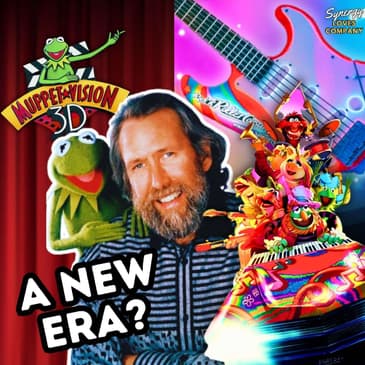
Disney, The Muppets, and Jim Henson
Disney just closed the Muppets Courtyard in Hollywood Studios to make way for Monstropolis. But while Muppet Vision 3D, Jim Henson’s Last Muppet project, is gone, the Muppets aren't leaving Hollywood Studios; they’ve moved into the Rock 'n' Roller Coaster.
Is this a promotion or a demotion? To understand what’s happening today, we have to look back to the deal that almost happened in 1989.
In this episode, we explore the history and connection between Jim Henson, George Lucas, and Michael Eisner. We dive into the the handshake between Eisner and Henson that almost changed Disney forever, the tragic timing of Jim Henson's final project, and why it took Disney 14 years to finally close the deal.
In this video, we look at:
The commonalities between Jim Henson and Walt Disney.
The George Lucas bridge that brought Jim Henson to Imagineering.
The "Muppet Babies" connection to Marvel and Star Wars.
The "Great Muppet Movie Ride" was planned but never built.
Why the 1990 TV Special "The Muppets at Walt Disney World" was a bittersweet turning point.
The future of the Muppets in film and in the Disney Parks.
Subscribe on Youtube for more Disney connections in Video:
https://www.youtube.com/@SynergyLovesCompany?sub_confirmation=1
Podcast:
Listen to Synergy Loves Company → https://synergylovescompany.com
Support the Show:
Shop official Synergy Loves Company merch → https://shop.synergylovescompany.com
Affiliate Disclosure: Some links above may be affiliate links. If you click and purchase, I may receive a small commission at no extra cost to you. Thank you for supporting the channel!
Connect with Me:
Instagram → https://www.instagram.com/synergylovescompany
Bluesky → https://bsky.app/profile/erichsynergy.bsky.social
Facebook → https://www.facebook.com/synergylovescompany
Credits / Resources:
• Music licensed via Melod.ie
• Synergy Loves Company is not affiliated with The Walt Disney Company or any of its subsidiaries.
• Images and clips are used under fair use for commentary, criticism, and education.
This podcast is powered by Pinecast.
00:00 --> 29:58 If you walk through Disney's Hollywood Studios today, you will find a construction wall just before Galaxy's Edge, right across the street from Baseline Taphouse, right where Muppet Vision 3D used to be. That whole corner of the park, the Muppets courtyard with its rat pizza, its exploded props and bad puns, it's all getting torn apart to make room for Mike and Sully in Monstropolis. Disney dismantled the last project Jim Henson personally directed before he died. But they didn't throw the Muppets in the trash, they just moved them. Walk across the park and you'll find Dr. Teeth and the Electric Mayhem plastered across the entrance to the all new rock and roller coaster. The Muppets have taken over Aerosmith's decades long residency and it's pretty cool to see that the Muppets still have a place in the park and in one of Hollywood studios. Most popular rides at that. But this gives us all something to think about in regards to Disney, the Muppets and Jim Henson's legacy. Does Disney know how to handle the Muppets? Hey, this is Synergy Loves Company, where we explore how Disney connects to everything. I'm Eric. And this story of the Muppets and Disney goes way deeper than a ride. Retheme. So today we're going to dive into the relationship going back to the beginning. Even before the beginning. Kermit is to Jim Henson what Mickey Mouse is to Walt Disney. These two men followed a similar path and neither one of them really planned it that way. Walt grew up in the Midwest drawing and doodling cartoons on scrap paper. And Jim grew up in Mississippi building puppets out of things he found around the house, like his mom's old coat and some ping pong balls. Neither of them went to film school. Neither of them had industry connections. They just had this drive to build characters that felt alive and use them to tell stories. And technology was always the bridge for Walt. Synchronizing sound to Steamboat Willie, a full length animated feature. And you might even know that story where Walt looked at a mechanical bird in New Orleans and thought, what if I could build a person like this? Or a whole room full of mechanical presidents? Audio Animatronics became his obsession. Jim Henson looked at traditional puppet theater with its stiff wooden mouths and thought, what if I use foam rubber and fleece and my actual hand to make something that frowns and smiles and squints? What he built were part marionette and part puppet. So he called them Muppets. And there had been puppets on TV before Jim Henson, but it was Usually a static shot of an actual puppet theater with the puppets inside of it. Jim pushed the boundaries of using the TV and what the camera could capture as the boundaries of his Muppets. Both Walt and Jim built these creative families, too. Walt had his nine old men. Jim had Frank Oz, Jerry Jewell, Jerry Nelson, and Dave Goelz, puppeteers and. And writers who would cram themselves into tiny spaces beneath stages while wearing headphones and make a pig fall in love with a frog and make it all feel real. Both men wanted their characters to outlive them. I mean, Kermit was Jim and Mickey was Walt. The difference is, Walt got his wish. Mickey is still everywhere. Jim's dream just got more complicated anyway. Jim's Muppets moved from commercials and short interstitials to longer TV specials and feature films and TV series. He turned his interest into art films without puppets, but kept the Muppets going strong. Henson and his team broke ground with children's television on Sesame street and crept into late night on variety shows like the Tonight show and that infamous stint on SNL when it first debuted. Like. Like Walt and Disney, Jim wanted the Muppets to be for everyone. Not just kids, the whole family. Grownups, too. And throughout this journey, Jim picked up some industry connections that we're going to call pre Disney connections. It's not Disney yet, but they would lead him to Disney. And today these connections are totally under the Disney umbrella. But they weren't at the time. In the late 1970s, while the Muppet show was in full swing, Frank Oz, Jim's closest creative partner, he's the one who performs Miss Piggy and Fozzie and Bert on Sesame Street. Well, anyway, he gets this phone call from George Lucas. They need a puppet for his little green Jedi Master character in the Empire Strikes Back. It's the sequel to the big smash blockbuster hit Star Wars. But you. You already know that Jim actually suggested Frank Oz for the role. Through this connection, George Lucas and Jim Henson got close. Lucas executive produced Labyrinth in 1986, and this was the same era when George Lucas was working with Disney Imagineering on Star Tours and Captain eo. Through George Lucas, Jim Henson officially had a stream directly to Disney. If he decided to pursue it. This relationship with George Lucas could put Jim in rooms with the Imagineers, the studio heads, and the people who were actively reshaping Disney under their new leader, Michael Eisner. Jim was now in that same creative orbit, and he was starting to become interested in seeing how that might be mutually beneficial. But hold on, there's another kind of pre Disney connection from around the same time that we have to talk about. The most profitable thing Jim Henson ever made started as a two minute dream sequence in a movie. The Muppets Take Manhattan came out in 1984 and Frank Oz directed it because Jim was drowning in other projects and figured his friend could handle the chaos. He's a Muppet veteran. There's a scene in the film where Miss Piggy imagines what the Muppets looked like as big babies. A few minutes of cute felt Muppet infants crawling around the nursery. And audiences lost their minds over it within months. Marvel Productions. Yep, that Marvel. They wanted to turn the Muppet Babies into a Saturday morning cartoon. At first Jim said no. He hated the idea. Saturday morning cartoons in the 80s were made fast and cheap, often just to sell toys. And this was the guy who had built the prestige children's programming like Sesame street and Fraggle Rock. He wasn't about to slap his name and his characters onto some 22 minute toy commercial. That's not his style. But it was also kind of a challenge. Jim Henson had this habit of talking himself into things by figuring out how he could do them better than anyone else. He sat down with Marvel and CBS and laid out a few ground rules. Some requirements. The show had to be about creativity, like the actual power of imagination. Every episode would be a different Muppet Baby directing a fantasy sequence with the other babies performing in it. Kermit liked adventure stories. Piggy wanted romance. Gonzo just wanted some action with stunts and explosions. The whole thing was built around how different brain think differently. But when you put those differences together, you get something magic. The way Jim and his studio of creative minds work together day to day. Marvel agreed and CBS picked it up and the show exploded. Critics praised it as the smartest thing on Saturday mornings. Kids couldn't get enough. I know. I loved it. And the merchandising. Oh, man. The plush toys and Happy Meal tie ins. There was a whole line of Avon Bath products. And of course, there were Marvel Comics. It was a Marvel project. Muppet Babies became a funding machine for everything else Jim actually wanted to make. Labyrinth had lost money. Muppet Babies could pay for that. The Dark Crystal had been a financial gamble years earlier. Muppet Babies made up for that too. The cartoon Jim almost didn't make let him take more creative risks without going broke. The show was also unique and regularly used live action film clips from Lucasfilm properties. There's that connection again. Raiders of the Lost Ark. Star Wars. The Muppet Babies would imagine themselves into these movies and suddenly you'd see actual Star wars movie footage spliced right there into the cartoon. The licensing agreement only worked because Jim Henson and George Lucas were so tight. When this was all going on in the late 80s, it was also when Michael Eisner was infusing those same Lucasfilm properties into in his Disney MGM studios park in Florida. And at the same time, Jim Henson was most definitely a household name to every demographic. The Muppet show was in syndication worldwide. Fraggle Rock had just wrapped. Muppet Babies was on top of the world, and Jim was exhausted. The business side was becoming a lot. Jim Henson just wanted to build things. He wanted to create. He to wanted. Which is why when he got a call from Michael Eisner, it was pretty much perfect timing. Michael Eisner had actually had a history with Jim Henson and the Muppets. Back in the early 70s. He was a young ABC executive who greenlit a couple of TV special pilots for a Muppet show in the United States. Nobody else at the network understood what Jim was trying to do, but Eisner got it. He had been a fan since those early days with Henson's first show, Sam and Friends. And now it was 1989 and Eisner was running Disney with Frank Wells and Jeffrey Katzenberg. And now they were on top of the world. Disney decade was about to kick off. Little Mermaid was hitting theaters, and Eisner wanted the Muppets to be a part of what came next for Disney. So he made an offer. Disney would buy Jim Henson Productions for $150 million. Disney would handle the business, the distribution, the marketing, all that Office Y stuff that Jim hated. Jim Henson would get a 15 year exclusive contract. His team got Disney's resources. Jim could actually stop being an executive and get back to creating. Disney would get the Muppets and the Creature Shop and the whole library. Well, except for Sesame Street. And it's not that Disney didn't want Sesame Street. In fact, Eisner really, really wanted Sesame Street. Like, maybe even more than any of that other stuff. But Jim Henson drew a hard line. Those characters stayed with the Children's Television Workshop. He was never going to sell Big Bird and the gang. They were his gift to public television. In August of 1989, Jim Henson and Michael Eisner stood together at the newly opened Disney MGM studios and announced the deal to the press. There were handshakes, smiles, photo ops, Kermit posing with Mickey. And then Jim toured all of Walt Disney World. He stayed at the Grand Floridian and then he went out to California and visited Imagineering in Glendale. And he started sketching out ideas for a whole Muppet section of the park. Muppet Vision 3D was already in development. And then they started to talk about this dark ride concept called the Great Muppet Movie Ride, where the Muppets would spoof famous movie scenes. It was all on the drawing board, and it was getting ready to go from blue sky to reality. This was the kind of creative environment he lived for. And in wonderful world of Disney fashion, Michael Eisner introduced the world to what Disney, with Jim Henson, was going to look like with a TV special. But it was possibly a little premature. The Muppets at Walt Disney World aired on NBC on May 6, 1990. In the show, the Muppets travel to Florida for Kermit's family reunion in a swamp. It turns out, though, that the swamp is right next to Walt Disney World. So the whole gang spends their time running wild through the parks. Piggy on Big Thunder Mouse, and Gonzo's causing all sorts of trouble. Charles Grodin plays a security guard trying to chase them all down. And it's all the Muppet chaos you could ever ask for. But underneath all the gags, this TV special is doing something kind of special. The Muppets are searching for a home. Literally, they're lost. They're tired of the swamp, and they want to spend the whole TV special discovering this magic, colorful, welcoming place that seems custom built for them. The final scene is Mickey Mouse and Kermit meeting in Mickey's office. And Mickey Mouse holds when you wish upon a star, and then Kermit answers with the rainbow connection. It was supposed to mark the beginning of something. But Jim Henson was already sick when this special aired. A few days before the broadcast, he appeared on the Arsenio hall show with Kermit. As usual, his performance, though, was a little off. Something was clearly wrong. He figured it was just a bad cold, and within days, he could barely breathe. Jim Henson died on May 16, 1990, 10 days after the special premiered. The infection was bacterial pneumonia, streptococcus. Completely treatable if caught early. He was 53 years old. The memorial service happened at the Cathedral of St. John the Divine in New York. Nearly 5 people showed up. Jim had left specific instructions. He wanted it to be a celebration, not a morning nobody wears black. Jazz band plays you out. So that's what they did. Harry Belafonte sang Turn the world Around. The Dirty Dozen Brass Band marched down the aisle playing when the Saints Go Marching in. And then Big Bird walked on stage. Carol Spinney inside that massive yellow suit, sang Being Green, and he barely made it through. Most of the cathedral couldn't make it through. And that Disney deal was never actually signed. Jim's five children inherited the company. But when Jim Henson died, the Muppet Disney partnership was already kind of in motion, even though there was no formal deal. Muppet Vision 3D was put into Disney MGM Studios park, and it opened in 1991, and it was the last Muppet project Jim Henson ever worked on. Disney also put the Muppets into stage shows like Here Come the Muppets and the Muppets on Days of Swine and Roses. The Muppets theme park's presence was Disney's. Throughout the 90s, Disney tried to keep the relationship strong by making deals with Jim Henson Productions for distribution and film rights. The Muppets programming showed up on Disney Channel. Disney's Buena Vista Home Entertainment distributed that Muppet home media. And after Disney bought abc, they greenlit the Muppets Tonight, a new, updated Muppets variety show for the 1990s. Probably most importantly, though, Disney produced the Muppets Christmas Carol with Jim Henson Productions. It was the first feature film produced without Jim's hands on the puppets or his voice in in the room. And so Brian Henson, Jim's son, took the director's chair, and the pressure was intense. If the movie flopped, it would prove that the critics were right, that the Muppets couldn't last beyond Jim Henson. But Disney stepped up as a co producer, providing the kind of polish and cinematic scale that Jim always pushed for. And they treated the production with a level of reverence that showed that they understood the gravity of the moment and how the Muppets ticked. The film was dedicated to Jim's memory, and when it hit theaters in 1992, it worked. And it became a holiday staple that defined the Muppets for a whole new generation. Disney and the Henson team followed it up with Muppets Treasure Island. But when the time came for Jim's son, Brian Henson, to make a film production company for the Muppets, Jim Henson Pictures, in 1995, he teamed up with Sony, not Disney. Disney was losing their grip. The ownership situation got even weirder. In 2000, a German media company called EMTV bought Jim Henson Productions for $680 million. But then the stock market turned and EMTV's shares collapsed. Within three years, the Henson family bought everything back at a fraction of the price, except for they couldn't afford to sustain it all long term, they started breaking the assets up. The Sesame street characters went fully to the Sesame Workshop permanently. That's where Jim always wanted them. Sorry, Michael Eisner, but Mike did get his hands on a piece. In 2004, Disney finally closed a deal that was 14 years late and $75 million cheaper than the original handshake. Disney now owned the Muppets. Kermit, Miss Piggy, Gonzo, Fozzie, all of them, and the bear in the Big Blue House. Remember him? At the time, he was one of the biggest things in children's television. So if you could get Sesame Street, I guess you got the Bear in the Big Blue house. This breaking up of assets kind of broke up Jim Henson's world. Back in the day, Kermit would show up on Sesame Street. He was the host of Emmett Otter's Jug Band Christmas. And that's because, like I mentioned earlier, Kermit was the felt embodiment of Jim Henson, the brand ambassador, just like Mickey Mouse. But he was ultimately a Muppet, not part of those other shows. Kermit still is on those old recordings, but that doesn't make those projects belong to Disney. And now he could never be part of those again. Back to the Disney side of things, though. Unfortunately, almost immediately after he got his hands on the Muppets, Michael Eisner, the guy who had earned Jim Henson's trust with the original handshake deal, got ousted from Disney. And then the Muppets took a while to actually get utilized by Disney. In 2007, they got a new park presence with the Muppet Mobile Lab. Professor Bunsen, Honeydew and Beaker roamed freely on a retrofitted Segway, interacting with guests at multiple Disney parks around the world as part of the Living Character initiative. This was really actually pretty cool. But the real work didn't start until Jason Siegel and Nicholas stoller pitched their 2011 revival of the Muppets for film. Siegel, who was a super fan of the Muppets, understood the Muppets are actually at their best when they're the underdogs trying to save their old Theater. That 2011 movie, the Muppets, was a massive hit. It won an Oscar for Man or Muppet Song from the movie. It felt like the Muppets were back on top. But Disney seemed to struggle still with the long term strategy. They tried a mockumentary style series on ABC in 2015 that went for a more adult tone, and it lasted exactly one season. It tried to be too much like 30 Rock meets the Office, because those TV shows had been hot a few years earlier, but it was too cynical for the kids and too weird for the adults. I liked it, though. Disney continued to make Muppet content with varying degrees of success. With the launch of Disney, we got the Muppets now Muppets Haunted Mansion, and the recent Muppets Mayhem series. They even revived the Muppet Babies for the Disney Junior crowd. Some of these were great, amazing even, and some were just okay, but they felt like Disney was just throwing spaghetti at the wall to see what stuck. The Muppets started to become this legacy IP that Disney clearly loved but didn't quite know how to modernize without breaking. And while the movies and shows were fluctuating in quality, there was one place where Jim's presence remained completely untouched. One place where the clock had stopped on May 16, 1991. To understand why the closing of the Muppet Courtyard in Muppet Vision 3D feels like such a gut punch for fans, you have to realize what Muppet Vision 3D actually was to fans. A historical monument, a tribute. I know, I know. That's in direct opposition to what Walt Disney wanted for his parks. He never wanted Disneyland to be a museum museum. He wanted it to grow. He wanted it to change and evolve. But we Disney fans also lean into that nostalgia for old park attractions and old park layouts that we grew up with. It's the contradiction at the core of the Disney fandom holding onto that old cause. We want to honor Walt and honor Jim, but also knowing that it was never the goal or intention of the theme parks. Muppet Vision 3D, though, was a monument to Jim Henson. It is the final project Jim Henson directed. He was working on the script, the storyboards, and the performances during the final months of his life. He was in the room with imagineers, teaching them how to translate Muppet humor into three dimensional physical space. And them teaching him about theme park experiences. When it opened in 1991, one year after Jim Henson died, it felt like Jim had left one last gift behind. The attraction was designed to be a tour of the Muppet Studios, and Jim filled it with every trick. We got Waldo C Graphic, who was the world's first digital puppet. You had that audio animatronic Statler and Waldorf sitting in a real physical balcony, heckling the audience with meta humor, knowing that they are audio animatronics. You even had a live performer in a Swedem suit running through the front of the the. It was a multimedia theme park experience that blended film, live performance and physical effects into a chaotic Beautiful mess that made you feel like you were in an episode of the original show. And in the world of the muppets. For over 30 years, while the rest of Hollywood Studios was being gutted to make room for Star wars and Toy Story, the Muppet Courtyard stayed strong. And it seemed like it wasn't going anywhere. It even got plussed in 2016 with pizza rizzo surfing up that rat pizza and hosting a never ending wedding reception upstairs. All in Muppet style. The Courtyard, with its iconic Miss Piggy fountain felt like a mainstay. And Muppet vision, its flagship, was the only place in the world where you could still hear Jim Henson's voice coming through those theater speakers in that last performance. The pre show alone was legendary. It was filled with those sight gags, those puns. It represented that great Muppet Movie ride future that Jim Henson had envisioned during those 1989 tours and meetings that we would never actually get. But then came the 2024 announcement. Disney decided it was time for a change. They needed a spot for a new Monsters Inc. Land, and the Muppet Courtyard was the casualty. All of it marked for demolition to make way for Monstropolis. On paper, I guess it makes sense. Monsters Inc. Is a bankable franchise with a massive box office history and a great opportunity for another thrill ride in the studio's park. But it's not the end for the Muppets. Disney didn't just evict them or put them in a vault somewhere. Instead, they announced a sort of relocation. They handed the keys to the rock and roller coaster over to Dr. Teeth in the Electric Mayhem. The Muppets are moving from a theater on one side of the park to a high speed launch coaster on the other. A thrill ride. It's the literal relocation of the brand's physical presence. But of course, it has sparked a massive debate among fans. On one side, you have the purists. They argue that Muppet Vision 3D is an irreplaceable piece of film history. Tearing it down is like painting over a mural by a master. A rollercoaster, no matter how fun, can't replicate the intimacy of a puppet performance. To the purists, this feels like the erasing of Jim Henson's hand built legacy. But there's another perspective. The optimists, maybe the ridiculous optimists, as Jim Henson might call them, they see this as an evolution. The Muppets have been stuck in a 1991 time capsule for three decades. I mean, the show was becoming less and less busy over the years. Always a walk on in its later years. But moving the Muppets into one of the park's most popular E ticket attractions, Disney is giving them a massive platform. They're putting the Electric Mayhem and the Muppets center stage in a way they haven't been in years. It's a sign that Disney still believes the Muppets have pulled and they aren't retiring the characters, they're promoting them to a faster, louder, more modern stage. And in other media, Disney tried a revival of the Muppet show in its most classic iconic form. Just this year, a Seth Rogen produced true revival of the Muppet show from the 1970s came to Disney and ABC as a single special event with guest host Sabrina Carpenter. Just like they did back in the day. It shows a return to the Muppets most iconic form, not trying to modernize it or make it something different. It's a back to basics interpretation. Maybe Disney does understand the Muppets better today than they have recently. So that brings the big question. Is a roller coaster starring the Muppets a worthy successor to the theater directed by J is a tough question. Jim Henson loved innovation in technology and art and he loved pushing the envelope. He probably would have been fascinated with the idea of an audio synchronized system in a high speed launch tech. For a roller coaster to tell a Muppet story this big Muppet relocation is the ultimate test of the Disney Henson partnership. Disney is treating the Muppets like a living, breathing part of their current portfolio rather than a museum exhibit. Whether that's a good thing depends on what you think. Your interpretation. In fact, let me know what you think about this whole situation down in the comments AS Muppet Vision 3D Rock and Roller coaster that move across the park. Or what about Aerosmith? I mean, they got evicted, right? Aerosmith. Let me know how you feel. Put it down in the comments below. But we can't deny that the Muppets are moving into a new era with Disney. This decision will define their place in the parks and in the company for years to come. And it's that gamble that Michael Eisner and Jim Henson started over 35 years ago with a handshake that we're still seeing played out today. And there were so many other Muppet things that I didn't even get a chance to talk about. One of them that comes to mind is I love that Liberty Square Muppets show that they did. There's the Regal Eagle Smokehouse. There's so many things that Disney has done with the Muppets. I didn't even get to get into all of them. So also, let me know what Muppet things I didn't talk about that that you love that Disney has done something with, or maybe even just stuff from back in Jim Henson's day. I'd love to hear your favorite Muppet things. There's too many for me to have stuffed them all into this episode. And then while you're down there, make sure that you subscribe to Synergy Loves Company for more of these deep dives into Disney history and how Disney connects to everything. For more on the parks, check out this video next. And remember, keep discovering the magic in everything.