
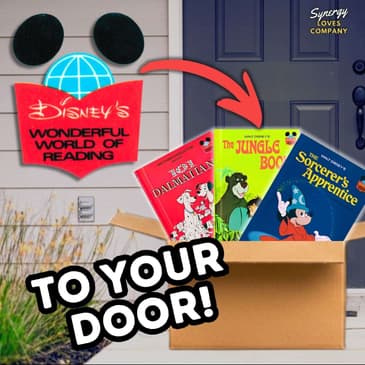
Did you have a shelf full of those iconic, colorful-spined Disney's Wonderful World of Reading books as a kid? They had that Red book, Blue globe, Mickey Ear Logo at the top! You probably remember the magic of receiving a new story in the mail, addressed specifically to you—but do you know how they actually got there?
Today, we uncover the hidden history of Disney’s Wonderful World of Reading. While these books are a staple of childhood nostalgia for millions, their origin story is tied to a massive door-to-door encyclopedia empire, high-pressure sales tactics, and a "negative option" billing system like Columbia House that Disney later adapted to their own Movie Club.
From the 1965 "prototype" set to the Federal Trade Commission’s battle against "subscription traps," we’re exploring how a 1970s mail-order club paved the way for the modern era of Disney Movie Club and even Disney+.
In this episode, we explore:
-The Grolier Empire: How door-to-door salesmen conquered the bookshelf.
-The "Negative Option" Trap: Why the books kept coming even if you didn't ask for them.
-The Disney Vault: How these books became the only way to "own" the movies in the 80s.
-The Legacy: How a book club from 1971 predicted the future of streaming services.
Subscribe to Synergy Loves Company for more deep dives into how Disney connects to everything:
https://www.youtube.com/@SynergyLovesCompany?sub_confirmation=1
Podcast:
Listen to Synergy Loves Company → https://synergylovescompany.com
Support the Show:
Shop official Synergy Loves Company merch → https://shop.synergylovescompany.com
Affiliate Disclosure: Some links above may be affiliate links. If you click and purchase, I may receive a small commission at no extra cost to you. Thank you for supporting the channel!
Connect with Me:
Instagram → https://www.instagram.com/synergylovescompany
Bluesky → https://bsky.app/profile/erichsynergy.bsky.social
Facebook → https://www.facebook.com/synergylovescompany
Credits / Resources:
• Music licensed via Melod.ie
• Synergy Loves Company is not affiliated with The Walt Disney Company or any of its subsidiaries.
• Images and clips are used under fair use for commentary, criticism, and education.
This podcast is powered by Pinecast.
00:00 --> 18:57 Think back to your childhood bedroom for a second. Take a look at that bookshelf. It probably had a mix of things. Little golden books, that big encyclopedia that took up a whole shelf. But if you were a Disney kid, there was a solid chance a section of it was taken up by these specific books. They all had that colorful spine, right? And up at the top, that little red book, blue globe, Mickey Mouse ears logo. They were just part of the furniture, a given. You had classics like Snow White and the Seven Dwarfs and the Sword and the Stone, but you also had modern masterpieces like Beauty and the Beast, the Little Mermaid. They were your library. But where did they actually come from? You couldn't buy them at the store. Your parents or grandparents didn't pick them up on a shopping trip. They showed up in the mail, a new one every so often addressed to you. It felt like getting a gift that just kept coming, building out this perfect curated Disney collection on your shelf. But that feeling was the whole point, because this wasn't a random gift. It was a subscription. A subscription club you might not have even known that you were in. Hey, this is Synergy Loves Company, where we explore how Disney connects to everything. I'm Eric. Welcome back. And today we're taking a look at how Disney took up all that prime real estate on your childhood bookshelf. All right, let's get down to business. It wasn't exactly Disney who took over your bookshelf. And to understand the book club, you have to understand the machine that built it. And that machine was called Grolier. In the middle of the 20th century, before Google, before Wikipedia, before any of the Internet, your home encyclopedia was everything. It was the Internet you had on a shelf. And one of the biggest names in that game was Grolier, the publisher of the Encyclopedia Americana and the New Book of Knowledge. But Grolier didn't sell these in bookstores. Their entire business was door to door. Salesmen would go into neighborhoods and make appointments, sitting down in people's living rooms with a very specific, very effective pitch. And it played right on parental anxiety. The idea was, if you didn't have this set of books, your child would fall behind and they wouldn't have the tools to succeed in the world. The salesman wasn't just selling paper and ink. He was selling a child's future. And he was selling it on an installment plan. A huge upfront cost broken into monthly payments that felt manageable, but added up to hundreds of dollars. There were tons of other encyclopedia publishers doing the same thing. Britannica World Book. This was massive business. In the 70s, Grolier's encyclopedia division alone did over 150 million in sales. Their sales force was thousands of people strong, working on commission. And they were good at it. So good that by 1971, the New York Times and the Federal Trade Commission were both investigating them for high pressure, deceptive sales tactics. This machine, though this direct to your living room sales force had mastered selling information. What they saw next was the market for entertainment. The parents who were worried about education wanted to make their kids happy too. And what made kids happier than Disney, Grolier had the distribution network, the billing systems and the playbook for selling to families inside their homes. Disney had the characters that every kid loved. It was a perfect match waiting to happen. But first they had to run a test, a sort of prototype to see if families would buy Disney in this way. So in 1965, Grolier released a box set called the Wonderful Worlds of Walt Disney. It was four hardcover volumes with stories each focusing on a different theme. Fantasyland, the worlds of nature, America and stories from other lands. And this wasn't a cheap thing. It was a prestige product. It collected art and stories from Disney's films and true life adventures into these beautiful books. And the key is Grolier sold it in that same Grolier way. They used their direct marketing muscle to get this multi volume Disney set into homes. It was an add on to the encyclopedias, a fun spoonful of sugar to go along with that educational volume. And it worked. It proved that the audience was there. Families weren't just willing to buy a single Disney storybook. They would commit to a whole collection delivered as a set. This was proof of concept. Think of it as the beta test for the bigger idea. The Wonderful World set showed that Grolier sales model and Disney's brand magic could work together. In 1971, Disney's Wonderful World of Reading officially began. And the partnership is pretty straightforward. Disney provides the license, the characters, the brand, the magic. Grolier does everything else. The printing, the mailing, the billing, and most importantly, the selling. They set it up to sell one little book at a time, forever as a subscription, through a model called the negative option. You've probably experienced this even if you didn't know that name. And here's how it worked. You'd see an ad, maybe in a magazine or a direct mail flyer, possibly even that door to door salesman trying to get you to buy an encyclopedia. The offer was incredible. Get three Disney books for just $1. You sign up and you get Your introductory books. That hook was the set of books. But then the trap was set. From that point on, every month, Grolier would send your child a new book and they would bill you for it unless you said no. And that's the negative part. You don't actively choose to get the book. You have to actively choose not to get the book. You had to mail back a little card, often within a specific window of time to stop the shipment. And if you forgot or you missed the deadline, or you just didn't see the notice, the book showed up and the charge landed on your bill. It was a brilliant business model for the company, but incredibly sticky situation for consumers. It turned procrastination and inactivity into revenue. The default state was, you own this now, so pay us for it. This system was actually so widespread and caused so many complaints that in 1973, the Federal Trade Commission actually created a special rule just to police it, the pre notification negative option rule. And it was aimed squarely at companies like Grolier and other book of the month clubs. The new rule forced them to send clearer notices and give people at least 10 days to opt out. They had to make the cancellation at least a little bit easier. But the core mechanisms still remained. And it wasn't always books. There was the Columbia House Record Club. You'd start with 10 records or tapes or CDs for a penny, and it was great. It was awesome. Then you would get the selection of the month. Unless you sent that card back to tell them you didn't want it. You might have ended up with tons of records that you didn't even want and large bills for all of them. For Grolier's Disney Book Club, it was the book of the month. So that colorful book arriving in your mailbox with your name on it wasn't the magical surprise for Mickey. It was the default output in this subscription machine. You were getting that book unless someone, usually a busy parent, remembered to tell them to not send it. And for years, most of the time, nobody pressed stop on this. So that's where the books came from. But where did the books actually come from? Like who made them? If you pictured a Disney artist at a desk in Burbank and carefully painting each page, that's not at all how this worked. The Wonderful World of Reading was a licensing deal. Disney provided the characters and the stories, but the physical creation of the books was totally outsourced. Grolier contracted the work out to third party book packaging studios. There was a company called Mega Books based in Florida. Another was Gutenhaus, part of the Egmont Publishing group in Copenhagen. And so many others. These firms would handle everything. They'd hire writers to adapt the movie scripts. They'd commission the artists to do the illustrations. They'd arrange the printing and the binding. The artists who worked on these books were often uncredited. Their job wasn't to innovate, it was to mimic. And they worked in what's called like the Disney house style, but only getting the characters to look at close enough that a kid wouldn't question it. But still, still within Disney's passable standard. But they also worked fast. The result was a product that felt Disney enough, even if it never actually passed through the Disney studio. And this system went worldwide. The club operated under different names in different countries all over the world, using local publishers to make the same books. In the uk, you'd probably get them from Purnell or Lady Bird. In Scandinavia, it was Egmont. The same model, the same colorful spines and covers, just with different international publisher names and logos on the back for the company sending it, it was a licensed product, manufactured efficiently to feed a subscription machine. The primary goal was just to keep the club running, to keep that monthly shipment and that monthly charge going for as long as possible. But as kids we did love those books. And that's why the system mattered so much. Especially if you grew up in the 70s, 80s or early 90s. This was the era of the Disney vault. Disney was famously hesitant about home video. They saw their classic films as special events. They'd re release Snow White or Pinocchio to theaters every seven years or so. And that was it. The idea of just selling a copy you could watch anytime at home was terrifying to Disney. They thought that it would kill the magic. So when they did finally dip a toe into selling those big ticket movies, it was a big expensive deal. And it took a while. The first release of Snow White on VHS was in 1994 and it was treated like a national event. Before that you had things like the Disney sing along songs tapes, but the actual movies, those were locked away. Also, did you check out my video on the sing along songs tape? I'll leave a link right there. So for years, if you missed a movie in theaters, you were just out of luck. You couldn't rent it, you couldn't buy it. It was gone for the next seven years or so. This is where the book club, the wonderful world of reading became more than just a subscription. These books were a way that you could own the story. You couldn't Watch the Fox and the Hound whenever you wanted, but you could read the book. You couldn't see the Aristocats, but you could follow the story along with the pictures. For many of us, the book club filled the massive gap between a movie's theatrical release and the distant, uncertain day that it might finally come out on home video. For a whole generation, the book was the movie plot points you memorized, the characters you loved. You didn't get them from the screen, you got them from those pages. To us kids, the club was the access point to a story that Disney itself was keeping under lock and key. And it turned your bookshelf into a personal, physical version of the Disney vault. And in addition to those regular monthly shipments, the Wonderful World of Reading had a secret weapon for retention. A way to make staying subscribed feel a little more special. And that was the yearbooks. Once a year, instead of the standard storybook, you'd get this much thicker, heavier volume. And it was an anthology, kind of like a best of collection for that year, packed with multiple shorter stories, maybe some activities. It felt special premium. If the monthly books were the episodes, the yearbook was that season finale for me and maybe a lot of you. These were the ones I I remember most vividly. They were the trophy on the shelf. I could still picture some specific covers from the late 80s and early 90s had that year right on the COVID And they felt a little bit more like an event. They were the reward for being a member, a physical reminder that you are part of this club. These dated volumes took it beyond just a subscription. It was a collection. You weren't just getting a book, you were buying, building the set year after year. And the yearbook was the anchor of that set, the volume that tied the whole year together. It turned a subscription from a bill into a collector's hobby. And speaking of collecting, Grolier expanded the Disney license to some educational collections as well. Around the same time that the Wonderful World of Reading came on the scene, there was Disney's Wonderful World of Knowledge, the An Illustrated Encyclopedia and the informational counterpart to the World of Reading. They also had specialized informational sets like Disney's Growing Up Healthy that focused on biology and health, or the Small World Library that told stories about Disney characters in countries around the world so readers could learn about geography and culture. Maybe you had one of those sets or some others that I didn't even list. So I gotta ask, which are the Wonderful World of Reading books you remember? Do you still have any on your shelf? Maybe at your parents house? Put Somewhere in the attic or the basement. Let me know in the comments if you had any of these. Which ones were your favorite. I did love those yearbooks. The Wonderful World of Reading Club didn't stay with Grolier forever. It was a successful asset that lasted, but it did get passed around. In the late 90s, Grolier itself was sold to the French media giant achette. Then in 2000, they sold Grolier's operations to Scholastic, the huge children's book publisher behind those book fairs that we loved. The club kept running under Scholastic for a while, and eventually the subscription part of the business landed with a company called Early Moments, which for you 90s kids, you might know better. As the folks behind Hooked on Phonics, they ran it for years, still sending out those familiar books and those familiar mailers with those cards that you had to reject if you didn't want the next one. Even as late as a couple of years ago, the program was still active and today it's still listed on Early Moments website. But when I tried to sign up for myself, the site seemed to be broken. So the Wonderful World of Reading seems to have fizzled out, but lasted a lot longer than I thought. But that model itself, that Disney direct to use subscription idea had already spawned another program you might even be familiar with. Maybe you were even a member. In 2001, Disney launched the Disney Movie Club. It was the same playbook, just updated for DVDs, get four movies for a dollar, then commit to buying a few more at full price. The envelopes in the mail, the negative option selection, the member exclusive titles. They did have some really great member exclusive titles. It was the Wonderful World of Reading. But for movies, it didn't last so long. In 2024, Disney announced that the Disney Movie Club would be shutting down for good, which it did in July of that year. And that was just the beginning of the final curtain for the Disney physical media era. And even though the physical media era is very quickly fading away, that subscription model didn't die. It just evolved into its latest, probably most efficient form. Why buy a physical book or a Blu Ray when you can now stream everything instantly? At least that's what the big companies are thinking. And Disney is the ultimate negative option service. You don't get a monthly postcard asking if you want to cancel. The charge just happens automatically every month. The selection isn't one book or one movie. It's the entire library. Licensed, not owned, and delivered straight to your screen. The commitment is seamless. The barrier to exit is just a little bit of forgetfulness, the same inertia that powered the book club for decades. So the colorful spines on our childhood shelves were more than just books. They were the test run for a way of selling that went from encyclopedias to DVDs and Blu Rays and ultimately Disney. The subscription you might not have even known you were in trained a generation for the subscriptions we all knowingly pay for today. The Disney magic was definitely there in the stories and books, but the trick, it turns out, was in the billing to our parents. All right, so I got to ask it again. If you didn't put down what books you had from this series, put them down there in the comments. Which ones did you have on your shelf? Do you remember a specific story or yearbook that you read over and over? Let me know down in the comments. And speaking of subscription models, are you subscribed to Synergy Love's company yet? Maybe take a second and hit that button so you don't miss the next story in this collection. It's like a wonderful world of reading for your YouTube feed, but free. Thanks for joining me for this look into bookshelves and subscriptions. And remember to keep discovering the magic in everything. Sam.