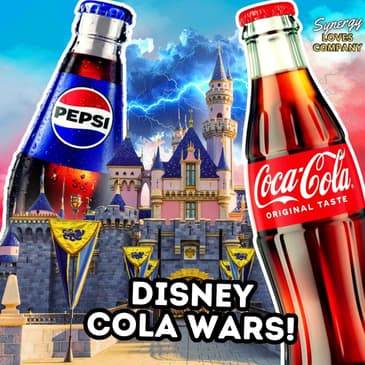
Coke and Pepsi didn't just fight in grocery stores. For 35 years, the real battlefield was Disneyland.
Before Coca-Cola became the only soda in the happiest place on Earth, the park was split down the middle. Pepsi got Frontierland and Adventureland. Coke owned Main Street and Fantasyland. And one counter in Tomorrowland sold both at the same time.
Then Pepsi called Walt Disney. And the result? One of the most iconic rides in theme park history.
This is the story of how two soda giants fought for the mouse — the World's Fair deal that changed everything, the 1990 takeover that locked Pepsi out for good, and the one place on earth you can still find a Pepsi hiding inside a Disney park.
Subscribe for more Disney connections:
https://www.youtube.com/@SynergyLovesCompany?sub_confirmation=1
Podcast:
Listen to Synergy Loves Company → https://synergylovescompany.com
Support the Show:
Shop official Synergy Loves Company merch → https://shop.synergylovescompany.com
Patreon: https://patreon.com/synergylovescompany
Affiliate Disclosure: Some links above may be affiliate links. If you click and purchase, I may receive a small commission at no extra cost to you. Thank you for supporting the channel!
Connect with Me:
Instagram → https://www.instagram.com/synergylovescompany
Bluesky → https://bsky.app/profile/erichsynergy.bsky.social
Facebook → https://www.facebook.com/synergylovescompany
Credits / Resources:
• Music licensed via Melod.ie
• Synergy Loves Company is not affiliated with The Walt Disney Company or any of its subsidiaries.
• Images and clips are used under fair use for commentary, criticism, and education.
This podcast is powered by Pinecast.
00:00 --> 15:04 In the '70s and '80s, the Cola Wars hit a boiling point. They were fought in grocery stores, in TV commercials, and in your fridge. There was the Pepsi Challenge, the New Coke, and the triumphant return of Coca-Cola Classic, and everybody chose a side. You probably have a favorite in your fridge right now. But years before all of that, the Cola Wars were being fought in a battlefield called Disneyland. Hey, this is Synergy Loves Company, where we explore How Disney Connects to Everything. I'm Eric, and we're taking a look at that Coke vs Pepsi debate and how this rivalry played out inside the Happiest Place on Earth. You might be thinking, I just went to Disneyland or Walt Disney World and I know they serve Coke products. I went to Club Cool, I got one of those cool thermal detonator Cokes at Galaxy's Edge. And you're right, today Disney is all Coke, but in the early days of the park, it was divided and served both Coke and Pepsi. But if you stick around, I'll tell you where in Disneyland you can still get a Pepsi today. Right now though, real quick, let me know in the comments, are you a Coke or a Pepsi person? Put it down there, let me know, let's get the debate started. Before we even get to Disney though, we gotta go back even further because this rivalry didn't start at the theme park, it started in drugstores. Coca-Cola came first, invented in 1886 by a guy named John Pemberton, and Pepsi Pepsi showed up about 7 years later in 1893, made by a pharmacist named Caleb Bradham, who was basically trying to build something to compete directly with Coke. So from the beginning, Pepsi has always been trying to catch Coke. The reason it exists is to go to battle with Coke. Now today we think of these two as massive corporations, but in the beginning, neither of these guys really made any money off of what they invented. Pemberton struggled for years trying to get Coke off the ground and eventually sold the formula for about $2. Bradham didn't do much better. He actually ended up filing for bankruptcy and went back to working as a pharmacist. But the companies that bought Coke and Pepsi are the ones that turned them into big business. And by the 1930s, Coke pulled way ahead of Pepsi. Coke had better distribution, iconic branding. They had the reach. Coke had the marketing down too, which is what brings Disney into this story. First, Coke had a radio show in the 1930s and '40s called The Pause That Refreshes on Air. Kind of a mouthful, but it's this Coca-Cola-sponsored, star-studded variety show that Walt Disney actually guest starred on in 1942. But Disney's first big soda relationship happens on TV in 1950. Walt Disney puts out his first-ever television production, a holiday special experiment called One Hour in Wonderland. And it airs on NBC on Christmas Day, and it's built around promoting his upcoming movie Alice in Wonderland, and it's sponsored by Coca-Cola. As an experiment in 1950, Walt is interested in television. He's interested also in building some kind of a real-world experience park. The experiment on One Hour in Wonderland opens Walt's eyes to see how he could leverage television to get people interested and promote his theme park idea and get corporate sponsors to fund it, just like Coca-Cola did with the TV special. Coke loves working with Disney because the TV special is successful. Like, everyone watches it. Coca-Cola is like Walt Disney's soda partner on television because it worked so well. So a few years later, when Walt is getting sponsors sponsors for his Disneyland project, Coke is definitely in, but so is Pepsi. Walt is not exclusive. He will take the money from wherever he can get it. He needs lots of money to build Disneyland, and his brother Roy didn't want to use all of the company's money or take out any more loans, so corporate sponsors were the way that they could raise this money. They'd underwrite individual attractions in exchange for having their brand attached with signage and all that stuff. If Coke and Pepsi both wanted in. There's enough park to go around. Disneyland opens in July of 1955 with a long list of original corporate sponsors, and Coke and Pepsi are both on this list. And this video is actually part of a series I'm doing on my Patreon where I'm looking at the 33 original Disneyland sponsors that inspired the Club 33 and seeing what happened to them and their relationship with Disney. If you wanna check out more about like, who they were and how they're still connected to Disney, you can go and support the show by becoming a member. Go check it out on Patreon, there's a link down below. But as far as those conflicting Disneyland sponsorships go, Coca-Cola gets the Coca-Cola Refreshment Corner right at the end of Main Street. It's one of the first things you see walking into the park, and it's a great pit stop at the end of a long day. Pepsi, on the other hand, gets the Golden Horseshoe Revue, which happens to be one of Walt's personal favorite shows in the entire park. So much so that he and Lillian hold their anniversary party there right before the official opening of the park. But what about the other concessions, the ones that sell other food? They gotta serve some sort of soft drink also, right? The Cola Wars are geographical in Disneyland. Pepsi gets Frontierland and Adventureland over by where their attraction is, and Coke had Main Street and Fantasyland, where their attraction is. In Tomorrowland, though, at the Space Bar, you could actually get Pepsi and Coke at the same counter. You could try the Pepsi Challenge, actually, before it existed. Disneyland's opening day itself was kind of a disaster. There was a plumber's strike going on right before the park opened, so Walt had to make a call between water working in bathrooms or water fountains, and he picked bathrooms. I mean, of course. But he famously said, well, you know, they could drink Coke and Pepsi, but they can't pee in the streets, so finish the restrooms. And going forward, that's how it would be. The park had 2 soda brands, Coke and Pepsi, battling for park supremacy. Coca-Cola pushes back into Disney television and sponsors The Mickey Mouse Club. But in the mid-1960s, Pepsi does something that helps them gain some ground on Coke, and it unintentionally gives them a bigger slice of Disneyland. Over in Frontierland, right in Pepsi's half of the park, a little spot called the Casa de Fritos, which is sponsored by Frito-Lay's. If you watched my last video on corporate sponsorship icons, you already know this is where Doritos actually got invented. In 1965, Pepsi and Frito-Lay's merged to become PepsiCo Inc. So now Pepsi is technically a double sponsor of Disneyland. And while that merger is in the works, over on the other side of the United States, Pepsi's got a problem. They've got land reserved for a pavilion at the 1964 New York World's Fair, and they're working with the United Nations Children's Fund, UNICEF, but they got nothing planned to put there. And the fair's gonna open in less than a year, so they do the only thing that makes sense. They call up Walt Disney. He seems to be helping everyone else out. General Electric, Ford, the state of Illinois. He comes up with this idea for a boat ride showing the children of the world living in harmony, singing together. Pepsi's board was not sold on this idea at all. The whole concept of singing dolls in a boat ride—it felt like a stretch to them at first. But Walt's like, "Hey, you got eight months. Either we get started now or this ain't gonna happen." And that's when Hollywood icon Joan Crawford steps in. She's Walt's friend, and she happens. to sit on Pepsi's board of directors. She goes to bat for Walt's pitch. She talks the rest of the board into doing this doll boat ride thing. And of course, that ride is a massive hit at the fair. People love it. You know it. It's a small world after all, right? Then after the fair, Disney packs the whole thing up and moves it to Disneyland, where it becomes one of the most iconic rides the company has ever made. It's still running today, and that song is probably still stuck in your head right now. Stuck in mine. When Small World moved to Disneyland, it got a new sponsor though, the Bank of America. Apparently, even though Joan Crawford worked her magic, some of the Pepsi execs were too cool for school and still thought it was embarrassing as a concept. I mean, they probably could have taken over Fantasyland with Small World, but they stuck with the Golden Horseshoe as their sponsored attraction. But all of this made the late 1960s peak for Disney and Pepsi's relationship. Pepsi filmed some commercials in Disneyland, aligning themselves with Disney even further. And around this time, Pepsi started throwing everything they had at Coke everywhere else too. There was the Pepsi Generation ad campaign targeting a younger crowd. And then in the '70s, that Pepsi Challenge. There were these blind taste tests where people kept picking Pepsi over Coke in all the commercials. Pepsi got the commercials that showed that, proving that people preferred Pepsi. But even with all those taste test wins, Coke was still outselling Pepsi almost 2 to 1 in actual sales. In 1971, Walt Disney World opens the Magic Kingdom, and Pepsi and Coke are both served over there too. Coke gets Refreshment Corner right at the end of Main Street like in Disneyland. It's Casey's Corner now. And Pepsi gets the all-new attraction, the Country Bear Jamboree over in Frontierland. It's actually sponsored by Pepsi-Cola and Frito-Lay together, and the writers even slip a little wink to Pepsi's ad slogan right into the show with, we've got a lot to give. But in the late '70s, Disney starts building EPCOT, and this is a completely different kind of project. Instead of splitting up refreshment stands between 2 competing soda companies like they've been doing in all their parks for decades, Disney decides they want one soda partner park-wide, an exclusive contract. And Coke comes with an aggressive offer and they win exclusive rights starting right on Epcot's opening day. And then the relationship expands and moves outside the theme parks and back on television. Sure, Pepsi has Disney superfan Michael Jackson in their commercials, but Coke gets Disney characters in their commercials in the '80s. Then in 1990, Coke and Disney sign a 15-year exclusive deal, and that deal has been extended and extended, and Coca-Cola takes over Disneyland and Walt Disney World fully, and it's still there today. But at the beginning, I told you you could still get a Pepsi at Disneyland, and you still can at Shanghai Disneyland. That, that's the one place. It opened back in 2016, and it's different from the American Disney parks because Disney doesn't fully own it. It's kind of like the deal Disney has in Tokyo with the Oriental Land Company. In Shanghai, Disney only holds a 43% stake of that park. The Chinese state-owned Shanghai Shendi Group owns the 57% majority stake, so they get to call the shots, and they like Pepsi, so that's who got the park's contract. So it's more of a loophole and less of a comeback. Pepsi just happened to be standing there when the ownership structure worked out in their favor over in Shanghai. And okay, I know, I, I gotcha. I was saying you would be able to get a Pepsi product in Disneyland, and then I told you it was in China, and You might be like, I'm not going to China anytime soon, but talking about Pepsi in Disneyland. But actually, Pepsi never fully left the American parks either. Technically, they still have a presence. Remember the Casa de Fritos, that little snack stand we talked about back in Frontierland in Pepsi's half of the original park? Well, when Pepsi and Frito-Lay merged into one company, PepsiCo, they diversified into a company very different than Coca-Cola. Most of their money now comes from other products, not soda. So when Pepsi soda got kicked out of the Disney parks in the '90s, Frito-Lay didn't go anywhere. It's a completely different business unit under the same parent company, and Disney's contract with Coke only covered the drinks. They were not concerned at all with the chips. In 2002, Disney and Frito-Lay, under PepsiCo, signed their own agreement, and it was a big one. Lay's started sponsoring California Screamin' over in California Adventure. Cheetos got its name on Typhoon Lagoon, the water park over at Walt Disney World. And Frito-Lay even got the naming rights of the baseball stadium at Disney's Wide World of Sports complex, which they called Cracker Jack Stadium. Cracker Jack is a Lay's product too. By now, a lot of those names have changed and the sponsorships have fallen off too, but you can still get Frito-Lay's products in the Disney parks. You can walk into the Magic Kingdom right now and you can't buy a Pepsi, but you can buy a bag of Doritos or Lay's potato chips, and it's the same company, but they're not selling you a drink. If you like this one, you can go and check out my Patreon for that ongoing series of the Club 33 sponsors of Disneyland, like Pepsi and Coke. And like I said, this one's part of it, but I have a little bonus on it over there where I'm taking the Pepsi challenge. Let's see which one I like better. Make sure you're subscribed to Synergy Loves Company so you don't miss any more videos like this. You can watch this one next, and remember, keep discovering the magic in everything.