
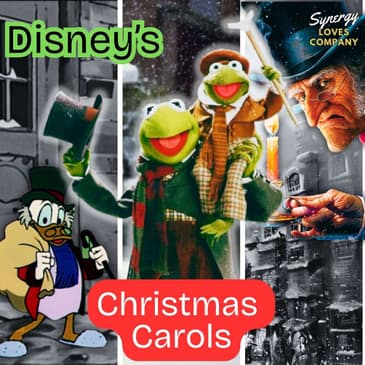
Every time Disney adapts A Christmas Carol, it’s a ghost story—but it’s not just about Scrooge. It’s a story about the Walt Disney Company itself.
CHECK OUT THIS EPISODE IN VIDEO FOR THE FULL EXPERIENCE @ https://youtu.be/pCARpdjm0rk
From the hand-drawn rebirth of Mickey Mouse in the 80s to the felt-and-friendship of the Muppets in the 90s, and the high-stakes digital ambition of the 2000s, each adaptation of Dickens’ classic reveals exactly where Disney was as a company, what it was struggling with, and what kind of "spirit" was guiding its decisions.
Join Eric as we unwrap the surprising corporate history hidden inside three holiday classics:
The Ghost of Ink and Paint (1983)
Mickey’s Christmas Carol was more than a cute holiday short; it was a desperate sign of life from a struggling animation studio. We explore how this small project became a proving ground for the next generation of Disney legends (Keane, Lasseter) and marked the grand return of Mickey Mouse during Ron Miller’s uncertain tenure.
The Ghost of Felt and Friendship (1992)
The Muppet Christmas Carol was the first Muppet film made without Jim Henson—and the first under the Walt Disney Pictures banner. It's a story of legacy, loss, and how Brian Henson fought to keep the heart in the story (and why a certain song was controversially cut by Jeffrey Katzenberg).
The Ghost of Digital Ambition (2009)
Robert Zemeckis’ motion-capture version starring Jim Carrey was designed to be the ultimate A Christmas Carol. Instead, it became a cautionary tale about the high cost of innovation, the "uncanny valley," and why Disney’s $200 million experiment (ImageMovers Digital) shuttered just two years later.
These films are a timeline of Disney's struggles, expansions, and triumphs. Watch now to discover the surprising synergy of art, commerce, and Christmas spirit!
Subscribe for more Disney connections:
https://www.youtube.com/@SynergyLovesCompany?sub_confirmation=1
Podcast:
Listen to Synergy Loves Company → https://synergylovescompany.com
Support the Show:
Shop official Synergy Loves Company merch → https://shop.synergylovescompany.com
Affiliate Disclosure: Some links above may be affiliate links. If you click and purchase, I may receive a small commission at no extra cost to you. Thank you for supporting the channel!
Connect with Me:
Instagram → https://www.instagram.com/synergylovescompany
Bluesky → https://bsky.app/profile/erichsynergy.bsky.social
Facebook → https://www.facebook.com/synergylovescompany
Credits / Resources:
• Music licensed via Melod.ie
• Synergy Loves Company is not affiliated with The Walt Disney Company or any of its subsidiaries.
• Images and clips are used under fair use for commentary, criticism, and education.
00:09 --> 19:05 Do you hear that? The bell tolls the hour and with it your invitation arrives. Tonight you will be visited by three spirits, not the kind that haunt the Haunted mansion. These are the ghosts of Disney's Christmas Carols. Three very different visions of Charles Dickens. Classic tal. All brought to life through the magic of Disney. For nearly half a century, Disney has returned to Dickens timeless story again and again, reimagining it for new generations. From hand drawn animation to digital performance capture, and even a Muppet or two, each version says something unique about the company, the technology and the era that created it. So consider me your guide tonight, a friendly spirit of Disney past, here to take you on a journey through the three Christmas Carols, three moments in Disney history, and three visions of what it means to keep Christmas in our hearts. Hey, this is Synergy Loves Company, where we explore how Disney connects to everything. So you can feel connected to Disney even when you can't be at the parks. I'm Eric and today we're taking a very merry trip through three of Disney's take on a Christmas classic, A Christmas Carol. Charles Dickens's story of Ebenezer Scrooge has been retold and retold countless times. But few studios have revisited it as often or as creatively as from hand drawn animation to Muppets to motion capture. Each version shows us something about where Disney was at that moment in history and what kind of spirit was guiding the company at the time. So grab a cozy blanket, pour some hot cocoa and get ready because your first ghostly visitation is about to begin. And let's start where it all began. With this story that marked the grand return of Mickey Mouse and a little holiday hope during one of Disney's most uncertain eras. In the early 1980s, Disney was in a difficult spot. Animation was struggling, young talent was leaving, and ever since Walt had passed, the future of Disney storytelling felt unsure. But out of that uncertainty came a spark. A longtime Disney veteran, Bernie Mattinson, had an idea that. A simple, heartfelt idea. Take a classic story, give it the warmth and humor of Disney characters and remind audiences and the studio what magic really looks like. Mattinson pitched a half hour adaptation of Charles Dickens, A Christmas Carol, using Disney characters like tons of Disney characters from different movies and shorts throughout all of Disney history. A concept inspired by an old Disneyland records album from 1974. When he nervously brought the idea to CEO Ron Miller, Miller pretended to be furious before breaking into a grin and saying, let's do it. What followed was a small but passionate production. The first original Mickey Mouse short in over three decades. And this wasn't just a comeback for Mickey. It was also a proving ground for a new generation of animators who would go on to define Disney's animation renaissance. Names like Glen Keane and John Lasseter and Mark Henn all contributed. Alongside talented veterans like Ed Gombert and Dale Baer. This short became a bridge between Disney's golden past and its uncertain present. The voice cast was equally iconic. Alan Young debuted as Scrooge McDuck in animation, a role he would carry for decades. Wayne Alwine voiced Mickey Mouse for the first time in an original theatrical short. And Clarence Nash gave his final performance as Donald D, leaving behind a legacy that stretched all the way back to Walt Disney himself. It was a perfect blend of old and new voices, characters and storytelling that honored Disney's history while planting seeds for its future. The story itself stayed true to Dickens, but with a Disney twist. Scrooge McDuck's greed and eventual redemption. Mickey as the earnest and good hearted Bob Cratchit, Goofy as the bumbling yet lovable Jacob Marley, and even Jiminy Cricket as the Ghost of Christmas past all blended together in a short that was both festive and nostalgic. The animation was cozy and detailed, highlighted by sepia toned title cards designed by Mike Purrazza Jr. And a memorable opening song, oh, what a Merry Christmas Day. Every frame reminded viewers that Disney storytelling at its core is about warmth, humor and heart. When it premiered in 1983, paired with a re release of the Rescuers, audiences were charmed, critics were mixed, and some loved the clever writing and attention to detail, while others felt it didn't fully capture Mickey's magic. I mean, it was mostly about Scrooge, but over time it became a holiday staple, broadcast on TV every year and beloved by generations of fans. It even earned an Academy Award nomination, the first Mickey short to be nominated since 1948. More than anything, Mickey's Christmas Carol reminded Disney and us that even in difficult times, the spirit of generosity, joy and imagination could come back to life. It wasn't a flashy spectacle, but it was heartfelt, meaningful and magical in the truest sense, a return to Disney tradition and the roots of the original animated Disney magic. And if you're feeling a bit nostalgic for classic Disney animation, for Scrooge's redemption and Tiny Tim's heartfelt God bless us everyone, go ahead and hit that like button. It helps other Disney fans discover the show and lets me know that that you want more deep dives into the magic behind the movies. But as the ink and paint of the 1980s began to fade, a new kind of magic was stirring. Our next ghost awaits, and he's bringing some very familiar fuzzy friends. It's 1992, and the Muppets are about to tell their version of A Christmas Carol. But this one feels different. There's laughter, yes, there are songs, of course. But behind the colorful characters and holiday spirit, there's a story of loss and healing. Just two years earlier, the world lost Jim Henson, the creative heart behind Kermit, Miss Piggy and so many others. The Muppets. His death in 1990 left a hole in the Muppet family that couldn't be easily filled. Brian Henson, Jim's son, found himself carrying not only a legacy, but but a responsibility to keep the Muppets alive. And so what began as a modest idea for an ABC Television special slowly transformed into something much bigger, a full theatrical feature. That film became the Muppet Christmas Carol, the first Muppet Movie made without Jim Henson and the first one produced under the Walt Disney Pictures banner. Brian Henson stepped into the director's chair for the first time, joined by longtime Muppet writer Jerry Jewell and legendary songwriter Paul Williams, who had already penned the Rainbow Connection and so many other Muppet songs together, they didn't just adapt Dickens's story, they honored it. Originally, the plan had been to make a typical Muppet style parody, with characters like Miss Piggy or Animal playing all the characters and the Christmas ghosts. But Jerry Jewel changed everything. Everything. When he read Dickens's novella, he fell in love with the original text and realized that the Muppets didn't need to mock the story. They could live inside it. The result was one of the most faithful versions of A Christmas Carol ever made, narrated, of course, by Gonzo as Charles Dickens, with Rizzo the Rat tagging along as comic relief. Then came the casting of Scrooge. The choice was instant and absolute. Michael Caine. When Brian Henson offered him the role, Caine famously said, I'll play this as if it were Shakespeare. No winks, no irony, just pure Ebenezer Scrooge, a man so cold that even the ghost of Christmas Present might catch a chill. Filming took place at the Shepperton Studios, where the streets of Victorian London were literally built on platforms raised 4ft in the air so the puppeteers could work beneath them. Michael Caine walked carefully along narrow planks, surrounded by trap doors and hidden performers everywhere. And through all the technical magic, something unexpected happened. Heart Kermit the Frog, now performed for the first time by Steve Whitmire returned to the screen as Bob Cratchit. His soft spoken optimism and quiet grief mirrored the Muppet crew itself. They were mourning Jim, but also choosing hope. Even in sadness, they found light. But not everyone was filled with the Christmas spirit. Disney's own Jeffrey Katzenberg, who had become a major force at the studio during the Renaissance era, decided that one particular song needed to go. The ballad When Love Is Gone. Sung by Scrooge's lost love, Belle. It was cut from the theatrical release. Katzenberg worried that kids would find it too slow. It was kind of a stingy cut from a Scrooge like character in Katzenberg. Director Brian Henson fought for the song, calling it a key emotional moment for Scrooge and for the audience too. But ultimately, it was cut. Years later, the song was restored in home video versions. And in 2022, a remastered full edition finally appeared on Disney, letting fans see the film as it was meant to be. When the Muppet Christmas Carol opened In December of 1992, it didn't break box office records. In fact, it had the misfortune of competing directly against Home Alone 2 and Disney's own Aladdin. But its warmth and its sincerity found a second life on home video and on cable TV. By the mid-90s, it had become a holiday staple, especially on the Disney Channel and on Freeform. And it cemented itself as one of the most beloved retellings of Dickens classic tale. Today, the Muppet Christmas Carol is seen not only as a great adaptation, but as a memorial. It proved the Muppets could endure beyond their creator. It carried Jim Henson's message that people are basically good and that even the smallest voices could bring joy to the world. And maybe that's why it still feels so alive. Every felt grin and fuzzy hand reminds us of something deeply human. Grief can be transformed by laughter. And the show really can go on. But as the Muppets sang us through Christmas cheer, Disney was already prepping for its next transformation. One made of digital ghosts and cutting edge technology. And so the third spirit appears like the Ghost of Christmas yet to Come, a cautionary tale, spooky, cold and cloaked in shadow. This ghost doesn't come from the ink and paint of animation or the felt and fabric of the Muppets. No, this one was conjured from pixels, performance capture and digital technology. In 2009, Disney partnered with filmmaker Robert Zemeckis, the man who sent Marty McFly through time and back to the future, who made us believe that a cartoon rabbit could share the screen with human detective Eddie Valent in who Framed Roger Rab? And who delivered the Polar Express through the magic of early motion capture. Together, Disney and Zemeckis set out to create the most faithful and visually stunning version of Charles Dickens, A Christmas Carol ever made. The result was Disney's A Christmas Carol, a lavish high tech experiment starring Jim Carrey as Scrooge and all three of the ghostly visitors. Symbolically, it was a film of mirrors. One man reflecting every aspect of the story's past, present and future. Zemeckis saw the tale as inherently cinematic. A ghost story full of spectacle, soaring flights and spiritual awakenings. He used the same motion capture process from the Polar Express and pushed it even further than before. Disney even went half and half with Zemeckis on opening a motion capture animation studio called Image Movers Digital. Every flicker of Jim Carrey's face, every twist of Marley's chains, every flickering flame of the Ghost of Christmas Past, all meticulously crafted from digital performance. But with that innovation came something unexpected. Many viewers couldn't shake the feeling that something was off. The technology was impressive, yes, but there was a chill behind the eyes, a stillness that left audiences uneasy. Critics called it uncanny. Others said it was all detail with no soul. And perhaps that's the cruelest irony, that in chasing the most lifelike Christmas carol ever made, Disney delivered one that some felt the hardest to feel. It wasn't for lack of heart. Zemeckis film is sincere, true to Dickens text, rich in mood and full of breathtaking imagery. But the emphasis on technology, on making Dickens a modern cinematic marvel, sometimes buried the warmth at its core. And the cost was enormous. Nearly $200 million to produce the movie earned back its budget, but not its promise, leaving Zemeckis and Disney's Image Movers Digital. The motion capture animation collaboration shuttered just after two years. It's a ghost story that haunted the studio's balance sheets. Still, there's something fitting about it, isn't there? A cautionary tale inside a cautionary tale. Dickens warned us about greed and obsession. And here, Disney, in its own way, was learning that lesson again. Don't let the glitter of innovation blind you to the heart of the story. Because once the spirit is gone, no amount of 3D magic can bring it back. Disney works best when focusing on great storytelling enhanced by technology and not the other way around. And just like that, the bells ring, the light returns, and the ghosts are gone. But their lessons linger, just as they always have. Each of Disney's Christmas carols tells us something not just about scrooge but about Disney itself. In 1983, Mickey's Christmas Carol brought Mickey Mouse back to the screen after decades in the shadows. It was a small story with big heart, hand drawn animation, a touch of nostalgia and promise that even in hard times, Disney characters would still shine with warmth and humanity. A return to Disney tradition. Then came 1992 and the Muppets Christmas Carol. Jim Henson's felt in fantasy family, carrying the Dickens spirit with music, humor and genuine soul. It was the partnership of Disney and the Muppets, reminding us that even after loss, new stories and new generations can carry the light forward. And finally, in 2009, Disney's A Christmas Carol. A grand experiment, dazzling and daring. Where technology took center stage, it reflected the company chasing innovation, but also wrestling with its identity, trying to find the heart inside the spectacle. Which one's your favorite? I'd love to know. Leave a comment below to tell me. What's your favorite Christmas Carol? I mean, I love the Muppets one. I love the Mickey one too. Leave a comment below and let me know. Together, these films are more than just adaptations. They're a timeline of Disney itself. From its struggles and rebuilding birth in the 1980s to its partnerships and expansions in the 1990s, to trying to find its place in the computer animation dominated 2000s. Each one shows where the company stood at the time and what it believed Christmas and storytelling could be. And through all of them, Dickens message still holds. It's never too late to change, Never too late to see the world with kindness or to share what you have with others. In its own way. Disney's been telling that story for over a hundred years in fairy tales and theme parks and yes, even in Christmas carols. This story about transformation, redemption, and the magic that happens when we remember the best parts of ourselves. Maybe that's why these stories endure, because whether it's Scrooge in London, Mickey as Bob Cratchit, or the Muppets singing in the snow, it's all pointing to the same truth. That the spirit of Christmas, the spirit of generosity and second chances, never really fades. So this season, as the lights go up and the carols begin, maybe take a moment to revisit one of Disney's Christmas carols. Each one carries a piece of the company's past and a reminder of what keeps it moving forward. A story of ghosts, yes, but also of hope. And as Tiny Tim might say, God bless us, everyone. And until next time, have a wonderful holiday season and keep discovering the magic in everything.