
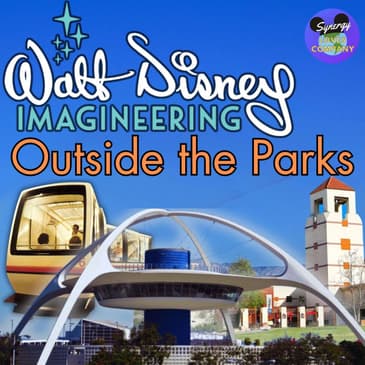
Explore Five Incredible Disney Imagineering Projects Hiding in Everyday Places Outside the Parks. You'll discover how Disney's Imagineers contributed to public spaces like the Houston Airport with the Wedway PeopleMover, the space-age Encounter Restaurant at LAX, and their work in children’s hospitals with interactive and comforting environments. Eric discusses Port Discovery Children’s Museum in Baltimore, where Imagineering created educational and interactive exhibits, and details how they brought immersive storytelling to the Autry Museum of the American West in Los Angeles. The episode offers an inside look at how Disney’s unique approach to design and storytelling can be found in airports, hospitals, museums, and more. Find me on socials to share your favorite Disney Imagineering space outside the Parks! Maybe it's not even one from this episode.
Thanks for Enjoying Synergy Loves Company! https://www.synergylovescompany.com
Donate to the show: https://ko-fi.com/synergylovescompany
Youtube: https://www.youtube.com/@synergylovescompany Bluesky: https://bsky.app/profile/erichsynergy.bsky.social
Facebook: https://www.facebook.com/synergylovescompany Instagram and Threads:https://www.instagram.com/synergylovescompany/
00:03 --> 00:05 Synergy Loves Company.
00:10 --> 00:34 We have this coterie of rich franchises, the company now that people want to engage with. I came here to try and continue what Walt Disney and his associates set in motion 50 years ago, which is to experiment with every new and innovative kind of entertainment possible.
00:40 --> 00:53 It's what they hope to do here, to really develop something that, well, just more than an entertainment enterprise, it's something that contributes in many other ways.
00:59 --> 28:31 You know those magical moments you expect experience while immersed in the theming of Disney parks. The incredible attention to detail, the seamless storytelling, the way everything just works to create pure wonder. The Disney parks give us a great imaginative escape from the mundane places that we visit in our everyday lives. Well, what if I told you that some of that same Disney magic is hiding in plain sight and, and exists in those places that you visit every day? Places like airports and hospitals and museums. Hey, this is Synergy Loves Company where we explore how Disney connects to everything. So you can connect to Disney even when you can't be at the parks. I'm Eric and today we're diving into something incredibly special. Something exactly like I just said, we're checking out some Disney Imagineering projects that took place outside the Disney theme parks. Walt Disney Imagineering is the creative force behind the design and the development of Disney's theme parks, their resorts, their cruise ships and all the attractions around the world. It began in 1953 as WED Enterprises, named after Walt Disney himself. Wedding Walter Elias Disney WED. Walt created WED as a separate kind of secretive division of his company. Bringing together a hand picked team of artists, engineers, architects and storytellers to bring his revolutionary idea of Disneyland to life. The truth is a lot of them were just the animators that he coerced into these new new positions as these people who would make a theme park, even though they never did. But this multidisciplinary team blended art and technology in a way that had never been done before. It even helped get that term imagineering. A combination of imagination and engineering. Over the decades, Walt Disney Imagineering has become synonymous with the immersive storytelling and, and the innovative design they've been responsible for. Iconic attractions like Pirates of the Caribbean, the Haunted Mansion, Space Mountain and of course the groundbreaking epcot center in 1982, which somewhat realized Walt's dream as a city of the future, but instead kind of turned it into a forward thinking showcase of innovation and culture. Imagineers also brought Disney's vision into new territory with parks and like Tokyo DisneySea, Disney's Animal Kingdom, and in innovative lands like Star Wars. Galaxy's Edge. Today, Walt Disney Imagineering continues to push creative and technological boundaries, blending cutting edge technology with deep narrative experiences to bring the magic of Disney to life across the globe. But imagineering actually does more than that. You see, while most people think Disney Imagineering only creates magic inside the theme park gates, they've actually been quietly transforming everyday spaces into extraordinary experiences for decades. As someone who loves helping fellow Disney fans find the magic in their everyday lives, I can't tell you how excited I am to share these hidden gems with you. We're about to explore some remarkable projects where imagineers brought their creative genius into the real world. Maybe even a city near you. And trust me, some of these will blow your mind. All right, here we go. Join me in counting down five incredible places where Disney Imagineering left their mark outside the park. Number one, the Houston Airport WEDWAY People Mover. Let's start our journey out in Houston, Texas, where Disney brought their transportation expertise to solve a very real problem. Back in 1981, the Houston International Airport needed an innovative way to move passengers between terminals. And who did they call? The same team that created the People Mover at the Disney Parks. The Disney People Mover came out of an idea that started with the Ford Magic skyway at the 19641965 New York World's Fair. It was actually inspired by the Ford plant in Detroit. The way that cars move down the assembly line. Disney Imagineers designed the wedway ride system for the Magic Skyway to be propelled by tires rotating in the track instead of on the vehicle itself. There were a lot of tires to make the track, like so many. In fact, Goodyear eventually sponsored the Wedway People Mover when it came to Disneyland. Ford didn't want to continue the sponsorship or they didn't want to move the Magic Skyway to Disneyland. In fact, Ford and Disney didn't necessarily always get along. I guess that's why Chevy is always the sponsor of the car themed attractions like Test Track now. But anyways, Ford didn't want to move it. Goodyear stepped in. So the ride system of the Magic Skyway got implemented on its own as like this touring attraction of Tomorrowland. The term people mover was actually around this time starting to be used for similar transportation projects by other companies for use in commercial and public transportation. Walt Disney saw the potential in the WEDWAY of for a practical public transportation functionality. He incorporated the WEDWAY People Movers into his vision for epcot, the experimental prototype community of tomorrow. That vision he had for a city of the future he passed away before his version of EPCOT could be made. But the imaginaries continued to develop and evolve. The Wedway People Mover concept for Walt Disney World. In 1975, Disney Imagineers installed a version of the people mover that used a linear induction powered ride system, even though it wasn't tires. Once again, the movement is in the track, not the vehicle. But this one features a moving magnetic field that activates along the track to propel the people mover vehicle. And this new magnetic linear induction system was the one where Disney saw potential. The potential to sell to outside customers. Disney could be a people mover manufacturer and seller. They just needed some clients who needed to move some people. In the early 1980s, Houston Intercontinental Airport, now known as George Bush Airport, needed a system that would function as a subway to bring passengers to their terminals. And they hired Disney to build the first and only wedway people mover system outside of the Disney parks. The Imagineers designed a system that transported over 68 passengers daily. They didn't just create a functional transit system. They incorporated elements of their theme park expertise, making the journey itself part of the experience. Disney never sold another WEDWAY peoplemover. The Houston one is the only one they ever sold to an outside customer. So if you ever took a ride at the subway at George Bush Airport, you rode the sibling of the Walt Disney World Tomorrowland Transit Authority Peoplemover, a Disney attraction hiding in plain sight in Houston, Texas. Now that we moved our people over in Texas, let's take a flight from Houston to LAX to find our next imaginary project outside the parks. Number two, the Encounter restaurant. LAX's space age dream restaurant. At the iconic theme building at LAX in 1997, Disney Imagineers transformed the upper level into the Encounter Restaurant, a retro, futuristic dining experience that would make the Jetsons jealous, but. But with a lot of 1990s flair. It could be argued that modern themed dining experiences were somewhat pioneered by Walt Disney's Imagineers of WED Enterprises. Developing restaurants for the intricately themed lands of Disneyland. Frontierland's Golden Horseshoe Saloon brought you the Wild West. The Carnation Cafe, a turn of the century restaurant right on Main Street. And I have to mention that the Enchanted Tiki Room was originally planned as a restaurant, but changed to a show only when Walt first realized that real birds above, well, you know, that would get messy. And when they were, you know, switched to audio animatronic birds, well, you know, people wouldn't want to leave their tables. They'd want to watch the show. By the 1990s themed restaurants weren't just in theme parks. They were all over the place. You had your Hard Rock Cafes, Planet Hollywood, Rainforest Cafe. But Disney still had it too. In the 90s they were still the best in my opinion. In the 90s we got Disney's Hollywood studios Sci Fi dine in a 1950s drive in themed restaurant where you get to eat in tables shaped like classic cars while you watch a drive in movie. It is my favorite for theming. So when Los Angeles World Airports Law needed a new restaurant concept for the theme building at lax, they turned to the best Walt Disney Imagineering. The theme building had been there a while. It was built in 1961 and designed by architects Paul Williams, William Pereria, Charles Luckman and and Welton Beckett. Welton Beckett also designed the Contemporary Resort at Walt Disney World. The theme building though was a symbol of the jet age and the space age and mid century Googie architecture. It had giant arches to support a UFO like structure that soars above the airport, giving 360 degree views of planes taking off and landing as well as the Los Angeles skyline and the surrounding area. It was originally intended as the control tower, but a change of plans turned it into a super cool swanky 60s restaurant and by the 90s it was feeling a little dated and Law asked Disney Imagineering to give it a modern refresh while still respecting the mid century Googie style of its exterior. Walt Disney Imagineering, led by imagineer Eddie Soto, created an otherworldly atmosphere with glowing lava lamps and light shows, floating UFO shaped platforms and a cosmic sound design soundtrack. The restaurant's pulsing colors of lights and space age decor made waiting for your flight feel like an adventure, an experience, an encounter all in itself. Though it closed in 2013, it remains a perfect example of how Imagineers could turn an ordinary space into something extraordinary, like a little bit of Tomorrowland in the middle of LAX Airport. Next up we go from the airports to another municipal mainstay that can be a very intimidating experience, especially for children. The Hospital Number three Healing with Disney Magic at Children's Hospitals all around the United States Disney Imagineers have partnered with tons of children's hospitals around the United States, including La Robita Children's Hospital in Chicago, the New York Presbyterian Children's Hospital and Children's Hospital Los Angeles to create environments that promote healing through imagination. Ever since Disney broke it big with Mickey Mouse, the company has used its iconic characters to comfort and ease the experience of children who have had to go through a scary and uncertain hospital stay. In the 1930s, Walt Disney himself would visit children in local hospitals and bring with him drawings from studio artists or even the latest Disney animated feature to screen for the kids. Just after the Disney Studios moved to Burbank on Buena Vista street, the Providence St. Joseph Medical center opened up just across the street, making it easier than ever for Walt and Disney Studio artists to visit kids in the hospital there. And by 1960, Walt Disney sat on the board of the Children's Hospital of Orange county, not far from Disneyland. Even after Walt's passing, the Disney Company found more ways to help comfort kids who have been hospitalized. They started working with Make a wish in the 1980s and have been the largest wish granter ever since. But even more recently, the whole Walt Disney Company has gotten involved in renovating children's hospitals to bring a little Disney magic to lighten what can be a very scary experience. Disney consumer Products provides Disney books, toys and clothing to patients. The Disney studios still, just like Walt did back in the day, they still bring the latest Disney animated films to screen for young hospital patients. And the theme parks, well, they bring their walk around characters to greet and cheer up the children at the hospital. But what about Imagineering? That's what we're talking about today. Imagineering has used their expertise to bring Disney experiences to these children's hospitals. They've designed play places for waiting rooms that are themed to Disney and Star wars properties. These offer a familiar franchise face when children arrive at the hospital. Imagineering has also developed magic windows. These windows are screen based and offer children a glimpse into the worlds of their favorite Disney movies or out into nature. Just different sights that they wouldn't normally see out their windows. These interactive windows and screens even allow children to interact with Disney stories and Disney characters in a pilot program. When testing out these Imagineering flourishes, Imagineering actually installed a copy of Turtle Talk with Crush from California Adventure and Epcot into the Houston Children's Museum. In addition to these windows, they've also designed interactive walls that respond to movement, installed whimsical art that tells stories, and created spaces where medical equipment seems less intimidating. And the best part, these magical touches are still bringing comfort to families every day, proving that Disney's ability to create joy extends far beyond the entertainment and the theme parks. Let's take a look though, at another space where Imagineering designed for children's enjoyment. The Children's Museum number four, Port Discovery. Baltimore's hidden Disney treasure. Let's not get this one confused with Port discovery in Tokyo. DisneySea. Port discovery is an interactive children's museum in Baltimore, Baltimore, Maryland. Children's museums, science centers and interactive exhibits are all in that lovely portmanteau we Disney fans know and love. Edutainment. And perhaps the best example of edutainment was that EPCOT we got back in 1982. It was educational, yet highly entertaining. Rides, shows and experiences gave guests to EPCOT a healthy dose of knowledge, but also kept us on the edge of our seats. Thanks to all those cutting edge interactive technologies. Who knew that learning about the universe of energy or all about communication and spaceship Earth or how to truly live with the land could be the most fun that you've had at a 1980s theme park. Not to mention the globe trotting experience where you could visit a dozen countries in one afternoon without a real passport. EPCOT set the standard for edutainment and tons of museums followed suit all over the United States and around the world. And by the 1990s, cities across the United States had their own museums full of edutainment temples devoted to science through cutting edge interactive exhibits. But the museums that needed interactivity the most were children's museums. Museums and kids don't always mix. Heck, even EPCOT kids don't always mix. As fun as Edutainment in the World Showcase can be for grownups, the kids always want to head back to the Magic Kingdom. Children's museums need to be very hands on, super interactive. They need to give kids the opportunity to play while learning. In the mid-90s, when Baltimore moved its Children's Museum into the old Fish Market building in Baltimore's Inner harbor, they asked Disney Imagineering to give them a hand. Imagineering jumped at the opportunity, seeing this as a laboratory to try out some themed entertainment ideas that they had Brewing. In 1998, Port Discovery's Children's Museum in Baltimore got the full Disney treatment. Imagineers worked their magic to create interactive exhibits that combine education with pure fun, especially for 6 to 12 year olds. They design spaces that encourage exploration and learning through play, including a three story urban tree house called kidworks where children can climb, crawl, jump and swing. Another exhibit was called Adventure Expedition where you traveled back in time to the 1920s and in the midst of Egyptomania when Egypt was taking the world by storm. In the experience, you would be immersed in an Egyptian dig site. You would cross the Nile and explore the opening of a pharaoh's tomb and learn all about hieroglyphics. Yet another exhibit that they had was Misperceptions Mystery House, where kids could take on the role of a detective to solve the Mystery of where a family had been disappeared to. The strange house was done up all in askew angles and had clues hidden all around. And child detectives would have to explore the strange house and come up with an answer as to where the family went. Port Discovery opened up in 1998 with these Disney attractions the same year as Disney Cruise Line first set sail. And Port Discovery has a heavy port and nautical theme. There's some giant ship decor that's not that different from the iconic Disney Cruise Line look. I almost wonder if Disney Imagineering's eagerness to work on this project was to help develop on cruise kids Club experiences, the ones that they already had brewing. Although the mystery house is long gone, the Port Discovery Museum still carries some of those special Disney touches today, like Adventure Expedition, the Egyptian Experience. And that shows how imagineering's principles can transform educational spaces from one museum to the next. We're moving from Port Discovery on the east coast across the country to number five, the Autry Museum. Reimagining the American West. Tucked into Griffith Park, Los Angeles, Disney imagineers helped bring the American west to life. At the Autry Museum, they applied their legendary storytelling techniques to create immersive exhibits that make history feel alive and relevant. Disney Imagineering was great with edutainment. We just kind of talked about that with Epcot to Port Discovery, making them the go to for museums. But the tipping point for this one wasn't necessarily edutainment. It was how well Disney did the West. Disney Studios had produced over 50 Western movies starting in the 1950s. And what was better yet, Disney Westerns were for the whole family. And of course, when Walt used his imagineers to come up with the worlds of his movies in real life for Disneyland. And they needed a Western representation and we got Frontierland. Frontierland would be the blueprint that Gene Autry would cite when turning to Walt Disney Imagineering and looking to build a museum of the American West. Using the same principles that make Disney attractions so engaging, Imagineering designed spaces that transport visitors through time while maintaining historical accuracy. When the Autry Museum of the American west first opened its galleries in 1988, Imagineering was responsible for the overall layout and design of the space. There were also seven permanent galleries designed by Walt Disney Imagineering, all of them starting with the phrase the spirit of opportunity, conquest, community, cowboy discovery, romance and imagination. Over the years, some of these have fallen off and others have been reimagined with the help again of Walt Disney Imagineering. One of the tricky parts for a Museum of the west presented by Disney and Hollywood's Gene Autry is playing a balance between the real events and life in the west, as well as the romanticized Wild west of the screen, and both are represented here. Imagineering designed serious staged exhibits to explore opportunity and conquest, and also made interactive spaces that explored romance and imagination, like the west of the Movies or Disney's Frontierland. The Autry Museum is still there in Griffith park today, across the street from the LA Zoo and not far from Disney's Carrollwood Barn. That was where Walt used to keep his trains, and also not far from the Griffith park carousel. That, as the story goes, sparked Walt Disney's interest in creating a theme park, which led to the creation of WED and Imagineering and Disneyland. These five incredible projects show us that Disney magic isn't confined to the theme park boundaries. The same creativity, innovation and attention to detail that makes Disney Parks special have touched countless everyday spaces across America. Now I know there are so many more Disney Imagineering projects out there in the world around us and and beyond the theme parks, and I'd love to hear about them from you. Have you experienced any of these spaces or do you know of any others I should cover in a part two of this episode? Remember, sometimes the most magical Disney experiences happen outside the park gates. You just need to know where to look. Thanks for joining me for this look into Disney Imagineering projects outside the parks, and if you're still listening, you're my kind of person and I've got some exciting news to share with you. I also create a video version of this podcast on YouTube. It's the same show, but it just has some visuals to go along with the audio. And recently my channel has surpassed 1 subscribers, a huge milestone that I am thrilled about. And to celebrate very soon, I will be hosting a special live stream. It'll have a different format, but it'll still have tons of Disney connections. And you'll even get to interact with me in real time. And if that sounds fun, make sure to follow me on social media so you don't miss the live stream announcement on bluesky. I'm rickhsynergy on Facebook, Instagram and threads. Just look for synergylovescompany now. Maybe YouTube's not your thing. I know you're listening to this. Maybe you're listening on the go right now. That's totally fine. Wherever you're listening, Apple Podcasts, Spotify, whatever. Head to synergylovescompany.com for links to everything. Make sure you subscribe to the podcast so that you don't miss any Synergy Loves Company and if you're not around for the live stream, no worries. I'll drop a recap right here in the audio feed so you don't miss a thing. Here's one more thing you can do for me. Could you tell a fellow Disney fan about the show? Bring a friend, a family member, a coworker, someone who loves Disney just as much as we do. Share your favorite episode on social media. Tag me so I can say hi. Or send them a direct link to synergylovescompany.com One more thing before we go. Synergy Love's company is supported by listeners like you, and if you'd like to support the show, check out the show notes for a link to my Ko Fi page. Your support helps me keep improving and evolving the show to bring you even more Disney magic in your everyday life. Thanks again for spending your time with me on Synergy Loves Company. And remember, Disney magic isn't just in the parks, it's all around us. So go out there and keep discovering the magic in everything.