
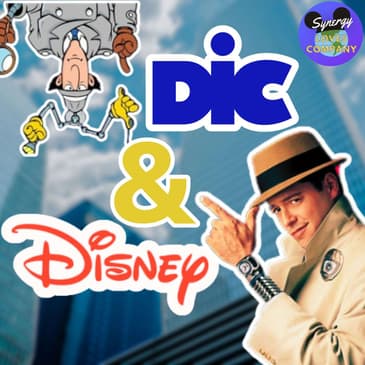
The Incredible World of DiC meets the Wonderful World of Disney
On this episode of Synergy Loves Company, Eric explores the surprising connections between DIC Entertainment and Disney, focusing on how beloved cartoons like Inspector Gadget ended up as Disney properties. The episode covers DIC’s origins in France, the company’s partnerships with prominent animation studios, and its expansion into the American TV market with hits like Heathcliff, The Real Ghostbusters, and Inspector Gadget. Eric discusses how DIC adapted comic strips, toys, live-action properties, and video games into cartoons, as well as their move into theatrical films and their collaborative relationship with ABC. Learn how Disney's acquisition of ABC Capital Cities brought DIC under the Disney umbrella, leading to projects like the Inspector Gadget live-action film starring Matthew Broderick, Meet the Deedles, and Genius, as well as animated series like Madeline and Sabrina: The Animated Series. The episode also covers DIC’s eventual sale and ties to Saban Entertainment, setting the stage for future Disney connections. If you’re interested in the history of Saturday morning cartoons, TV animation business deals, and unexpected Disney collaborations, this episode covers it all.
Thanks for Enjoying Synergy Loves Company! https://www.synergylovescompany.com
Donate to the show: https://ko-fi.com/synergylovescompany
Youtube: https://www.youtube.com/@synergylovescompany Bluesky: https://bsky.app/profile/erichsynergy.bsky.social
Facebook: https://www.facebook.com/synergylovescompany Instagram and Threads:https://www.instagram.com/synergylovescompany/
00:04 --> 00:06 Go Go Gadget Synergy.
00:10 --> 00:34 We have this coterie of rich franchises, the company now that people want to engage with. I came here to try and continue what Walt Disney and his associates set in motion 50 years ago, which is to experiment with every new and innovative kind of entertainment possible.
00:40 --> 34:02 It's what we hope to do here, to really develop something that, well, just more than an entertainment enterprise, it's something that contributes in many other ways. Like every other kid in the 80s and 90s, I loved to watch cartoons. And the best time to watch them was either in an after school block or on Saturday mornings. Of course, there were great Disney ones. I liked to watch originals like the Gummy Bears, new spins on old characters like Chip and Dale, Rescue Rangers and Tailspin. And then there were the adaptations of Disney's animated features like the Little Mermaid and Aladdin. I loved all of those. But to tell you the truth, one of my favorites wasn't Disney. One of my favorite cartoons growing up was the real Ghostbusters. Like the guys in the movie Ghostbusters. I know it's a universal property kind of thing, but like, I just loved the Ghostbusters so much and I love their cartoon show. We even had an old VHS tape where my parents had recorded some of the episodes from tv. And I could watch them whenever I wanted to rewind the tape and watch them all over again. But then at the end of each episode, there was this thing that always happened. There would be this little video of a kid lying in bed. And then the camera would shoot out of his window to reveal a twinkling star in the sky. And underneath it would appear the letters dic And a voice would say, deke. I started to notice this at the end, end of more and more of the cartoons that I watched. Heathcliff, G.I. joe, Rainbow Brite, Captain Planet, and of course, the crown jewel of Deke Entertainment, Inspector Gadget. Wait a minute. Wait. Do you remember when Inspector Gadget was a live action dark Disney movie? Walt Disney Pictures presents Inspector Gadget starring Matthew Broderick. It was billed as a summer family blockbuster. There were McDonald's Happy Meal tie in toys where you could get different parts of Inspector Gadget, like an arm and a leg and his torso. And then you could put the toys together to build your own Inspector Gadgets. It was kind of weird because if you didn't get them all, you might just be left with an arm or a leg. And the movie itself even had a special Disney castle intro with a gear wheel motif. So how did DIC's animated classic cartoon show become a live action Disney movie. Hey, this is Synergy Loves Company where we explore how, how Disney connects to everything. So you can connect to Disney when you can't be at the parks. I'm Eric and today we are taking a look at how the wonderful world of Disney got all tangled up with the incredible world of DIC and brought Inspector Gadget into the Disney cinematic universe. And to get to that story, we have to go back in time to France in the 1970s. In 1971, Jean Chalopin had been working as a French media advertiser and had made a deal with a Luxembourg based media company to make animated children's television programming that would air all around Europe. The company would be called Diffusion Information Commercial or DIC. Deke. Throughout the 70s and into the early 80s, Jean Chalopin developed and wrote a number of animated children's television series that were often outsourced to Japan for the animation work. DIC's partnership with anime studio Tokyo Movie Shinsha gave many DIC programs an anime flair. Out of this relationship, we got animated series like Ulysses 31, a sci fi take on the Greek classic Homer's Odyssey. It was sci fi because that was new and entertaining in the late 70s and early 80s, but it was based on the classics because France required children's programming to be educational. So basing it on something classic would be enough to count. Adaptations would somewhat become the bread and butter for dic, but they would continue to develop new show concepts as well. In 1982, American animator Andy Hayward took an interest in Deke. Andy Hayward had worked as an assistant under Joe Barbera of Hanna Barbera, the kings of the Saturday morning cartoon in the 70s. Throughout the 1960s and 1970s, Hanna Barbera produced a majority of the cartoons that kids love to watch on TV in the United States. Andy Hayward saw Deke as a way that he could start his own television animation empire in the United States. He'd just have to bring it over. Hold on a second, really quick. I want to talk about Deke's name again. Deke has had so many different name shifts over the years. Deke Entertainment, Deke Audio Visual. The incredible world of Deke. There's. There's even more all of them though have in common DIC or Deke. We're just going to go ahead and keep calling the company DIC just to keep it less confusing as the company shifts and changes over the next few years. Andy Hayward bought out the shares of Deke from that Luxembourg based media company, the one that co Founded it with John Chalopine, putting him Hayward in business with Chalopin. And then Andy Hayward set up a satellite office for Deke in the United States in Burbank, California, just down the street from the Walt Disney Studios. But hold on a second. We're not ready to talk about Disney yet. We're still talking about television animation in the early 80s. Disney is above that at this point. They're making theatrical animation, not this lower quality made for TV stuff. Well, at least yet they're gonna eventually. Over in TV animation land, Andy Hayward was looking to develop a program that would launch Deke for American audiences. And in 1983, Jean Chalopin, along with Bruno Bianchi over in France, co developed with Hayward over in America a series that was kind of like the American television detective comedy series Get Smart. But instead of the main character just having some gadgets to use to help solve the mysteries in fight crime, in this animated one, the main protagonist would be the Gadget himself. A kind of like, friendly cyborg robo detective. Inspector Gadget not only took inspiration from the popular Get Smart series, they even got the same actor who played Maxwell Smart on Get Smart, Don Adams, to voice the protagonist, Inspector Gadget. He would have this special catchphrase. He would say, Go Go Gadget. Like it. Like, if he wanted to, like, fly around, he could say go Go Gadget Copter, and a helicopter would like, pop out of his head and he could fly around with it. The bumbling Inspector Gadget was accompanied by his niece Penny, and their super smart dog brain. Each episode, they would try to stop the evil MAD crime organization. Led by the faceless rumbling baritone voice and single clawed hand of Dr. Claw. The show was released in syndication and quickly became a smash success for American audiences. Just as they were hoping, Inspector Gadget hit the top five of most viewed children's shows in the United States in its very first year. And it would continue to be a success and run for a total of 86 episodes across two seasons and then continue airing in syndication for years and years after its initial release. The huge hit Inspector Gadget proved Deke's viability for the US Market and opened doors to growth. And of course, they continued to make more original programming. But like I said earlier, Deke really leaned into pop culture cartoon adaptations. They adapted comic strips like Heathcliff, as was the fashion in the 1980s. They adapted toys into cartoons like Popples and G.I. joe and Teddy Ruxpin. They adapted live action entertainment into cartoons like the real Ghostbusters, Hulk Hogan's Rock in Wrestling. And the new Kids on the Block even got a deep produced show. They even tried making their own adapted live action children's programming like Zoobily Zoo with Hallmark and Hey Vern, it's Ernest, starring Jim Varney as Ernest, a Disney star in his own right. Did you check out the episode I did on Ernest and Jim Varney in Disney? You should. Let's get back though, to the DIC adaptations. They adapted video games like the Super Mario Bros. Super show, the Legend of Zelda and Sonic the Hedgehog. They even adapted greeting card characters after the American Greetings Care Bears movie outshined Disney's Black Cauldron in the summer of 1999. 1985. Dethroning the theatrical animation kings, Deke adapted the Care Bears for television. Deke also adapted Hallmark's Rainbow Bright into a cartoon. And when Hallmark saw what the Care Bears for American Greetings had done at the box office, they enlisted Deke to help them make a Rainbow bright theatrical film, 1985's Rainbow Brite and the Star Stealer. In 1985, DIC released their first two theatrical films, that Rainbow Brite 1 and Here Come the Littles, based off of their original series, the Littles, that launched on ABC around the same time as inspector gadget in 1983. Even though DIC diversified with movies and live action television shows, they did stick to what they knew best, television animation. Deke did a lot of syndicated shows that could be picked up by any network in a viewing market who was willing to pay. But they also would work with individual networks to develop animated programming for cbs, NBC and especially abc, the American Broadcasting Company. ABC had been the first network to work with Deke in 1983 on the Littles. But the relationship didn't end there. The Littles got that ABC produced movie, and Deke developed tons more programming for abc. And of course, some of the ABC affiliates picked up syndicated DIC programming. All right, all right, we got all the players set up, we got Deke, we got abc, and you know, this is a Disney show. So now let's get down to business. Like the business deals. In the early mid-1980s, while Deke was developing into a Saturday morning juggernaut, Disney was going through some tough times and through the shakeup that would bring Michael Eisner and Frank Wells on board in 1984. In 1985, after ABC had developed a relationship with Deke, a company called Capital Cities acquired abc, creating a new company, ABC Capital Cities. Can you feel it coming, Disney fans? In 1987, Andy Hayward, the animator who brought Deke's North American offices online, bought out the whole company and moved its headquarters from France to the United States. In order to do this, though, he took on a lot of debt. He had to sell off some of Deke's assets. Chaim Saban of Saban Entertainment, you might know him from the Power Rangers. He bought the international rights to the Deke catalog, and then he sold some of them back to Jean Chalopin, the original co founder of Deke. And that kind of made some bad blood with Andy Hayward. But they still kind of all work together, but they're like frenemies. It was a whole thing. Heim Saban, though, had actually been working with DIC since the beginning. He wrote the theme songs to tons of the DIC shows, including Heathcliff and Inspector Gadget. And Chaim Saban's got a big Disney connection too. Well, are you subscribed? Maybe right now you should take a moment to subscribe so you don't miss a future episode like that one. And in the near future. All right, let's get back to business. By the time the 1990s rolled in, Disney was back on top of the animation throne with renaissance classics like the Little Mermaid, Aladdin and Beauty and the Beast. It was the Disney decade. And Disney also seeing that television animation was in a boom, they started getting into television animation as well. And they had developed an entire programming block. The Disney Afternoon. Disney was becoming another competitor to Deke. After school and Saturday morning children's programming blocks were in a golden age in the 1990s. Deke continued developing new shows for television into the 1990s. And TV was still great, but the home video VHS tape was king. Kids could watch their favorite shows, rewind, and then watch them all over again. I know I did. And Disney had developed a great distribution arm for those home videos that dated all the way back to the Ron Miller era. Disney's Buena Vista Home Video was exactly who Deke turned to when. When they wanted to distribute Deke Animation on vhs. It was a big deal. And commenting on this business deal, the Disney president of Theatrical and Worldwide Video, Bill Mechanic, said, we believe Deke is not only one of the leading producers of animation, but also complementary to the product that we're presently releasing, which basically translates to they make cartoons, we make cartoons, we'll put them all on a videotape, and we're all gonna make lots of money. DIC was still making tons of cartoons, but now there was a lot of competition from other children's Programmers like Saban, who had the rights to much of the DIC back catalog and was making his own stuff. And Disney, who was making money off of Deke Distribution but also making their own stuff. And Jean Chalopin, who had originally started DIC in France. Even he started a competing animation studio called C and D after Hayward had bought him out of Deke. There was more competition than ever and it was becoming harder for Andy Hayward to recover from the debt incurred by his 1987 buyout. ABC Cap Cities was trying to get into the cartoon game and they set their sights on the prolific cartoon maker D. ABC Cap Cities bought a majority stake of Deke to help them make more children's programming and help diversify the ABC Cap City's portfolio. Andy Hayward stayed on board and kept the remaining 5% of Deke. All right, Disney, here we go. By 1995, Michael Eisner wanted to buy a television network to give Disney a more rounded out entertainment portfolio. Michael Eisner would turn Disney into a multimedia corporation. And television was one of the things it was missing. After reaching out to all the major networks, Eisner finally settled on a deal with ABC cap cities. In 1996. Disney became the owner of the American Broadcasting Company and all of its subsidiaries. And there were a lot of them, some of them pretty high profile like ABC television stations and radio stations, and then there was espn and then there were some parts of the company like Deke that Disney didn't really even know that they were getting at all. But any way you slice it, Deke was now a subsidiary of Disney whether they knew it or not at first. Well, when the dust of the deal settled, they figured it out that Deke was theirs. And Disney pretty much let Deke continue to operate independently, which was the deal they had with abc. Deke could still make syndicated shows and they could work with other networks, but Disney would get a first look option on any Deke projects. Deke, seeing the possibilities under a company like Disney, launched a new movie focused arm, DIC Films. The first movie DIC Films and Disney ever Produced together was 1998's Meet the Deals. And you guys, guys, Meet the Deedles is, well, it's not very good. And I know there's gonna be some Meet the Deedles fan out there who's like, no, it's the, the best, but it's, it's not very good. Meet the Deals is an attempt at a wacky live action comedy movie produced by Walt Disney Pictures and Deke Entertainment, centered on Phil and Stu Dietle. Who are played by Paul walker and Steve VanWormer, two wealthy thrill seeking surfer twins from Hawaii who accidentally find themselves in Yellowstone National Park. They're mistaken for park ranger recruits and the clueless but good hearted brothers must stop a disgruntled ex ranger's bizarre plot to reroute Old Faithful. With over the top antics and some colorful characters and total 90s extreme sports vibes, the film aimed for slapstick fun but received pretty lukewarm reception. It became more of a cult curiosity rather than a hit. I don't think I'd even call it a cult classic. Scratch that lukewarm reception. I think it's maybe too kind. Disney and Deke spent $24 million to make the movie and it only made 4 million back at the box office. I remember watching this one when it first came out and I was the target demographic and I I just wasn't a big fan. Except for its one saving grace, it had a really ska heavy soundtrack and I do love me some ska so that part was pretty awesome. I do think I am going to have to give Meet the Beatles a second look. It's been years since I've watched it, but you too can give it a look on Disney plus. It's it's actually streaming there anyway. Disney being burnt by the D wanted to make sure that their next Deke Films collab would be a hit. So DIC pulled out its ace in the hole. The hit they had already produced over 15 years ago. Inspector Gadget. Inspector Gadget would be a star studded blockbuster affair. The film stars Matthew Broderick as the lovable but bumbling security guard John Brown, who becomes a high tech cyborg crime fighter Inspector Gadget after a near fatal accident with the help of an array of Gadget filled enhancements and his genius niece Penny, played by the late Michelle Trachtenberg. Gadget takes on the villainous Sanford Skolix, better known as Dr. Claw, played with unfortunate campy flair by Rupert Everett. Inspector Gadget co creator and DIC's own leader Andy Hayward, even makes a cameo in the movie as Mr. Dic or Mr. Deke. The movie features slapstick humor, flashy effects in a very cartoonish tone, but received not so good or maybe mixed reviews, gaining only a modest following for its nostalgic charm. And the mixed reviews came from critics and fans alike. Some of the poor reception came from messing with the nostalgia that people had for the source material. Okay, okay. There's always going to be people who object to a movie adaptation of a cartoon or a novel or a comic book. I'm looking at you Marvel fans, but there are some big flaws with this movie compared to the source material. Matthew Broderick is a great actor and performers in roles that he was meant to play like the Producers and Ferris Bueller's Day off. But he was too straight laced and not bumbling enough to manage the inept zaniness and physical comedy of the character of Inspector Gadget. At one point I guess they wanted to cast Brendan Fraser, but he opted not to because he was already signed on with Disney's George of the Jungle, another cartoon portrayal. I don't even know if any of that would have helped because the fatal flaw of the movie is that they showed you Dr. Claw. Throughout the whole TV series we only ever heard his low rumbling voice and saw the claw. Like you'd catch a glimpse of the metallic claw from behind his chair. But Rupert Everett was signed on and he wanted some screen time. He even made it on the movie cover Art fans hated this. Disney's Inspector Gadget had too many missteps and it just made this movie kind of a flop. I mean, it made its money back, but it took a while and just barely. It made Disney not really want to tap Deke for any new big future projects. Disney only made one more movie with Deke and it was a made for TV. Disney Channel Original Genius is a 1999 Disney Channel Original movie that blends teen comedy with sci fi flair. The story follows Charlie Boyle, played by Trevor Morgan, a 13 year old physics prodigy who enrolls early at a prestigious university to work with his idol Professor Krichstein on an anti gravity project. To fit in and experience normal teen life. Charlie creates a cool alter ego named Chaz and secretly attends a nearby junior high where he tries to impress a girl named Claire. As Charlie juggles his double life, things spiral out of control, leading to classic Disney Channel hijinks and a lesson about being true to yourself. Genius became a fan favorite among early 2000s Disney Channel viewers. But Deacon Disney didn't just work on movies, they actually had some animated television collaborations as well. The first comes from one of those classic Deke animated adaptations, but if you really think of it, Disney is kind of known for adapting things too. Folk and fairy tales like Snow White and Cinderella, as well as contemporary children's literature like 101 Dalmatians and Winnie the Pooh into their classic animated features. DIC had developed a series adapting Ludwig Bemelman's Madeline books with the Family Channel, which aired on abc. When Disney acquired DIC and abc. Seeing that it would fit in really well with their brand, they moved the Madeline series series onto the Playhouse Disney preschool programming block and subsequent channel. In 1999, Deke released the direct to video movie Madeline Lost in Paris. It was of course distributed by Buena Vista Home Video and it was billed as Disney Presents Madeline Lost in Paris. Another of the opportunistic Deke series prime for Disney synergizing was Sabrina the animated series. The live action sitcom Sabrina the teenage witch premiered in 1996 on ABC. That same year that Disney bought ABC Cap Cities, Sabrina quickly became one of Disney and ABC's hit programs and a cornerstone of ABC's TGIF block. The show itself is an adaptation of the Archie comics character Sabrina Spellman. In the sitcom, Melissa Joan Hart portrayed Sabrina, coming to terms with discovering that she is a witch on her 16th birthday. All the while, her aunts Zelda and Hilda, played by Beth Broderick and Caroline Ray, teach Sabrina about their witching world with help from the talking cat Salem. Sabrina, the animated series, which also aired on abc, was an adaptation of the already adapted sitcom, but for a spin. In the animated one, Melissa Joan Hart would voice the aunts Hilda and Zelda, while Melissa Joan Hart's little sister Emily Hart would voice Sabrina. So there you go, Deacon. Disney had some synergistic collaborations, some more successful than others, but it didn't really last that long. Four years after they acquired ABC Cap Cities the year 2000, Andy Hayward had partnered up with investors to buy Deke back once again, this time away from Disney. He never intended for Deke to be part of another entertainment company. He wanted it to stand on its own. Originally, as part of the deal, Disney was going to try to retain the rights to the Deke shows that were developed during this time when they were a Disney company. Ultimately, though, Hayward and Deke retained the rights to that programming and Disney just let Deke go. I mean, Disney never totally seemed that interested in Deke. Sure, they made some movies together, but that didn't really go so well. And besides, one year later, Disney would actually become the owner of a bunch of Deke's international back catalog thanks to a deal that Disney would make to purchase Saban Entertainment. Remember Heim Saban? Okay, okay, I'm going to do it. Next time on Synergy Loves Company. Saban and Disney, we're going to talk some Power Rangers. Make sure you're subscribed so that you don't miss it. Thanks for joining me into this dive into that time when the wonderful World of Disney met the incredible world of Deke. If you listen to this podcast and you made it here to the end, you are my kind of person, so I wanted to invite you to something exciting. I also do a video version of this show on YouTube. It's basically the same show, but it has visuals that go along with the audio. In fact, there's a lot of little clips and images from the cartoon shows that I mentioned in this episode over there, so you could go check it out if you wanted to see a little bit more about what I'm talking about. But my YouTube channel has been growing and it just hit 1 subscribers since I hit this milestone. To celebrate, I am going to host a live stream. I know I talked about this earlier and I'm still ironing out some of the details, but I wanted to invite you to join me over there on YouTube. The live stream will have a different format, tons of Disney connections, and it will give you a chance to interact with me in real time. If you're interested in joining me for the live stream, make sure you follow me on social media, where you'll see any of the news of when I'm going live. You could follow me on bluesky, rickhsynergy, or find me on Facebook, Instagram, and threads on all of those places. I'm Synergy LovesCompany. Maybe you're not interested in checking the show out on YouTube. I'll miss you there. But I get it. You're like, Eric, I listen to this show on the go. I can't watch it while I'm driving or out for a run or something like that. That's okay. I understand. But could you do this for me? Wherever you are enjoying Synergy Love's company right now, whether that's any Apple Podcasts, Spotify, whatever it is in that podcast app, can you click the Follow or subscribe button? And then I'll drop that live stream episode in the audio feed and you will hear what went down on the live stream after the fact. I would love it if you would join me on the live stream. And it would be great if you brought a friend of yours, a family member, a coworker who loves Disney just as much as we do. Think about how much they would love this show. You know, they'd love it. Wouldn't they love it? Tell that Disney fan person about the show the next time you see them. Or maybe you could post what you loved about the show online, send a link to a friend on social media and tag me in it. So I of course can say hi. Or you could tell them go visit synergylovescompany.com it's all there. And now a word from our sponsors. Synergy Loves Company is sponsored by listeners like you. I want you to check out the link in the show notes to give back to the show on Ko Fi. You can support the show in any amount. It's a great way to show that you appreciate the work that I do to put out this show. And if you give to Synergy Love's Company, it helps me keep innovating and evolving the show to make a better program for you. No matter how you decide to support Synergy Love's Company, I really appreciate you in the time that you spent with me today. So thanks again for joining me on this adventure. And remember, Disney magic isn't just in the parks, it's all around us. So go out into the world and keep discovering the magic in everything.