
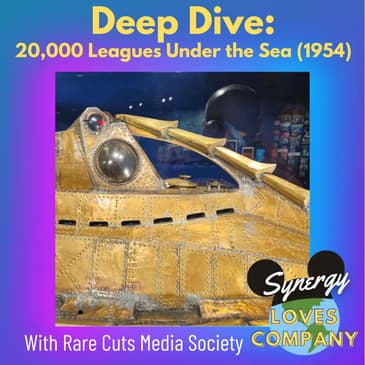
In today's episode, we're diving deep into the classic 1954 film "20,000 Leagues Under the Sea" with friends from Rare Cuts Media Society. Synergy Host Eric and the rest of the Rare Cust team, Rob Lachcik, Andrew Jagoda, and Mike Ross explore the film's iconic elements, from Kirk Douglas' unexpected musical numbers to the portrayal of Captain Nemo. They also discuss the historical significance of the movie, its blockbuster status, and its impact on Disney's entertainment legacy. So sit back, relax, and join us as we navigate the depths of this cinematic adventure! Oh yeah….and Eric takes a look at the 20K leagues experiences in the history of Disney Parks.
Visit https://rarecutsmediasociety.com for more rare cuts media society
Thanks for listening to Synergy Loves Company: How Disney Connects to Everything.
https://www.synergylovescompany.com
Donate to the show: https://ko-fi.com/synergylovescompany
Instagram and Threads:https://www.instagram.com/synergylovescompany/ Youtube: https://www.youtube.com/@synergylovescompany Twitter: https://twitter.com/EricHSynergy Facebook: https://www.facebook.com/synergylovescompany
00:05 --> 00:06 Synergy loves company.
00:10 --> 00:47 We have this coterie of rich franchises. The company now that people want to engage with. I came here to try and continue what Walt Disney and his associates set in motion 50 years ago, which is to experiment with every new and innovative kind of entertainment possible. It's what we hope to do here to really develop something that is just.
00:47 --> 00:49 More than an entertainment enterprise.
00:49 --> 00:53 It's something that contributes many other ways.
00:58 --> 02:52 Hey, this is Synergy loves company, where we explore how everything connects to Disney. I'm Eric, and thank you so much for tuning in to listen. The first time I visited Walt Disney World, I was five. But I have some vivid memories from that trip. Being scared by trolls and then going backwards on Melstrom character breakfast on the Empress lily, and going deep underwater in Fantasyland in 20 leagues under the sea. I absolutely loved that ride. The ship was dark, but the portals were bright underwater. And when the bubbles filled my little window, I believed it. I thought we were going deeper. It was adventurous and magical, and I never got to experience it again. But I thought the ride was so cool. And over the years, I have wished that there was some way I could revisit it, go back, write it again, capture that nostalgia. If only there was a way to revisit 20 leagues under the sea. I am embarrassed to admit it. I had never seen the 1954 movie 20 leagues under the sea. It's a Disney classic. It seems obvious. I love the ride so much. I might also enjoy the movie. I just never got around to it. Recently, I found myself in the perfect storm to watch 20 leagues. I'm part of another podcast called the Rare Cuts Media Society. It's a panel of four who take turns each month picking a movie, an album, a book, maybe, whatever, based around a certain theme for everyone on the panel to enjoy, or maybe not enjoy. And then we discuss it, review it.
02:52 --> 02:53 Talk a little bit about what we.
02:53 --> 03:46 Liked and didn't like. Now, I talked about that theme. All of our episodes tend to fit into a theme, and the theme that we were working on right now were movies we had been meaning to watch but never got around to. Bingo. 20 leagues under the sea. So what you're going to hear today is that podcast conversation all about Disney's 20 leagues under the sea. You might recognize some of the voices because all of the members of the rare Cuts Media society have guested on Synergy Love's company. I do have to give a quick warning. If you've never seen 20 leagues under the sea. There may be some spoilers, although I don't think anything too bad that will ruin the whole thing for you, although I know some people are touchy on spoilers. So take a listen. I'll be back at the end of.
03:46 --> 03:47 The show to tell you more about.
03:47 --> 03:53 20 leagues under the sea in the Disney parks. So here we go.
04:02 --> 04:16 Hello, and welcome to Rare Cuts Media Society, the podcast that looks at hidden media gems that even captain Nemo might find tempting with your hosts. As always, I'm Andrew Gigoda, and with me, we've got rob Lachick. How are you, Rob?
04:17 --> 04:21 I'm doing very well. I'm ready to dive to those many leagues under the sea.
04:21 --> 04:25 Me too. And we've got Mike Ross. How are you today, Mike?
04:25 --> 04:27 I just want to be a part of that world.
04:29 --> 04:30 Wrong movie.
04:31 --> 04:34 Are we talking about little Mermaid?
04:34 --> 04:35 Disney reference.
04:36 --> 04:37 Eric can appreciate it.
04:37 --> 04:38 I'm sure it's true.
04:38 --> 04:39 Indeed.
04:39 --> 04:43 And of course, we've got Eric Hathorne. How are you today, Eric?
04:43 --> 04:59 Pretty good. I am a little ashamed as a Disney fan to say that I hadn't seen this one before, making you all watch it for our theme of not movies that we haven't seen before, but probably should have.
05:00 --> 05:02 Well, we've corrected an error then.
05:02 --> 05:05 Just don't make me eat any of those under the sea delicacies.
05:05 --> 05:07 I mean, who knows?
05:07 --> 05:13 They all seem to enjoy them, so just don't tell me what's in know.
05:15 --> 05:20 I'll skip that long John Silver's trip right there.
05:22 --> 05:23 Oh, man.
05:23 --> 05:35 Anyway, like Eric was saying, it's our arc of episodes on movies we've always meant to watch but just never got around to. And it's Eric's pick, so I will pass it straight on over to him.
05:35 --> 06:11 Yes, thank you. And I did pick 20 leagues under the sea, so it's one of those that it's kind of a milestone in Disney movies, which we'll kind of get into. It was kind of a big deal at the time, and it still kind of is in the Disney fan community and Disney nerds and stuff like that, like me. But I never saw it. And it might have something to do with my fear of water movies, which is a thing that is true. But this one, I'm going to just attest to that.
06:11 --> 06:27 Just growing up with you, and I remember it was clone wars, but they go to that ocean planet where they're checking on the clones, and Eric was just like, oh, no.
06:28 --> 06:41 Now, you see, I was thinking at first of Jar Jar Binks and them going underwater, because that freaked me out. But I think I was blanking out that scene where they go to check on the clones because there's so much water and there's a storm, and now I'm getting anxious.
06:42 --> 06:44 So let's dive in. Right?
06:45 --> 06:48 So you're telling me you don't want to watch a famous Kevin Costner film either?
06:49 --> 06:50 Water world.
06:51 --> 09:09 I did watch Waterworld, and I was more fine with that. But no, this one, I will report that this one did not get me. And I think it's probably because you could kind of tell that they weren't too far offshore in a lot of the water scenes, except for, like, one of them, which they was totally done in the studio. More on that later. Did get a little freaky to me, but it was still okay. It was still okay. But yes. So 20 leagues under the sea did pass my test for being water freaky. But it's also the secret sequel to my pick from last summer when we did our 1953 series, because in that episode, we talked about how Disney created Buena Vista distribution for the Living desert, being the first Disney project released with Buena Vista. And 20 leagues under the Sea was the first Disney feature distributed by Buena Vista. So it's also kind of a cool thing. Also, Walt Disney got the idea for making this movie when he was reviewing underwater footage for a true life adventure, which kind of plays into that. So I figured instead of a Disney reference on this episode, because the whole thing's a Disney reference, I would reference rare cuts media society in the podcast as, like, a flip there. See how I did that? See how I did that? But anyways, let's get into some of our discussion. Yeah. Crickets. No, let's get into some of our discussion on 20 leagues under the sea. So it's the classic Disney live action adventure film released in 1954, directed by Richard Fleischer, who, I will note is the son of the Fleischer studios. I can't remember. Was it Max Fleischer, who was a direct competitor to Walt Disney? So Disney hired his competitor's son just because he was the right man for the job. So it's based on Jules Verne's novel of the same name, 20 leagues under the Sea. And the story follows professor Pierre Aranax and his assistant and a harpooner, Ned Land, as they join an expedition to.
09:09 --> 09:14 Investigate a mysterious sea disturbance and a possible sea monster.
09:14 --> 09:39 And very soon, they figure out that there's this advanced submarine out there called the Nautilus. That's commanded by this enigmatic captain Nemo. And as the crew explores the wonders and dangers of the deep sea, they struggle with Nemo's disdain and approach to society's destructive tendencies. The film combines thrilling underwater sequences with the exploration of ethical dilemmas.
09:39 --> 09:43 Very Disney, right, offering a captivating blend.
09:43 --> 09:56 Of science fiction and adventure set against the backdrop of the underwater world. So I got to ask, did any of you see this? Are any of you out disneying me here? And you saw this before?
09:56 --> 09:57 Slash.
09:57 --> 10:10 Has anyone read the book by Jules Verne? And when I say, has anyone read the book? And I saw Andrew make a little motion, I was definitely directly asking Andrew that because I figured he was our best bet.
10:12 --> 10:57 So I've never seen this before, but I grew up as a big Jules Verne fan. I loved and watched it with my mom all the time. The adaptation of Journey to the center of the earth with the fabulous James Mason. And that as, uh. So I hadn't seen it before and I actually hadn't read it before. So what I did was I read it in prep for this podcast because I have complete Jules for his complete works on my Kindle. And I said, well, you know what? Let me dig into this so that I'll be a little better prepared. And it did help a lot.
10:58 --> 10:58 Nice.
10:59 --> 11:09 Having said that, I could do like an entire podcast on comparing the two, but I won't do that today because that would take over your thunder.
11:10 --> 11:27 We'll definitely pop in with some of those when we can. Because one thing, I've never read it either, but one thing I have heard is that Walt Disney did try to stay pretty close as far as a two hour Hollywood movie could do that.
11:27 --> 11:28 But he did try to stay close.
11:28 --> 11:30 Is what they claim.
11:30 --> 12:17 It's a very good adaptation. And when I say that, I don't mean that it sticks really close to the novel. It does in ways, and especially early in the movie, but then it really kind of does distance itself later on because a lot of the later on stuff, and especially the Nemo, well, his end, they changed it, but they also incorporated a lot of Jules Fern's sequel to the Mysterious island, which he wrote five years later. And so that the whole know, oh, Volcania. Well, they don't call it volcania, but the mysterious island is basically volcania in the movie.
12:17 --> 12:18 Gotcha.
12:18 --> 12:23 And Nemo doesn't actually die until mysterious island.
12:24 --> 12:25 Spoiler alert.
12:28 --> 13:11 There's a lot that you could dig into in that, but as far as being a film adaptation, I think it's fantastic because it took all of the meat and bones from the book and made it a possible two hour movie, whereas if you took the book and stuck straight to it, it would be the most boring thing you've ever seen. Because I love Jules Verne, but he's so scientific. There are parts of the book that are, like, 20 pages long just telling you all of the different things he sees underwater with Nemo, 20 pages, that.
13:11 --> 13:43 Kind of coincides well with. I watched a documentary about the making of 20 legion of the sea, and the director basically is saying what you're saying, which is, how am I going to make this into a cohesive film? And so he knew he had to get the right writer on it right away to make it possible and make it so it's not just like a collection of stories and make it into a film narrative.
13:44 --> 14:04 Yeah, because the book, for 20, there are so many more little episodes that they do under the water, like Atlantis and the pole. Just crazy stuff. But you couldn't do the movie with all of that. It would be a series.
14:05 --> 14:28 Yeah, I will say the only reference that I had to, that I could speak to specifically about 20 leagues under the sea was the reference in back to the Future three, where Doc Brown and Clara are talking back and forth and about how he read it as a child. But then she makes the point of, like, it was just published. Guy, what are you talking about?
14:28 --> 14:29 Just came out.
14:29 --> 14:46 Yeah, but I had not seen the film. I did not read the book. I mean, only just kind of had it in pop culture of, like, the giant squid and big boat under the water, but never watched the different mediums or read them.
14:46 --> 14:50 Let me ask you this. Was it what you were expecting it to be?
14:50 --> 16:05 I thought it was going to be more of kind of a standard adventure film because I hadn't read the story. I hadn't seen the movie either. I had seen clips of it, and a lot of the clips I see are there's a YouTube series called Monstrom. It's a PBS thing that they do on YouTube, and their episode on the Kraken, there's a lot of footage from the movie in there. So it's like, that's my connection. I had not had any familiarity. So going into it, I think I had more of the mindset of something similar to journey to the center of the earth, where it's going to be like an expedition, and they're going to go down and explore the very depths of the ocean and discover bizarre, strange creatures I was kind of taken aback to find that, oh, it's this very vindictive person who is trying to create an undersea utopia board his ship. So it was not what I expected.
16:06 --> 17:01 Ultimately, I agree with Mike. It was not what I was expecting in the end, but it was for, say, the first 30 to 45 minutes, I think, like, getting on the boat, how they got on there, and the dining with him and eating all the crazy foods that were all from the ocean, and even to diving to harvest more food, that part really grabbed me. But I'm kind of with Mike once kind of dived into some of the other areas of how captain Nemo kind of not the greatest of characters, like, nicest of characters, if you will. I don't want to say soured me, but it was kind of like a place I didn't expect it to go, and I kind of lost interest. But it's a little bit of a downer.
17:01 --> 17:02 It took a turn.
17:02 --> 17:09 Yeah, it took a turn for. It did. It's surprising in that way.
17:09 --> 17:09 Right.
17:09 --> 17:22 Like, it's not necessarily what we'd expect from what Disney was known for making at the time and what you think, adventure. And it does get kind of moral dilemma.
17:24 --> 18:19 Like, the underwater sea footage and stuff was really cool, and I immediately was like, oh, this reminds me of the living desert and things like that. And I was like, oh, so he had a bunch of stock footage, and he wanted to use it in a movie. He's the really high end Ed Wood of the world. But honest, I got to be honest about one scene. I just want to make sure I mentioned, this is the scene where they go out of the ship to collect food, so they're collecting plants, different sea creatures, like lobsters and stuff. There's a scene where they have and are physically holding sea turtles by their fins. Yeah, I had nightmares about that scene afterwards. I was like, that's so disturbing to me.
18:19 --> 19:05 Hollywood pre animal restriction and PETA and, yeah, it definitely was not cool the way they were handling the sea creatures, for sure. All right, so enough. About 20 leagues under the sea. Let's talk about something completely different. No, just kidding. But I do want to change the subject a little, and I want to ask you this question. It's maybe a leading question. I want to ask you about what makes a movie a blockbuster movie. Maybe you have an example of when I think of a blockbuster movie and not one that you rented from a blockbuster rental place, but when you say, like, the summer blockbusters, what makes a blockbuster movie for you? What makes something big like that. That's going to be that big summer.
19:05 --> 19:10 Movie, huge budget, but equally huge box.
19:10 --> 19:37 Office blockbuster movie is one that makes me yell, wow, what a difference. Oh, man, that makes me sound aged. But no, to me, it's got to either break box office records or come close to it like they think it will. And it just almost does. It's got to be something big like that in the box office.
19:38 --> 19:54 I agree. I think the biggest definer for me is that it's very financially successful. But I will say that does not necessarily mean the film is any good, but it's just very successful financially.
19:54 --> 23:36 That's true. Yeah. And that's like, too the big event is kind of like what I feel like they make an event out of it because they've spent so much money on marketing and the movie itself and all that. So the reason I ask that is I kind of want to get us set up here because film historians would claim, they'd tell you that Jaws was the first blockbuster. I tried to figure out what was the first big blockbuster movie. And the 1975 success of Jaws demonstrated the financial potential of releasing a high profile, entertaining film during the summer when audiences were more available out of school, maybe like vacation time, those kind of things. And this success is what prompted other studios to kind of follow this, establishing our current summer blockbuster season as a lucrative and anticipated period for releasing films in the industry. But 21 years before that, Walt Disney put more money and effort into making a live action movie than he ever had with 20 leagues. He only started making live action movies to spend the money that he had tied up in Europe after World War II. They had some rules about taking money out of the countries, so he decided to make some. I'll just make some cheaper live action films in England and then I can get the money back when I release it in the States, so. But after seeing, he saw, like, he could make a lot of money off of these live action movies. He can make them quicker than an animated movie. He kind of added that to the Disney repertoire and he went bigger than ever. When he made 20 leagues under the sea. He made it a big kind of event, big budget thing. It was the biggest budget for a Disney film up to that point. And it was, I'm pretty sure, the biggest budget in Hollywood at the time, which makes me wonder if I should have picked this for rare cuts. But none of us had seen it, so I think it's still pretty rare as of today. But he projected it would take him about 5 million to produce it, but it ended up taking 9 million, like, almost twice that. And it was the most expensive Hollywood film at the time. So 20 leagues was one of the first films to truly take advantage of the new anamorphic widescreen, Cinemascope technology. So when you watch that and saw that widescreen, it's probably something we're used to today. But it was the first Disney film to do that, and it was one of the first films to kind of take advantage of using the whole widescreen and framing the shots for that size. The movie did also feature an all star cast and crew, which Disney usually didn't do. They usually kept it to more affordable stars. And it was the first Disney live action movie to be filmed at the Walt Disney studios. And because of that, they did have to build another soundstage, this one with a giant state of the art water tank, to film some of those scenes, like that one with the giant squid. But that wasn't even enough. Disney also had to rent larger studio spaces at Universal and Warner Brothers, as well as filming on location in the Bahamas and Jamaica. And when it was released in July of 1954, it was ultimately a smashing success. It made 28.2 million at the box office and it took home Academy Awards for special effects and art direction. So it got a good return on its investment, even though it was a high cost movie at the time. So is 20 leagues under the sea really the first blockbuster, or at least the Godfather of the modern blockbuster? I want to hear what you guys think of that.
23:36 --> 24:04 Well, I just want to add to one thing you said there. The advertising for this film was also one of the largest advertising campaigns a film had ever had. They went all out. That's part of the reason the budget got started creeping up. And so, yeah, to answer the question, I would say this is definitely the grandfather of the summer blockbuster.
24:04 --> 24:23 I would say it's a blockbuster, but I wouldn't call it the Godfather or anything like that. I'd call gone with the Wind the blockbuster Godfather, because it's been rereleased and things. But its box office totals 390 some million dollars.
24:24 --> 24:25 Mama mia.
24:25 --> 24:43 That was 1939, though I will say, if you look up the history of the use of the word blockbuster, it wasn't used for film until after gone with the Wind. It was used in the 40s, sometime 43, I think.
24:43 --> 24:45 There weren't any other movies out.
24:48 --> 24:51 It was only gone with the Wind for like, three years.
24:52 --> 25:00 But, I mean, with that at the same time, wizard of Oz, too, was the same year, and that was a huge success, obviously.
25:01 --> 25:04 Yeah, I never heard of that one.
25:06 --> 25:07 Come on.
25:07 --> 25:09 Sounds like a rare cut.
25:12 --> 25:17 Starring Dr. Oz. That's a rare cut right there.
25:19 --> 27:48 So, yeah, it's a good point you brought up with the advertising budget. I do want to bring up, too, that this came out in theaters right around the same time that Disney was starting the Disneyland TV show. That was like the first time they were making a show to help fund, like a show for television. Movie studios didn't used to like to do that, and they were going to use the money that they got in that deal to fund the creation of land. So this is all kind of roped into that same time as to what's going on in the Disney company. This movie's coming out. They've got the show, they're building. The park is like a big time in the Disney company. But when we're talking about these blockbusters, there have been a few blockbusters, and I'm going to continue to call this one a blockbuster now, because even if it wasn't the godfather or it was, we still said it's in that zone. But one of the things that's happening with high profile movies now, and this has kind of been something that's been popping up in the news is that musicals in movies, movie musicals are starting to come out, but the advertising is kind of downplaying the music or the musical aspect of them. And we've seen this with the new mean girls musical Wonka and the color purple musical remake. So when those movies just came out in the past, kind of like holiday movie season, a lot of people did not necessarily expect them to be musicals because of how the advertising was going. And there's this idea that maybe a musical was like damaged goods. Like, don't tell people it's a musical because it's not going to do as well as if people, for some reason, and I don't know, I love musicals, so it doesn't bother me. But I got to ask the question. Does the music in 20 leagues work in the context of the film? There's like a musical moment in the 1950s, was that just, like, more common to do versus would this still work today if you just snuck a musical number into your blockbuster movie? What did you guys think of the music in this one?
27:49 --> 29:14 It wouldn't be to that length. Like the actual Kirk Douglas Ned Land full. Like, that's a pretty big chunk of time. It's a good way to use up time. Make your film longer. It builds this character. But I don't think modern audiences are going to be as tolerant, and so they might be like a little diddy that they play really quick as they are doing a transition. But I always struggle with films that have pretty much the orchestra playing constantly, and it can be distracting from what you're watching at times. And then they were doing musical gags, too. And so there's music, then there's sing along, and then there are musical gags. And so there's a lot of musical elements that are going through this. Like when Ned land plays with conceal's hair and they make like a little xylophone sound, moving it back and forth. And it was just kind of a musical joke. I don't see people, I was thinking in context of how would this come across in a modern blockbuster movie? And it's like, I don't think it would work, but that's my opinion.
29:16 --> 31:36 Yeah, I have to agree that it doesn't work today. In the think, in this case, I would argue that not the background orchestra, but the Ned Land song and the orchestra, or, I'm sorry, organ playing by Nemo. They serve good points because Ned land, and this is also going back to the novel, Jules Verne tries to show that he's really wanting to get back to land, but that he loves sailing so much that he can't ever leave the sea either. So he needs that freedom to be able to choose where he goes. And the movie gives a little bit of that. But then the song is what really gives you that kind of characterization because he's so overjoyed while he's singing it. And you don't really get that kind of joy in the novel. But there's all these other times where they talk about adventures he's done and things like that. So I think that that helps kind of bridge that character from the novel to the movie. And then the organ playing by Nemo, it's a box tokata and few in d minor, which actually, a lot of music critics say it represents a storm. And in the movie, you could say, well, it's the storm of his emotions about his anger versus should he be killing when they were the ones killing and all that. But then also it ties into the novel, because in the novel, the end isn't he gets shot and the island and all that. It's that they get caught in a massive storm and the three of them escape, and we don't know what happens to the Nautilus. So it's good to have that as not only the show of his madness when he's sweating like crazy playing it. But also to kind of give that tie to the novel. So, yeah, I think the music for that aspect works. But like you said, Mike, the constant orchestra playing, that wouldn't really work today.
31:39 --> 32:12 I'm going to add one last thing here. So I agree about the captain Nemo playing. The organ fit so perfect into the film, right? And I think even the consistent music playing and reacting to the film, it added to the film. And it really kind of put it together. Especially the scenes underwater where there's no sound. I mean, you're going to have basically no sound for 510 minutes when they were all underwater.
32:14 --> 32:15 Just ambience.
32:16 --> 32:40 I think it kind of fit well. But I will say, if there's one thing I never see again is Kirk Douglas singing a song and playing guitar, I'm good. When I first watched the movie, I was watching it. I'm like, what is going on? It just seems so out of place. I was like, this is just weird. I don't get it.
32:41 --> 32:53 Which is interesting because, Rob, I was thinking that you would be the one who would maybe be the most comfortable with it. Since you do watch a lot of older movies. But maybe it's more of a Disney thing to put a song in something.
32:54 --> 33:06 I guess the part that got me was he is the only one who sings. And it's the only song in the entire film.
33:07 --> 33:08 And it's the only one he knows.
33:09 --> 33:11 He repeats it throughout the movie.
33:11 --> 33:15 Yeah, it's got little reprises here and there.
33:15 --> 33:44 I think it would have fit better because I think you made a good point, Mike. It ate up time to extend the film. If there were small tidbits of him as he's just killing time on the boat, like at the beginning, and he's just hanging out and he sings it for like 1020 seconds and then that's it. And then he comes back to it a little bit longer. That's his favorite song, and he likes to hum and sing it. But the whole routine and it just didn't fit, in my opinion.
33:45 --> 34:08 Devil's advocate, though, I feel like it is a product of its time. A lot of movies had little sound and dance numbers. And I feel like if they didn't have that, I could see critics or audiences be like, it's a pretty mundane film. There wasn't even a song and dance.
34:09 --> 34:31 It's kind of like a 180 from today. When you look at how people are downplaying actual full length musicals and not really showcasing the musical aspect of it. We're like, back then, people wouldn't be okay unless they got at least one good song, a good song in dance out of it. It's kind of a weird place where we are in movies.
34:32 --> 34:42 I'll throw you a curveball. How do you think the film would have fared if it was entirely a musical? Because they could pull it off.
34:42 --> 34:43 I don't know about that.
34:43 --> 34:45 They could pull it off.
34:46 --> 35:36 I think you'd have to get, obviously, the right tunes and such and all that kind of stuff. But I think they have between the beginning part that currently there, which I don't know if I care for it as much. Maybe it's Kirk Douglas. Singing is one thing, but then you have the scene of them dining. You could totally build on something there, like with all the different foods. I mean, think of, like, BR guests. Br guest type of thing. You could totally pull something off then, even under the water, because obviously in a musical, you can talk and hear each other under the water when you're singing. They would be able to pull that off. Right. But I could see it potentially landing if the entire film was a musical for me, I found that beginning.
35:36 --> 35:37 What is it?
35:37 --> 35:39 A whale of a tail, I believe.
35:39 --> 35:41 Whale of a tail. You got it.
35:41 --> 35:43 It's a great song. I'm sorry.
35:48 --> 35:52 It's like a sea shanty, right? Like, it kind of has a seashanty.
35:52 --> 35:55 I listen to a lot of seashanty, scottish irish music.
35:55 --> 35:59 So it could fit right in your playlist.
35:59 --> 36:00 Yeah.
36:03 --> 36:09 You can't currently see it on the podcast because there's no visual, but my two thumbs are down.
36:11 --> 36:19 If you're looking for another good seashanty song and tale, check out the mermaid song by great Big Sea.
36:19 --> 36:20 Well, there you go.
36:22 --> 36:30 So Rob had a problem with Kirk Douglas singing, and it might have been just Kirk Douglas. So I think this is a good.
36:30 --> 36:31 Time with Kirk Douglas.
36:32 --> 36:55 Just Kirk Douglas for real. All right, let's talk about the characters. Let's talk about the characters. We have problems with Kirk Douglas, but did you have any favorites or anti favorites, like having problems with Kirk Douglas, or did one character steal the show? Was it a good ensemble? Was it worth the money to get the big stars that they did for this one?
36:55 --> 37:48 James Mason makes a wonderful have. Sorry, I have to do that impression when I can, because that's one of my first impressions I ever did, was actually James Mason. But no, he makes a great understated madman. You get the moments where he's playing the organ and he looks insane. But most of the movie, it's just straight faced. He could be perfectly normal or perfectly out of his mind. You have no way of knowing. And that's not easy to pull that kind of just straight faced, like, super serious. But knowing the whole time that what you're doing is just. You're a madman. To me, he was the perfect casting for Nemo.
37:48 --> 38:15 And they say that he stayed in character, like, on set the entire time, even between. Like, he just stayed in that character. But Kirk Douglas, to me, it almost felt like I was watching a live action movie. Almost feels like a black and white. Like, everything feels slow. And then there's Kirk Douglas, and it just feels like a cartoon character has been inserted into this.
38:19 --> 38:28 I mean, that tracks with him being the only character singing the song. Yeah, like, that's more of a cartoon character move. I got you there.
38:28 --> 39:10 I can feel that really kind of a goofy character. Like, in reality, let's say that 20 leagues under the sea is happening in the real world. If they were on board, they wouldn't have let Kirk Douglas back on because they can see that he is going to be disruptive to what they're trying to build here. They would have let him gone, go away and drown concealed. I could see them letting stay on because, well, you're going to help the professor. And so it just didn't fit. Like, his character was so over the top and chaotic that I wouldn't see a nemo taking a chance with.
39:11 --> 39:38 That's. I agree with you, Mike. That was the one thing that gnawed at me from the point that they kept him on. I think it was not the first time they threatened to kick him off, like, right when they first got on the boat. But it was like, later on, they kind of threatened him kick off. He would have been gone, man, for how many, like, make it. Imagine how many years and how long it took Captain Nemo to get to where they were then. His crew, how many chances they did not take.
39:38 --> 39:38 Right.
39:38 --> 41:03 They did all the right things. Like you said, to keep this guy who's crazy and who knows what he's going to do. Why would you keep him on the boat? Now I know there was the whole thing of, like, the professor was like, oh, he's my guy. I got to save him. But I would have been like, sorry, professor, you're gone, too. Beat it and let you. All right. Because it just seems so. He wouldn't have gotten that far if he made those decisions in the. So I don't know. They just kind of didn't sit well with me. But I agree with Chicoto's point. I think Captain Nemo was by far the most intriguing character. I kind of likened him. He might not be where the story starts from, but it's who it's about. I kind of likened it to red and Andy in the Shawshank redemption because it's kind of like in the purview of the professor, right? In his view, he meets Captain Nemo and then it's all about Captain Nemo. So it's kind of like in a Shawshank redemption, Red starts the film. Well, not necessarily starts filming because it does start with Andy Dufrain, but it's really in the view of Red. And then Andy Dufrain comes in and it's really all about Andy through the rest of the film.
41:04 --> 42:10 And coming from the standpoint of having read the novel, I have to say Nemo very well cast, the professor very well cast, conceal very well cast because they improved on the character with Peter Laurie a lot. Kirk Douglas should not have been in it. In the book, Ned Land is the reason he basically survives through it is because he doesn't pull all that crap. He tells the professor, like, this is ridiculous. We've got a plan, whatever. But he doesn't go up to Nemo and start berating him and doing all that. He's a seaman that kind of knows, like, these smart guys are going to talk, but I got to figure something out. So that whole bravado that Kirk Douglas brings, it's not in the novel. I mean, the guy. Yeah, he wants out. He wants back to his freedom, but he doesn't do it stupidly, like four.
42:10 --> 42:45 Yeah. I wonder how much of that, though, is just Kirk Douglas because he's renowned for being a difficult actor to work with and being pretty combative if he didn't agree with lines that were written or how he's supposed to act scene. So I just wonder if that came across and he was trying to make the character more lively even though the script may not have called for. Don't. I don't know. I was just going to say I loved Peter Laurie. I mean, I thought he was a fantastic cast for the role and.
42:48 --> 42:49 It.
42:49 --> 43:34 Was nice to see him to not be cast as a bad guy, but actually someone who has become more insightful. I mean, he starts to film off as the professor's apprentice and pretty soon he starts to realize that the professor is just being taken in by this nemo with the promise of all the unbelievable things and way of life here, that he is forgetting about all the research that can be done. And Peter Lori conceal sees this, and he's trying to let the professor know. And I think he's a wonderful cast, wonderful character.
43:34 --> 43:46 I will say with Peter Laurie, I can't get out the vision of Bugs Bunny cartoons and Peter Laurie whenever I see him. Come on. Not going to lie.
43:47 --> 44:49 Oh, man. So we kind of figured out that Nemo, James Mason's nemo, kind of steals the show. He becomes the object of the movie, the one that we're looking at. We kind of talked about it at the beginning with, was it what we expected? But this got deeper than I thought it was going to get in. The morality and the talking about have the. I got to know what you guys think was Nemo from the movie. And maybe, Andrew, you could give us some insight from the book, too. But is Nemo a misunderstood vigilante like a Batman in that he's trying to stop kind of these heinous crimes against humanity as he views it? Or is he an evil supervillain like Elon Musk? I mean, Lex Luthor? I did go there. What do you think?
44:49 --> 45:02 I feel like the world that is painted for us in the film, it seems as though these atrocities against humanity are taking place, and we don't see.
45:02 --> 45:03 Any.
45:05 --> 46:00 Action or steps being taken to stop this and to stop the mistreatment and slavery that is taking place. And so I see Nemo as a potential for being a true vigilante. He's taken matters into his own hands, and clearly the governments of the world can't figure it out. And so he feels that this is the only way, which maybe it is. We don't really get a really good idea of what the world governments are doing or plotting. So all we're left with is Nemo's view, and we see it happening, and it's like, oh, that's terrible. What can we do about it? Well, we can destroy their mean, I kind of see him as an. Yeah, I mean, maybe. Maybe a little Batman there.
46:01 --> 46:02 In its own way.
46:02 --> 47:14 I agree with Mike. In the movie vigilante Batman, he's got a specific goal, like these. That's what I'm trying to get rid of. In the book, he selects Luther because there's a lot of how it starts out. It's like, oh, well, there's been reports of accidents with ships and reports of a sea monster, but it's never given, like, oh, it's these specific ships from such and such a region in the book. They travel up and down the whole world. He's not going after one specific. Like, these are the people that did this, even though there really is a government that killed his wife and kid. So in the movie, you get this very narrowed viewpoint. Okay, this is who I'm going to go after. But in the book, it's like I'm just going to go and do what just so Batman in the movie, Lex Luthor in the book.
47:15 --> 47:16 Yeah, that's interesting.
47:17 --> 47:23 I wonder if they did that on purpose to give him more of a.
47:24 --> 47:28 I hope so, because it was smart. It was very smart of them to.
47:28 --> 47:29 Do that for the.
47:29 --> 48:13 Because, you know, again, I like Jules Verne, but sometimes his villains, they don't have the motivation that you want them. Like, if you ever read Master of the world, I highly recommend it. That's a much better villain. But in this and the villains for journey to the center of the earth and some of those other stuff, it's like their motivation doesn't make sense, whereas the movie, it makes sense. This is where he was held. He wants to get rid of these ships, hit him where it hurts, not just, oh, I'm going to randomly attack ships around the world.
48:14 --> 48:16 It sounds a little bit more jokerish.
48:17 --> 49:02 Yeah, I got that kind of vibe, too. It was meant to just instill fear instead of getting to a final, like, this is what I want to happen. It was just for the sheer sake of instilling fear. Kind of hoping that my one desired outcome would come to be instead of taking definitive actions to get what I really want to be done to protect the people who are being enslaved. Right. Seems like he could have done something maybe a little different. But again, like you said, differences between the novel and the film version. Very interesting.
49:02 --> 49:36 Also, in the novel, there's a lot of times where he lets ships see him and doesn't destroy them or anything. So it's like, okay, there's this rumor of a sea monster that he wants to go around, but then certain ships he'll sink and then others he'll just like. To me, it's like if you were really trying to instill that, maybe you'd go after more of the ships instead of it being like one in ten or whatever it feels like from reading it.
49:36 --> 50:08 Yeah, it makes it sound like his character should have been really laying into kind of his misanthropic viewpoints and just rejecting all of society as a whole as a failure. And so then targeting any type of commerce ship or trade ships and just all of it just to destroy world economies and make them fall because he knows the folly of their governments or whatever, I think that could have been a better role for the novel anyway.
50:09 --> 50:10 Right.
50:10 --> 50:14 So there you go. Maybe Disney did improve Nemo slightly.
50:15 --> 50:25 I think so, having read it, I think Disney did, like I said at the beginning, they did a great film adaptation. They made it hit better.
50:26 --> 50:34 The only thing I don't like is that clearly the crew of the Nautilus is a part of a cult.
50:37 --> 50:42 Yeah. They are devoted to Nemo. Like, yeah, no, it is cultish.
50:42 --> 50:43 Yeah.
50:43 --> 50:45 It's basically Jim Jones at the end.
50:50 --> 50:52 Yikes. They're all going down.
50:52 --> 51:02 Instead of, he said, lock the rudder or whatever, and we're going down and we're all going to die together. Oh, my God.
51:04 --> 51:25 And I will say that that part Jules Verne did a better job with because I didn't read the mysterious island. But it's like as the years go by, they slowly die off working with him, and then he's the last one left. So it's not know, just, well, you're with me. You're going to die.
51:28 --> 52:00 All right, so Disney made some improvements. At least I thought it was a good movie. I enjoyed watching it. As a Disney fan, I feel like it filled that gap. Did you guys overall give me a quick little overall, I know Andrew kind of talked about they gave the kind of improvements in some places, but overall, what did you guys think? Like, good movie? Yes. No, watch it again. Watch it once. Don't even bother. What do you think?
52:00 --> 54:10 Yeah. If you watch it, I'm going to highly recommend that you follow it up immediately with the making of because it'll give you so much more appreciation for what you just watched in terms of the complexity of what they did here. They did a lot of innovation in terms of new types of diving equipment, new types of filming rigs to pull this off and techniques. It's very fascinating. And upon watching the movie, I was like, meh. It felt like a movie that had potential to be even better. I think that if we had some more encounters under the sea. Again, I know this movie, like you said, it had a huge scope creep in terms of their budget. And if this movie had flopped, there would not be a Disney. Today, essentially, is what that amounts to. It was going to be financially ruinous if they didn't get this money back. And so watching the making of it just gives you such a good appreciation. It's fascinating. They go into greater detail of what you mentioned, Eric, in terms of building studio three and the complexities of trying to make a giant squid come to life. And then they talk about how they had two different methods the first method was a complete failure. Walt didn't like it and was like, you're done. Go do something else for a while so that we can figure out what's going on and we can make this work. And I just have one other thing to say about that whole scene. Why do they have to go out and fight the squid off of the Nautilus? Why couldn't they just wait it out? Because clearly it's not going to be able to eat the Nautilus, so just wait it out. That's my national side.
54:11 --> 54:13 But it was a cool scene.
54:17 --> 54:17 And.
54:17 --> 54:19 Walt made him shoot it again.
54:21 --> 54:25 Just a little tidbit on that scene for you. In the book, it's twelve of them.
54:26 --> 54:28 Twelve giant squids.
54:28 --> 54:28 Yes.
54:29 --> 54:31 I mean, budget wise, that would have.
54:31 --> 54:32 No.
54:34 --> 54:40 One was enough to answer your question, Eric. Yeah, I'd watch it again, but I'd.
54:40 --> 54:49 Skip whale of AJ.
54:49 --> 55:58 I say watch. Say, if you're at all interested in it, read the book. I'll give you two little tidbits that will help you with reading it. Number one, the word cetacean means whale. Just think whale. He uses that word over and over. I don't know why. And the other thing is this maybe interests everyone, but the name Nemo, he actually took from Homer's odyssey. Because at one point, Odysseus is asked his name and he calls himself outis, which in Latin is, well, I mean, otis translates to no one, but then in Latin, no one is Nemo. So just a little interesting, because obviously in thodacy, Odysseus travels the ocean for years aimlessly, which is Nemo. So be sure to read it if you're at all interested in this movie. Nice, and have patience.
55:59 --> 56:04 And thank you, Andrew, and thank the Phoenicians for that language lesson.
56:08 --> 01:02:21 If you had fun listening to that, like I had fun joining in that conversation, you could catch more of rarecuts. Mediasociety@rarecutsmediasociety.com but I'm so glad I was finally able to watch 20 leagues under the sea. But we still have to talk about its impact on the parks. That's what I told you I'd be back for. So 20 leagues under the sea and the Disney parks were actually being dreamed up and created at the same time. This made for some great Disney synergy opportunities. In 1954, not only did the movie come out, but Walt was also building Disneyland in Anaheim and showing off its progress on the Disneyland TV show on ABC. The 7th episode of Walt Disney's Disneyland aired on December 8, 1954, just two weeks before 20 leagues premiered. It was called Operation Undersea. It featured some behind the scenes footage of the production of the movie. Disney was promoting its new major motion picture with its television show that was meant to hype its new theme park. So much synergy. But that's not all for Disneyland. Just a few months later, when Walt decided that he actually did want to open up Tomorrowland with the rest of the park in July when it opened, he would need some attractions to fill that space. At the last minute, they set up a 20 leagues under the sea walkthrough that featured props and sets from the movie. The focal point of the attraction was that giant squid. It was rigged up with some motors and wires to make it move. This walkthrough attraction was only meant to be a temporary placeholder for opening day, maybe only lasting a couple months to a year, but it ended up staying in the parks for eleven years. But there are still some remnants around the parks if you know where to look. First off, when it closed, Captain Nemo's organ became part of Haunted Mansion's ballroom scene. Yep, it's that one played by the ghostly organist. The space that it once occupied became adventures through inner space, which is now star tours. Next up, we got my favorite 20 leagues under the sea attraction, Walt Disney World's 20 leagues under the sea submarine voyage. It was kind of a spinoff of Disneyland subs, but with a nautilus overlay. It was basically an opening day attraction in 1971, it opened just a little bit after opening day, and it closed in 1994, after which it became a massive backdrop for Ariel's grotto meet and greet. And now it's filled in by new fantasy land, especially that seven dwarfs mine train. One of the Nautilus subs, though, can still be seen if you're scuba diving at Castaway key on Disney cruise line. All right, so far we're two for two defunct Disney parks. But wait, there's more, and you can visit them today. There's a modern version of the Disneyland walkthrough in Disneyland Paris. Le misiag de n. I can't do a french accent or pronunciation. Sorry about that. France. I did go for it, though, just like the one in Disneyland. You step aboard the Nautilus and explore some scenes from the story of 20 leagues. But just recently, they did remove their giant squid animatronic in favor of some projected screens. So maybe it's just a little watered down pun intended we got an update on Disneyland's walkthrough in Disneyland Paris. But what about that dark ride? What about that underwater submarine dark ride? Don't worry, you can still experience a 20 leagues under the sea submarine style dark ride at Tokyo Disney Sea. They got the update over there. I really want to go. I think everyone really wants to go to Tokyo Disney Sea. There's two kinds of people, the ones who've gotten to go and then the rest of us who really want to go. Even though we can't experience 20 leagues in the US parks, we still can if we visit Tokyo or Paris. If you have some fond memories of the 20 leagues attractions at the parks, or you did get to experience one of the attractions overseas, I'm so jealous of you. Let me know how you liked it. You can find me on Instagram and threads at Synergy loves Company and if you're enjoying synergy Loves company, there are a couple of ways that you can support the show. If you feel like you get value from the show and you want to give something back, you can do that on Ko Fi. Ko fi is a way that you could make a donation. Buy me a know something like that. If you look in the show description or go to synergylovescompany.com, you will find a link to my Ko fi page where you can give back to the show and help it keep going. Every little bit helps. Another way you could help support the show is by sharing it with someone who you think would enjoy it as well. Just tell them to go to synergylovescompany.com and I will be forever grateful that you pointed them in my direction. No matter how you decide to support the show, your support means the world to me. Thank you. That's all for today. Thanks for exploring Disney's connections with me. And until next time, keep discovering the magic in everything.