
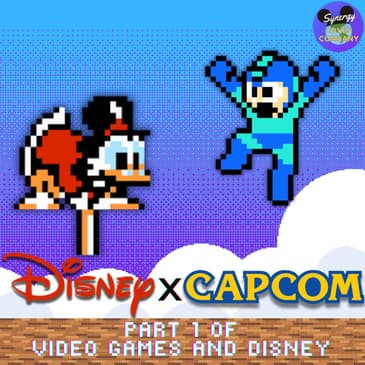
Move over, Kingdom Hearts—Disney and Capcom’s legendary alliance paved the way for Disney’s rise in the video game world! In this episode of Synergy Loves Company, Eric uncovers the untold story behind the creation of DuckTales for the Nintendo Entertainment System—and how it sparked a golden age of Disney gaming through the late ’80s and ’90s. From unforgettable classics like Chip ’n Dale Rescue Rangers and Darkwing Duck to the Aladdin SNES vs. Genesis showdown and Disney’s leap into making games in-house, you’ll discover why these iconic titles still mean so much to fans. Find out how Capcom’s expert game design and Disney’s unmatched storytelling created a synergy no gamer—or Disney lover—can forget!
✨What You’ll Discover in This Video: How the Disney/Capcom partnership ignited the Disney Afternoon game craze The secret Mega Man DNA baked into your favorite NES Disney classics Capcom’s inside scoop on making DuckTales feel like a real cartoon The epic Aladdin game battle: Capcom SNES vs. Virgin Genesis—who won and why How these games shaped a new era for Disney (and inspired today’s hits!)
🎮Featured Games in This Episode: DuckTales (NES) Chip ’n Dale Rescue Rangers (NES) Darkwing Duck (NES) TaleSpin (NES) The Little Mermaid (NES) Aladdin (SNES & Genesis) The Lion King (SNES & Genesis) Goof Troop (SNES) Gargoyles (Genesis)
Check out Shaun’s Book Dreaming In Digital (affiliate link) https://amzn.to/4fbgm3S
Thanks for Enjoying Synergy Loves Company! https://www.synergylovescompany.com
Support the Show! Buy stuff and donate: shop.synergylovescompany.com
👾More Disney Gaming Deep Dives from Synergy Loves Company: Part 1 Sierra On-Line and Disney → https://youtu.be/bNsOVMMfPzs Interview with Shaun Jex → https://youtu.be/2D7Bly27P_s
🌐Let’s Connect:
Youtube: https://www.youtube.com/@synergylovescompany Bluesky: https://bsky.app/profile/erichsynergy.bsky.social
Facebook: https://www.facebook.com/synergylovescompany Instagram and Threads:https://www.instagram.com/synergylovescompany/
00:01 --> 00:55 Cindy loves company. We have this coterie of rich franchises, the company now that people want to engage with. I came here to try and continue what Walt Disney and his associates set in motion 50 years ago, which is to experiment with every new and innovative kind of entertainment possible. It's what we hope to do here is to really develop something that, well, just more than an entertainment enterprise, it's something that contributes in many other ways.
01:05 --> 32:02 Disney and Capcom's DuckTales for the Nintendo Entertainment System just might be the greatest Disney video game of all time. More than just a hit, it helped kick off a golden era of Disney gaming. One that would eventually lead to Disney making its own games in house. And DuckTales wasn't just a great game. It was the perfect example of Disney synergy in action. The company's strategy of uniting its movies, TV shows, theme parks and merchandise to spread magic, expand its brand and of course, maximize profits. This approach was started by Walt Disney and Ron Miller attempted to carry it on. But in the 1980s, Michael Eisner took it to a whole new level. DuckTales itself was rooted in the classic Uncle Scrooge comics. It premiered as a TV series on the Disney Channel, became the cornerstone of the Disney Afternoon lineup and appeared in the theme parks. And since kids in the late 80s were obsessed with their Nintendo's, it made a leap to video games as well. Hey, this is Synergy Loves Company where we explore how Disney connects to everything. So you can feel connected to Disney even when you can't be at the parks. I'm Eric and today, like Uncle Scrooge and his money bin, we are diving back in to Disney video games and taking a look at some of their collaborations with the biggest video game makers of the time. This is part two of a three part series, so make sure you're subscribed so you don't miss an episode. And then after this one, you go back and watch that first one. Also, I want to give a shout out to friend of the show, Sean Jecks and his book Dreaming in the World of Disney Video Games. This book served as insight, inspiration and a big source for the series. And you should definitely go check it out. You could pick up a copy for yourself. There is a link in the description. Anyway, let's get on with the show. Capcom and Disney. When we last left off in the mid-1980s, Disney was going through a corporate shakeup that ousted Ron Miller and brought Michael Eisner and Frank Wells on board. Sierra Online were giving up their license on Disney computer games. But after A dark few years, console gaming was making a big comeback thanks to the release of the Nintendo Entertainment System or the Nintendo Famicom in Japan. And Capcom was capitalizing on this as a third party developer making Nintendo games. Capcom's roots trace back to 1979 when a company called IRM Corporation was founded in Japan to manufacture and sell electronic game machines. In 1981, the company established a subsidiary named Japan Capsule Computers which specialized in arcade video games, eventually leading to the name we know today, Capcom, a shortened form of capsule computers. By 1983, Capcom Co. Was officially founded and began making a name for itself in the booming Japanese arcade market. Capcom's early years were defined by a string of successful arcade titles titles. Its first official arcade release, Vulgus in 1984 was quickly followed by the better known hits like 1942, which became a breakout success internationally. These fast paced colorful shooters and action games helped establish Capcom's reputation for polished, challenging gameplay and memorable design. By the end of 1984, Capcom had laid the foundation for what would become one of gaming's most iconic studios. With its arcade hits gaining popularity, Capcom was poised to make a major leap into home consoles, setting the stage for its pivotal move to develop for Nintendo's Famicom in 1985. And the way Capcom would break into Nintendo's success was by porting its popular arcade games into game cartridges playable on the Famicom and NES. Its first major release on the system was 1942 in 1985. It's a vertically scrolling shoot em up game based on the arcade hit of the same name. Though graphically downgraded due to hardware limitations on the console, the port maintained the tight gameplay that made the arcade version so popular. And it marked the beginning of Capcom's fruitful relationship with Nintendo and paved the way for a steady stream of arcade to console adaptations like Commando Ghosts and Goblins and bionic commando. In 1987, Capcom took a bold step by developing an original title specifically for the Famicom and nes rather than just porting over an arcade game. And that game was Mega man. Created by a small in house team led by designer Akira Kitamura and artist Keiichi Inafune, who would go on to become the face of the franchise. Although the first Mega man didn't sell particularly well at launch, it introduced a revolutionary non linear level selection system and tight action platforming mechanics. Its creative robot masters, colorful aesthetic and catchy chiptune music laid the foundation for one of Capcom's most beloved and enduring franchises. That same year, Capcom made waves in arcades with the release of Street Fighter, a fighting game directed by Takashi Nishiyama. Rough around the edges with stiff controls and limited character selection, it introduced the concept of special move inputs like the now iconic H.A. duke. And the first Street Fighter was far from perfect. But it planted the seeds for what would become one of the most important video game franchises of all time. Its sequel, Street Fighter 2, would change gaming forever. But it all started with this experimental one on one fighter in 1987. In 1988, Capcom had its first run in with Disney. The previous year, Hudson Soft had released Mickey Mouse Adventures in Wonderland for the Famicom in Japan. It was a side scrolling platformer starring Mickey and Minnie Mouse. And though it was loosely inspired by Alice in Wonderland and segments of Disney's Fun and Fancy Free, the game mashed together a variety of unrelated Disney characters and themes. When Capcom published the game in North America in 1988, they changed the title to Mickey Mouse Capade. But they didn't make many changes to the gameplay, which was known for its odd enemy placement, cryptic level design and uneven difficulty. Even though Capcom didn't develop Mickey Mouse Capade, its role as the US Publisher marked the beginning of its relationship with Disney. And the first game Capcom would produce for Disney would be the Synerg Energy juggernaut DuckTales. When Michael Eisner became the CEO of the Walt Disney Company in 1984, he brought with him a fresh focus on television. At the time, Disney's presence on the small screen was limited and somewhat outdated. But through his own children, Eisner saw the growing potential of syndicated programming and Saturday morning cartoons. One of his first moves was to invest in original animated content for tv, something the company company had rarely pursued since Walt's era. The first results of this new initiative were the Wuzzles and Disney's Adventures of the Gummy Bears, both debuting in 1985. The Wuzzles was a quirky, colorful show about hybrid animals like a bumble lion and a butter bear living in a whimsical world, combining elements of familiar creatures in creative ways. It was light and silly and heavily merchandised, but it only lasted one season. In contrast, Disney's Adventures of the Gummy Bears found more staying power. The show followed a hidden civilization of bouncy, magical bears living in the medieval woods. With surprisingly rich world building, serialized storytelling and high production values, Gummy Bears signaled that Disney could bring a higher standard of animation to TV. But the real breakthrough came in 1987 with the launch of DuckTales, based loosely on Carl Barks classic Uncle Scrooge. Comics DuckTales brought Scrooge McDuck and his grand nephews Huey, Dewey and Louie into globe trotting, treasure hunting adventures filled with humor, heart and action. With a much larger budget than typical Saturday morning fare, DuckTales was a standout for its cinematic visuals, smart writing and the catchiest theme song ever. It was a hit both in syndication and merchandising, proving that Disney could dominate after school programming the same way it did in the theaters. The video game came about because of that licensing relationship between Disney and Cap. When CapCom began developing DuckTales for the Nintendo Entertainment System in 1989, the company treated the Disney license with a level of care and quality rarely seen in licensed games at the time. The project was led by a small team that included several developers who had just worked on Mega Man. Rather than rushing out a quick cash in, the team approached the game like a core Capcom title, the focusing on tight controls, engaging level design and memorable music. They adapted Mega Man's non linear choose your own adventure level selection style, but added new innovative features like Scrooge McDuck's pogo cane mechanic which allowed players to bounce on enemies and obstacles, adding gameplay depth with a classic Disney sight gag. Capcom collaborated with Disney to ensure the characters to tone and settings matched the popular animated series and the result was a game that felt like an interactive episode of DuckTales with familiar characters like Launchpad, McQuack, Huey, Dewey and Louie and globe spanning levels set in places like the Amazon, Transylvania and even the moon. The game's art was praised for capturing the spirit of the cartoon using the limited NES color palette and sprite resolution. DuckTales went on to become one of the best selling and most beloved NES games of all time, cementing Capcom's reputation not just as a great developer, but as a studio that could turn licensed material into genuinely great video games. And of course they kept working with Disney and one of Capcom's next Disney video games brought the Disney parks to the Nintendo Entertainment System. Adventures in the Magic Kingdom, released by Capcom in 1990, was a unique NES title that blended trivia, mini games and side scrolling action inspired by actual Disney parks attractions. The Magic Kingdom in this game is not one theme park, but rather an amalgam of all the castle parks, which at the time included Walt Disney World's Magic Kingdom and Disneyland in California and Tokyo Disneyland. The game tasked players with collecting six silver keys scattered throughout the park to open the castle gates for a parade. Each key was hidden within a Non linear selected level based on a classic Disney attraction, Haunted Mansion, Pirates of the Caribbean, Space Mountain, Autopia and Big Thunder Mountain. With gameplay styles ranging from side scrolling platforming to top down driving and a first person space shooter between levels, players answered Disney trivia from guests in the park hub. While not as polished or beloved as DuckTales, the game stood out for its variety and for it being one of the earliest attempts to digitally recreate the Disneyland experience on a home console. In the meantime, Disney launched the Disney Afternoon in the fall of 1990. The Disney Afternoon was a syndicated weekday after school programming block that featured high quality animated series following the mold of DuckTales shows like Chip and Dale, Rescue Rangers, Tailspin and Darkwing Duck. It was designed to capture kids attention after school and it became a cultural phenomenon and marked Disney's dominance in TV animation throughout the 1990s. The Disney decade and many of those shows got Capcom game tie ins. There was 1990s Chip and Dale Rescue Rangers, a co op platformer that allows two players to team up as Chip and Dale, using boxes and other objects to defeat enemies and solve puzzles. 1991's Ducktales 2, a sequel to the original that expands on that Pogo jump mechan and features new abilities, secrets and levels. 1991's Tailspin, a unique horizontal scrolling shooter starring Baloo the Bear from the Disney cartoon of the same name. 1991 also brought us Darkwing Duck, a platformer heavily inspired by the Mega man series, featuring a similar level design and an energy weapon that can be powered up. In 1993 we got a sequel to Chip N Rescue Rangers with Chip n Rescue Rangers 2, the second installment of the co op platformer offering more levels and challenges. And in 1993 we got Goof Troop on the Super NES, a co op puzzle adventure game featuring Goofy and his son Max, where they must solve puzzles to progress through the game. It's often praised for its unique gameplay and cooperative mechanics in kind of a deep cut. In 1994 we got bonkers on the Super Nintendo playing as police officer Bonkers D Bobcat, you must traverse a series of side scrolling levels to recover three stolen Disney cartoon treasures in this platformer based on the Bonkers animated series. Capcom also continued on with the Mickey Mouse capade trend of titles starring Disney's most popular character, Mickey Mouse. For the Nintendo, they produced the Magical Quest starring Mickey Mouse and all of its sequels, but those ironically would not be as popular as the Disney Afternoon Capcom titles. And anyway, Nintendo's competition, Sega had actually developed a more popular Mickey game in 1990 with the Castle of Illusion starring Mickey Mouse, right at the same time when Nintendo and Sega were entering a console war. The console war between Nintendo and Sega exploded in the late 1980s and early 1990s as Sega's Genesis challenged Nintendo's dominance with bold marketing, faster hardware and edgier titles like Sonic the Hedgehog. Nintendo, known for its family friendly image and iconic franchises like Mario and Zelda, fought back with the Super Nintendo and a strong library of polished, critically acclaimed games. The rivalry defined a generation of gamers, split playgrounds in two and pushed both companies to innovate rapidly. It also led to some side quest battles between third party video game developers. Capcom dominated the market of adapting Disney television titles for Nintendo, but they also took on theatrical releases, starting with the film that launched the Disney animation resurgence, the Little Mermaid. Released in 1991. Capcom's Little Mermaid for the NES was developed by the same team responsible for DuckTales and Chip N Rescue Rangers, aiming to create a more accessible action game tailored to younger players and fans of the film. The game was notably marketed to young girls, making it a gateway into video games for that normally ignored demographic. Players controlled Ariel as she swam through side scrolling underwater levels using her voice powered bubble attack to trap enemies and throw them as projectiles. The game featured colorful cartoon like graphics that closely mirrored the 1989 animated film with levels based on locations like Ursula's Lair and the Sunken Ship Graveyard. Though shorter and easier than some other Capcom Disney titles, it was praised for its smooth controls and vibrant design, successfully adapting the film's undersea adventure into a light playable experience. As Disney animated films were becoming must view theatrical entertainment again, Sega wasn't just going to stand by and let Nintendo and Capcom get all the glory. In 1992, Disney released a film ready for an adventure video game tie in. Disney's Aladdin is a high energy adventure that follows Aladdin, a clever street thief who discovers a magic lamp while escaping death and is swept into a world of genies, flying carpets and palace intrigue. It's set in the beautiful vibrant city of Agrabah and Aladdin must outwit the evil sorcerer Jafar, win the heart of the Princess Jasmine and discover that true worth comes from within. With daring escapes, magical transformations and unforgettable music, the film delivers non stop action and adventure. I mean, come on, it already sounds like a video game. Capcom over in Japan, continuing its Disney Nintendo licensing expertise, began developing an Aladdin game for the upgraded Super Nintendo and Super Famicom. However, the UK based Virgin Interactive Entertainment had just recently opened up offices near the Walt Disney Studios in California. And they used that proximity connection to snag a license to produce an Aladdin game for the Sega Genesis. In 1993, Disney's Aladdin made its way to home consoles. But in a rare twist, it arrived as two completely different games developed in parallel by the two powerhouse studios. While both were based on the same blockbuster film, the results couldn't have been more different. Capcom Super NES Aladdin was led by Shinji Mikami, who would later create Resident Evil. True to Capcom form, the game focused on tight, responsive platforming and clean, colorful visuals. Aladdin didn't use a sword. Instead he bounced on enemies and threw apples. With gameplay that felt more in line with DuckTales or Mega man, it was polished, fast paced and family friendly, delivering a strong Disney platformer in Capcom's signature style. Meanwhile, over on the Genesis, Virgin Interactive teamed up with actual Disney animators to create a game that looked and moved like the film itself. Virgin had access to new technology called Digicel that allowed hand drawn animation cells to converted into sprites. Disney was totally on board after seeing this tech in action. They put in house artists on the project and Aladdin directors John Musker and Ron Clements got involved with the game's production as well. The Genesis Aladdin stunned players with its fluid motion and expressive visuals. This version featured sword based combat, a more aggressive and action heavy tone, and a cinematic feel that set it apart apart from anything else on the console. And when it came to sales, Virgin's Genesis version of Aladdin came out on top, selling over 4 million copies, making it one of the best selling Genesis games ever. Capcom's version still did well, moving over 1.7 million units on the Super NES. But the Genesis Aladdin became a cultural touchstone, a title Sega fans could proudly point to during the height of the console wars. Two games, two visions, both beloved in their own way. But depending on which console you had, Aladdin might have meant something very different to you. Disney's work with the Virgin Interactive team ultimately won out. I mean, Disney actually had a hand in making the game. So when it came time to make a game for the Lion King, Disney turned to Virgin Interactive to publish the game for both Sega Genesis and Super nes. Virgin Interactive and Disney enlisted Westwood Studios to develop the game. And following in the footsteps of Aladdin, Disney artists worked side by side with the game developers to give the game more of a cinematic feel. However, because Westwood was working on the game while the film was was still being created. They had limited access to film footage. They would find that parts of the game that they had been developing were cut out of the movie, and they would have to cut them out of the game or they would not be able to match the complexities of the animated scenes in a way that Disney was pushing for. In 1994, the Lion King was released for both Sega Genesis and Super Nintendo. With nearly identical gameplay and visuals, the game followed Simba's journey from Cub to King, featuring beautifully animated levels based on scenes from the film. But it became notorious for its high difficulty, especially in early stages like the can't wait to be king level. The collaboration with Virgin Interactive seemingly ended that long relationship with Capcom. Sure, there were more Disney licensed Capcom games after this point. In fact, fact, many of the handheld games for Nintendo's Game Boys and Sega's Game Gear were released by Capcom. But it wasn't the same as that prolific period before. But whoa, whoa, whoa, not so fast, Virgin Interactive. Disney was pretty much through with you. Also, you see, Walt Disney Productions had started their own software arm after ending their licensing agreement with Sierra Online. In 1988, Disney created Walt Disney Computer Software Consumer Products Division. Walt Disney Computer Software developed and produced some software for PCs, but their main job was working as a liaison with the third party companies that would be licensing the characters and making the software. Like Capcom, Walt Disney computer software was mostly the quality control mechanism to make sure Disney games were up to Disney standards. But as the video game market grew and Disney decided to double down, collaborations on titles like Aladdin and the Lion King gave Disney a front row seat to the creative and technical process behind successful video games, while still leveraging the expertise of established developers like Virgin Interactive and Westwood Studios with the animation talent of Disney's own artists. By working closely with these external studios, sometimes even embedding Disney animators into the game development process, Disney gained valuable insight into how to translate its films into interactive experiences. These experiences laid the groundwork for the eventual formation of Disney Interactive Studios, revealing the company's intent to take more creative control and explore video games as a core part of part of its entertainment empire. This was common in the Eisner era. Michael Eisner's Disney Company would take back control of their hotels at theme parks. They would create the Disney Vacation Club. They would not only produce television shows, they would own the network that they were airing on. Michael Eisner's Disney wouldn't just license Disney products, they would make their own products and sell them at the Disney Store that they owned. At the mall in your neighborhood or vertical integration Synergy Disney Interactive Studios replaced the Walt Disney computer software division, and going forward, Disney itself would design and produce any of their most notable titles for any game system or computer. Sure, they would still license characters, but they would develop special titles in house. Like when Disney turned once again to the Disney Afternoon programming block to create a game for Gargoyles, their new dark, action packed animated series about ancient stone creatures who awaken in modern day New York to protect the city from evil. For Synergy, Gargoyles for the Sega Genesis was developed at the same time as the show itself. The game wasn't simply a retelling of the story, it was an expansion of the universe. The game was meant to support the show, and the show was meant to support the game. It was released and developed by Disney Interactive Studios and published by Disney's Buena Vista Interactive. Totally in house during this time, Capcom had picked up another license that at the time wasn't so Disney, but now it's totally part of the company. Capcom developed arcade and console games for Marvel comics, and this led to iconic fighting games like Children of the atom, X Men vs Street Fighter, and the Marvel vs Capcom series. But the legacy of those original Capcom Disney games still lives large in millennial memories. In 2012, Disney and Capcom's DuckTales was remastered to give it an updated, more hand drawn animation look, and it was made available on all the major consoles of the time, as well as PC and mobile platforms. And in 2017, Disney, Capcom and Digital Eclipse released the Disney Afternoon Collection that features the classic Capcom Nintendo Entertainment System games, DuckTales, Chip N Rescue, Rangers Tailspin, Darkwing Duck, and both the sequels for DuckTales and Chip N Dale. It was made available on PC, Xbox One and PlayStation 4. It's a little ironic that the Disney Afternoon Collection, a bundle of classic games that originally helped define Disney's presence on Nintendo consoles, totally skipped the Switch entirely. But maybe that irony points to a bigger, more complex relationship between Disney and Nintendo, two companies that in many ways are spiritual siblings. They both built their empires on iconic, family friendly characters, and both have shaped the childhoods of generations through their commitment to imagination, polish and playability. In my next episode, we'll take a closer look at how these two creative giants have crossed paths, not just through licensing deals and video games, but through shared values, innovation, influence, and a few surprising connections that might just change how you see both these brands. Don't forget to check out Sean Jecks's book Dreaming in Digital for the full story on these Disney games and so many more. Thanks for joining me for this look into Capcom and all things Disney. I'd love to stay connected with you online. You could follow me on social media to keep up with everything I'm working on. On bluesky I'm erichsynergy and on Facebook, Instagram and Threads I'm ynergylovescompany wherever you're tuning in, Apple, Podcasts, Spotify, wherever, click, follow or subscribe and you'll never miss an episode again. If you're enjoying this show, could you share it with someone who loves Disney just as much as we do? Send them a link and tag me on social or just bring it up the next time you're talking about your favorite park snacks. You can send them a link to synergylovescompany.com and one last thing, Synergy Loves Company is supported by listeners like you. If you like this show and you would like to help it keep going, check out my new shop. You can buy shirts inspired by Episodes and Synergy Loves Company branded merch. You can also just donate if you want to give back. For the content that I share that you enjoy, visit shop.synergylovescompany.com every little bit of support helps me continue making something special for fellow Disney fans like you. And remember, sometimes the most magical Disney experiences happen outside the parks. You just need to know where to look. Until next time, keep discovering the magic in everything.