
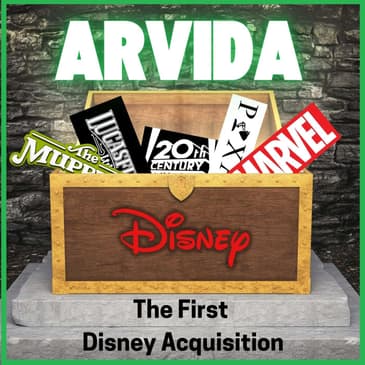
Long Before Pixar, Marvel, LucasFilm, 20th Century Fox and even ABC disney Acquired Arvida! In this episode of "Synergy Loves Company," we delve into the intriguing history of Disney's first major acquisition under CEO Ron Miller, Arvida. We explore how this acquisition came about as a defensive strategy against corporate raider Saul Steinberg and how it ultimately led to Miller's ousting. We take a look at Walt Disney's original philosophy against acquisitions, Ron Miller's innovative ideas such as the Disney Channel and Touchstone Pictures, and how these ideas were ahead of their time. We also discuss the involvement of the Bass Brothers, the role of Roy E. Disney, and how the failed Arvida acquisition shaped the Disney Company's future, including the creation of the Disney Development Company. Finally, we touch on how subsequent acquisitions under leaders like Michael Eisner and Bob Iger defined the company's modern growth. Tune in to uncover how these pivotal events contributed to Disney's legacy.
Thanks for Enjoying Synergy Loves Company! https://www.synergylovescompany.com
Donate to the show: https://ko-fi.com/synergylovescompany
Youtube: https://www.youtube.com/@synergylovescompany Bluesky: https://bsky.app/profile/erichsynergy.bsky.social Facebook: https://www.facebook.com/synergylovescompany Instagram and Threads:https://www.instagram.com/synergylovescompany/
00:03 --> 22:01 Synergy loves all the companies that Disney acquired. We have this coterie of rich franchises, the company now that people want to engage with. I came here to try and continue what Walt Disney and his associates set in motion 50 years ago, which is to experiment with every new and innovative kind of entertainment possible. It's what they hope to do here, to really develop something that, well, just more than an entertainment enterprise, it's something that contributes in many other ways. The Walt Disney Company we know today is a lot bigger than Mickey and Friends and the animation and movie studio that Walt and Roy built. We got the Marvel Cinematic Universe, the Galaxy, far, far away in Star wars, and of course, all our Pixar pals. And the way the company has gotten bigger is through those major acquisitions. CEO Bob Iger is pretty much known for this. He's the one who brought on Pixar, Marvel, Lucasfilm, and biggest of all, 20th Century Studios. You know, Fox, all of those, especially 20th Century Studios, helped fill out the direct to consumer programming for Disney. But he's not the only Disney CEO to get into the acquisition game. Michael Eisner grew the Disney Company by adding the Muppet. Miramax. Yeah, that, that Miramax. A bunch of little tech companies that became the go.com network. Go check out the episode I did on go.com but his biggest acquisition of all was the ABC Capital Cities acquisition that put Disney into the television game. And it was also how Disney got a hold of Bob Iger. No wonder Iger loved acquiring companies so much. He came from an acquired company. But for all of the great companies Eisner and Iger acquired and made jewels in the Disney crown, they weren't the first to take on acquiring a company. We gotta go further back in time. No, no, no, it wasn't Walt. Well, not really. Walt loved to make his own stuff. He would make a company and then name it after himself. Like Walt Disney Productions. Sorry, Roy. And like WED Enterprises, the company that would become Imagineering. WED was named for Walter Elias Disney. It was originally part of Walt's holding company called Retlaw, or Walter Backwards. I guess technically these were the first Walt Disney Company acquisitions. Walt would make these companies, name them after himself, and then sell them back to Walt Disney Productions, the first company that he had ever named after himself. But that's really like moving money from your right pocket to your left pocket. Not a true acquisition. Walt wasn't thinking about acquiring other companies. He was interested in new, innovative ideas that he himself had. He was the guy with the big ideas. And then they were executed by his team. And he put his name on the finished product. Like Disneyland. When Walt died in 1966, the company didn't have any idea of how to move forward. The idea man was gone. They had his last big idea, Epcot, that they would try to make something out of in Florida. But that was all that was left around the company. Throughout the 70s, executives would try to make decisions, thinking, what would Walt do? But that's the thing. Only Walt knew what Walt would do. That's how big idea thinkers work, by trying to do what Walt would do. Without direction from Walt, the company was stuck to the status quo. Which High School Musical taught us is totally stifling. Walt had never made an acquisition outside of the company, so that wasn't on anyone's mind. Because Disney was in a dark period slump. They limped right into the 1980s. And in 1980, Walt Disney's son in law, Ron Miller, took over as the president of the company. As Disney fans, we often forget about the impact Ron Miller had on the company. His tenure was short, but he had a longer lasting effect than most realized. And Ron Miller was that first trend setting Disney CEO to make an outside acquisition. And it would ultimately lead to his ousting. Hey, this is Synergy Loves Company, where we explore how Disney connects to everything. So you could connect to Disney when you can't be at the parks. And today I want to tell you the story of Disney's first acquisition. And to do that, we got to talk about Ron Miller. Walt's son in law, Ron Miller gets known for almost losing the Disney company and being ousted as CEO by his cousin in law, Roy E. Disney. But he actually offered a lot to the company. Enough for an episode just about him. This is probably a good time to make sure that you subscribe so you don't miss any future episodes. I might do one about Ron Miller. Go ahead, click that button. I'll wait. In 1983, when Ron Miller became the CEO of the Walt Disney Company, Epcot, Walt's last big idea had just opened. Well, a lesser version of his Epcot City of Tomorrow, but still the best theme park ever in my opinion. But that was Walt's last big idea. There was no more. What would Walt do? Ron actually had some great ideas of his own that he got started. Fresh ones that Walt may or may not have ever even thought about doing. A movie studio for grown ups, a cable channel, home videos of Disney classic. The kind of stuff that would make Disney relevant again for the 1980s. But the company had been stuck in the past, wondering what Walt would do for so long that the sharks started circling. Speaking of Disney acquisitions, the theme today. This story could have gone very differently. Disney almost got taken over and acquired by a corporate raider. Saul Steinberg. Saul Steinberg was an American financier and corporate raider known for his aggressive leverage buyouts in the 1960s and 70s and is the founder of the Reliance Group holdings. He made a name for himself by taking over undervalued companies and restructuring them for profit, sometimes breaking them apart and selling the part. One of his most famous attempts was his failed 1969 bid to acquire Chemical bank, which helped usher in stricter regulations on hostile takeovers. Steinberg was a key figure in the rise of modern corporate rating and high stakes finance. A real Gordon Gekko type, Steinberg saw the weaknesses in Walt Disney productions as a whole. But he also saw dollar signs when he looked at the individual pieces. Theme parks, the vault of classic animation, iconic characters. Each of these could make a lot of money on its own when sold to the highest bidder. He immediately started buying chunks of Disney stock and very quickly became one of the company's largest shareholders. At the same time, Roy E. Disney, Walt's nephew Roy's son, didn't like the way things were going and he left the Disney board. But he too started buying up more stock to try to become an even bigger shareholder as well. Ron Miller's Disney needed a way to try to protect the company from getting taken over by Steinberg. A way to make his holdings less powerful. Disney board member Ray Watson suggested that they bring on his friend Sid and his brothers to help enter the Bass brothers. The Bass brothers of Texas, Sid, Edward, Robert and Lee are billionaire investors known for transforming a multimillion dollar oil inheritance into a diversified financial empire. They put their inheritance to work and gained prominence in the financial world of the 1980s through some savvy investment. They even had worked with corporate raiders to take over companies kind of like Saul Steinberg. But in this case, they would be Disney's answer to a corporate raider. More like a corporate Robin Hood. And they wouldn't sell the company for parts. Sid Bass took the lead in the negotiation with Disney and worked with Ray Watson to make the deal happen. Though not as influential as in the 1980s, the Bass family still remains powerful in finance, real estate and in energy. The Disney board came up with a deal that would both bring the Bass brothers on board and dilute Saul Steinberg's holdings. Just a year earlier, in 1983, the Bass brothers bought a company called Arvida. If Disney bought Arvida with Disney stock, the Bass brothers would get a head start on Disney stock ownership. And combined with Disney's holdings, they would be able to push Steinberg out. Sid Bass would also get a Disney board seat. Disney agreed to acquire Arvida for $200 million worth of Disney stock. Here's that big first acquisition. Let's take a look at the company they bought. The name Arvida comes from the first two letters of the founder's name, Arthur Vining Davis. And if that name sounds familiar, you probably watch a lot of pbs. Also, the Arthur Vining Davis foundation has sponsored tons of public broadcasting in the dates over the years. Otherwise, you might also know him if you're really into aluminum. If he wasn't their competition, he would probably be in Kaiser's Aluminum hall of Fame in Disneyland's Tomorrowland. Arthur Vining Davis's company Alcoa is named for the first letters of Aluminum Company of America. This guy really had a naming convention. First letters of everything. Alcoa got its start in Pittsburgh in 1888, but really started taking off during World War I. Alcoa's State of the art production facilities were surrounded by company towns. Arthur Vining Davis took part in founding towns to give his workers places to live and play and keep them really close to work. This was a common American practice during this time. A company would plan a whole city that would offer every necessity to its workers and their families. The planned cities of company towns were a big inspiration to Walt Disney's vision for epcot, the experimental prototype city of tomorrow. One of Arthur Vining Davis planned communities for the employees of his large Canadian aluminum smelting plant was Arvida in Ontario, Canada, founded in 1927. This is, this is the town Arvita we're talking about. It's, it's not a company yet. As Davis's companies bought more and more land for production facilities and the towns around them, they would need a way to manage their real estate and their properties. They could even invest in unrelated real estate ventures. In 1958, Davis founded Arvida, a real estate development and holding company. Over the years, Arvida would start to buy land and develop office buildings, business parks, shopping malls, communities, resorts, hotels, and here's the kicker. By the 1980s, most of their properties were in Florida and Southern California. Sounds a little bit like Disney. Arvida could really be a great real estate asset for Disney. The company could help them develop their land at Walt Disney World. And Disney could really get a lot out of Arvida. It just made sense. At least that's the story that Disney told their investors. Oh, no. Corporate raiders. No, no. What are you talking about? We just wanted to buy Arvita. It just seems really neat. And they can help us with like, you know, like real estate stuff on our undeveloped land. Yeah, that's the tick. It just seemed like, you know, like fun to buy another company today. And you know, like Disney, like, never really bought another company before. Not like this, but. But that's like something people do, right? This is totally normal, right? And yeah, that Sid Bass guy, he's just a. He's just a really nice guy. Who's Saul Steinberg? Some of the things they actually told investors were that they bought Arvida because they wanted to expand the development of land on Walt Disney World property. They wanted more hotels and they were exploring building a residential community on Disney property. And they could expand Disney properties beyond the parks with more resorts outside of Walt Disney World and Disneyland. Arvida would just be what they needed. Just the thing to make it all happen. But everyone could see right through it. They were buying Arvida to bring in the Bass brothers and deter Saul Steinberg. It was a last ditch effort to save the company. Saul Steinberg didn't like it at all and he sued to get the courts to shut down the deal. Roy E. Disney didn't like the deal much either. But he did kind of like that Sid Bass guy. Sid Bass, who made the deal with Disney, didn't really like Ron Miller as the CEO. And that's why Roy Disney liked Sid Bass. They both thought Ron Miller should be out as CEO. The Arvida deal held off Steinberg enough so that Disney was able to buy him out of a hostile takeover bid. A practice called Green Mail. It cost Disney a lot of money, but it did kick Steinberg out of the picture. After shaking Steinberg, they needed to make some changes before the next raider came around that the sharks were circling. Sid Bass and Roy E. Disney got their way. Ron Miller was out, and Michael Eisner and Frank Wells were in. Roy was back on the board and back at the studio. And everyone was ramping up for what would become the Disney decade. Okay, real quick, shout out to one of my favorite Disney books ever, Disney War by James B. Stewart. It gets into this whole hostile takeover bit from the early mid-80s and covers the triumphant arrival of Michael Eisner and then continues along the story of the Walt Disney Company all the way through the early 2000s and the fall of Michael Eisner's tenure. It is a biography of the origins of the modern Walt Disney Company, and it is required reading for Disney fans. So if you haven't read it yet, go and pick up a copy from your local public library. All right, let's get back to Ron Miller. Ron Miller's Disney Channel and his development of Touchstone Pictures and his home video unit are all things now we associate with the Eisner era. But they were Ron Miller's moves with the company. And they were a real example of what would Walt do. Something innovative, something no one else could have thought of. That's truly what Walt would have done. Walt Disney Productions acquisition of Arvida, though desperate, was ahead of its time, and it saved the company. But it also led to Miller's ousting the mid-1990s. Through the 2010s, Disney would grow and become defined by its acquisition in the 1980s. The new regime. Eisner and Wells weren't even ready for acquisitions like Arvida. They actually did something counterproductive with Arvida. In 1984, after Disney acquired Arvida, they also created from scratch the Disney Development Company. The Disney Development Company was a real estate unit that focused on developing and master planning Disney's properties around the world. Pretty much like the same thing as Arvita, a corporate redundancy. Okay, maybe they learned a little bit from Arvida and built the Disney Development Company on what they learned. But you had Arvida. Why reinvent the wheel? Both of them couldn't last together. In January of 1987, Disney sold off Arvida and its assets to JMB Realty Corporation of Chicago for $4 million. They did turn a profit and double their money. Arvida, though, was really a flash in the pan. Disney Development Company went on to do all of the things that Disney claimed. They bought Arvida. They developed more hotels and resorts around Disney property. They planned and built Celebration, a residential community on Disney property. And they helped expand Disney Vacation Club to properties outside of Walt Disney World and Disneyland, in Vero Beach, Florida, and Hilton Head Island, South Carolina. If Disney had hung onto Arvida and shaped it into a subsidiary that would plan and developed and manage its real estate and property. It would have been a closer move to the modern Walt Disney Company. They could have leaned into the strengths of Arvida. They could have given its existing properties Disney flair. Its resorts could have been Satellite Disney Resort. Its residential communities could have been Disney Living. And its shopping malls could have included elements of themed entertainment in the past 30 years acquisitions have made the company so much stronger and so much more valuable. Instead, with the Arvida situation, they did something from the what Would Walt Do? Playbook in the worst way. They created their own real estate arm from scratch and named it after themselves, the Disney Development Company. Thanks for joining me on this. Look into Arvita, Disney's first acquisition. And if you haven't, you should definitely, definitely check out James B. Stewart, Disney War I really do just love that book. Check your local public library. I do love sharing stories of the Walt Disney Company. Synergy Loves the Disney Company, right? So if you want more episodes about the Walt Disney Company and you know the executives like this one, let me know. I'd love to do some more and I would love to hear if you want to hear more like this, reach out to me on bluesky, richhsynergy or you could find me on any of those meta apps like Facebook, Instagram and Threads. All of those places. I'm at Synergy Loves Company and as always, I've got some more great Disney connections coming right up. So if you want to make sure you don't miss them, go ahead and subscribe or follow wherever you are enjoying Synergy Loves company right now. YouTube, Apple Podcast, Spotify. Or you could even just go to synergylovescompany.com and you'll find a link to any of those, all of those, and even an RSS feed link. Click Follow or Subscribe and you'll know exactly when a new episode drops. This show though, is best when it is shared with friends. So could you share this show with a friend of yours who would enjoy Synergy Loves Company? Tell them about this episode or maybe even another one that was your favorite. Send them a link on social media and definitely tag me in it so I can say hi. Or you can just tell them to visit synergylovescompany.com and now a word from our sponsor. Wait a minute. Synergy Loves Company is sponsored by listeners like you. Check out the link in the show Notes to give back to the show on KO Fi. You can support the show with any amount. It's just a great way to to show that you appreciate the work that I do to put this show out and it helps me keep the show hosted. No matter how you decide to support the show. I really support you and the time that you spent with me today. So thanks again for joining me on this adventure. And remember, Disney magic isn't just in the parks, it's all around us. So go out into the world and keep discovering the magic in everything.