
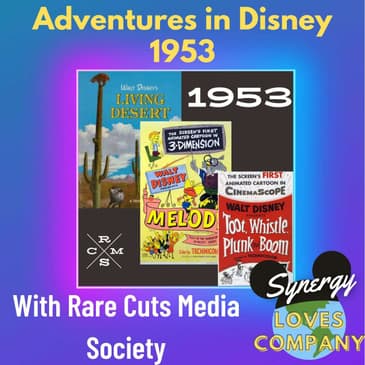
Join Eric for some podcast synergy as he revisit's his discussion with his other podcast Rare Cuts Media Society! In a recent episode they talked all about three Disney Projects from 1953:
In this episode, we shine a spotlight on The Living Desert, a mesmerizing nature documentary that takes us deep into the vibrant and diverse world of desert wildlife. We also explore the controversial animated shorts Melody and Toot Whistle Plunk and Boom from the Adventures in Music series, where Disney's signature storytelling combines with the magic of music to create experimental animated experiences. Through engaging discussions, we uncover the artististry, cultural impact, and problematic imagery. Not all Animation ages well! Don't miss this immersive exploration of The Living Desert, Melody, and Toot Whistle Plunk and Boom, as we celebrate the beauty of nature and the power of music in the world of Disney. Join the Rare Cuts Media Society as we embark on this nostalgic journey through the enchanting films of 1953.
Find out more at http://rarecutsmediasociety.com
Melody (Animated Short) https://www.youtube.com/watch?v=K3_TQp_fyrg
Toot Whistle Plunk Boom (Animated Short) https://www.youtube.com/watch?v=8iVf0pPHvjc
The Living Desert (True Life Adventure Documentary) https://vimeo.com/339307897
Thanks for listening to Synergy Loves Company: How Disney Connects to Everything. https://www.synergylovescompany.com
Youtube: https://www.youtube.com/@synergylovescompany Twitter: https://twitter.com/EricHSynergy Instagram:https://www.instagram.com/synergylovescompany/
00:00 --> 00:02 Synergy loves company.
00:04 --> 00:32 With activations across our Synergy machine, we have this coterie of rich franchises, the company now that people want to engage with. I came here to try and continue what Walt Disney and his associates set in motion 50 years ago, which is to experiment with every new and innovative.
00:32 --> 00:34 Kind of entertainment possible.
00:40 --> 00:42 It's what we hope to do here.
00:42 --> 00:47 To really develop something that just more.
00:47 --> 00:49 Than an entertainment enterprise.
00:49 --> 00:53 It's something that contributes many other ways.
00:59 --> 02:55 Hey, this is Synergy Loves Company, where we explore how Disney connects to everything. I'm Eric, and keeping me company today is the rest of the Rare Cuts Media Society. Well, not exactly. This one's going to be a little bit different than some of my other episodes. You see, I'm a panelist on another podcast. It's called the Rare Cuts media society. It's a podcast kind of like a book club, but for underappreciated movies, music, TV, pretty much any kind of media. There's four of us, in fact, the other members guested on Synergy Love's Company about a year ago. You can go back and check out their episodes on the show rare Cuts Media Society. We pick a theme, and then each of us takes a turn picking something to watch, read, or listen to on that theme. We just started a new theme. It's called rare cuts. Time warp, 1953. And we're taking a look back 70 years ago and watching some movies and TV kind of things from back in 1953. I got to pick for the first episode of the series, and of course, I had to pick something Disney. The problem, though, is that there's almost too much to pick from Disney. In 1953, I had so much to choose from, I decided to make the rest of the Rare Cuts Media Society crew watch. Three things. I limited myself to three things that's okay, two of them are shorts, and one's a shorter feature. So the two shorts I had them watch were the Adventures in Music Melody and toot whistle plunk boom. And then the third thing I had them all watch was the first feature, true Life Adventure, The Living Desert. So here it is going forward. The rest of it. This is rare cuts. Time Warp, 1953. Adventures in Disney films. Here we go.
03:04 --> 03:19 Hello and welcome to Rare Cuts Media Society, the podcast that looks at hidden media gems and stays far away from those desert monsters. With your hosts, as always, I'm Andrew Jagoda, and with me, of course, we've got Mike Ross. How are you today, Mike?
03:20 --> 03:28 I feel like I was on acid and looking at desert creatures.
03:30 --> 03:33 Are you still on acid right now, Mike?
03:36 --> 03:44 It's a trippy. Hey, what we're talking about? I thought the whole thing was a little bit trippy.
03:46 --> 03:50 Since he talked already. Probably. Chick, how are you today?
03:51 --> 03:56 I'm doing well. Not currently on acid, so all is well here.
03:57 --> 04:02 This is getting a little off the rails, of course. Eric Cathorn, how are you doing?
04:02 --> 04:10 So I go ahead and pick some things and apparently they're too psychedelic or.
04:11 --> 04:14 Psychedelic things might help this experience.
04:16 --> 04:46 All right. So now with today's episode, we are going to start up our new arc of episodes. And welcome to Rare Cuts Time Warp 1953 edition, a captivating journey back in time to uncover the hidden gems and forgotten treasures of the silver screen, brought to you by Rare Cuts Media Society, your trusted guide into the realm of cinematic rarities. And so with that, I will pass it over to our host for this month's episode with Eric.
04:46 --> 05:50 Yes. So last time when we were finishing up our last kind of theme arc and Rob brought the anvil to the table, I think it was pointed out by you all later that I did not talk about Disney in that episode. And if you've listened to any Rare Cuts Media Society episodes, you know that I try to sneak some Disney in there. So to make up for that, I had to pick a bunch of Disney stuff from 1953. There was a bunch of great Disney stuff from 1953. And there's some big kind of big important movies and things that happen, like Peter Pan. But there's also some nice little gems that I had you guys watch and we're going to talk about. So I'm super excited to get into this, like, little disney 1953 Film Festival, I think is what I'll call it. I don't know. Any suggestions for something better to call this than the Disney 1953 Film Festival?
05:50 --> 05:52 Adventures in 1953?
05:53 --> 05:53 Adventures.
05:54 --> 05:56 Disney Adventures of 53.
05:56 --> 08:32 It is a true life adventure. Anyways, I'll get into it. All right. Before the feature films and the theme parks, walt Disney Animation Studio began its journey with short films that pushed the boundaries of animation. In 1928, Walt and his animation partner, Oba Iworks, created their first massively successful sound synchronized animated short, steamboat Willie, featuring Mickey Mouse as the star. Then in 1932, the Disney studio once again revolutionized the industry by producing the first technicolor animated short, Flowers and Trees, which also became the first cartoon to win an Oscar. Even after Walt Disney introduced animation to feature length films with Snow White, a groundbreaking innovation that changed the way the world perceived animation, the studio continued to produce short form animation. And it was in these shorts that they truly had the freedom to experiment. In 1953, Disney embarked on a short lived series called Adventures in Music, aiming to depict musical concepts through animation. The series included two shorts released in that same year, and the first in the series was Melody, the first 3D animated film released in the United States. The second short was titled Toot Whistle, Plunk, and Boom, marking the first animated film released in the CinemaScope widescreen format. All right, so we got to talk about our first two films of our film festival. The short two they would be the ones that happened before the feature. So it's fitting that they come as the first little shorts of our 1953 theme here. And so in the adventures and music in general, so we had melody and we had Toot whistle, plunk and Boom. But in general, we kind of get this story where we have this classroom of birds and they're learning. They seem to only learn about music, and each series is giving us a different piece of the music. So I want to get into a few different parts of these series and what was kind of going on in them. And we'll kind of weave our way through both of them together at times and then kind of jump out into each one individually. So the first thing I got to ask is, were any of you familiar with any of the adventures in music? Did you recognize characters or anything like that? Have you seen this before?
08:32 --> 08:33 Never.
08:34 --> 08:35 For Rob.
08:35 --> 09:00 I have never seen it. It was interesting, but I never saw the character. It fits the bill of kind of that initial Disney animation, right. The animal characters and such. But I can't say that I'm familiar I was familiar with any of these. I didn't know that they had I mean, obviously, being in these two, I didn't know these were like ongoing characters either.
09:01 --> 09:09 Right. They were only in the two. Not exactly. They were in some other things too, but like, pretty much.
09:09 --> 09:36 So for me, I don't think I ever watched them before. But as soon as they came on in my mind, I'm going, do I know those from somewhere? They all seemed very familiar. I don't know if it was the art style or if I actually had some kind of, like, time when I saw it as a little kid that I'm kind of touching on. But yeah, it felt weird.
09:38 --> 10:01 Yeah, I recognized the characters in kind of the Owl Schoolhouse. I remember watching something with them when I was a kid. I'm not positive I can't remember if they were in Fantasia at all, but I don't think so.
10:01 --> 10:09 Now I will say these shorts are on the Fantasia 2000 bonus features if you are a Fantasia 2000 fan.
10:10 --> 10:20 I am a fan of Fantasia in general. What were those characters from? Because I know I saw it and it's been driving me crazy.
10:20 --> 11:00 So Disney would reuse little pieces of stuff like that later on in different Disney Channel things and whatnot. But these were featured a lot in the sing along songs, VHS tapes in the 90s. So they would take like a Disney song and do like a little sing along bouncing ball music video kind of thing. And they would feature these birds in the beginning, like the intro sometimes, or in different scenes. I guess two out of three had some sort of recollection of this seems familiar. I always think of the birdie, bird brain. I guess is his name the bird with the duns cap?
11:00 --> 11:31 The Duns Cap one. Yeah, right. Absolutely. Him. And what is it? Professor Owl. Yeah. No, those instantly I recognize them. But I couldn't put my thumb on where from and I think it is probably from like a Disney sing along song because I think I had either a VHS tape or a recording from the TV that my parents might have made and I watched it a lot. But I don't have enough of a.
11:31 --> 11:59 Memory to recognize core memory unlocked. No, it brought some back to you. So I just wanted to know because I know the first time I had watched it, I had that same and I'd watched these two shorts before, kind of like our viewing here, but I had that same kind of spark of like, these look familiar? What are these from? And that's kind of what I traced it back to for me. Those sing along tapes from the 90s.
11:59 --> 12:02 Which yeah, the bouncing ball sing alongs.
12:02 --> 12:34 Yes, the sing along songs. So I'm glad some of you had that little spark back there in your brain about it. So did the characters remind you of any other Disney characters in that, too? Where do these kind of stack up in? Are these worthy Disney characters? This was supposed to be a series. Do these characters do you think they had that star power that some Disney characters get? Rob saying, rob's already shaking his head no. Tell us why, Rob.
12:35 --> 12:39 I didn't think any of them were memorable. The only one was the owl.
12:39 --> 12:42 That's the only one like Cap One that does Cap One.
12:44 --> 13:26 To that point, you guys are discussing it, but I didn't remember it. The only one I remembered was the owl. Like, watching these two, I just remembered all of the different segments as they're singing about love or the inappropriate characterizations of Native Americans and such. But those are the pieces I remembered, not necessarily the characters. It kind of felt like they were just kind of carrying the show along. It didn't seem like any of them specifically stuck out where it would be like, oh, I remember that one. Other than the owl.
13:27 --> 13:47 I think that they could have had some staying power. I think that definitely they could be using them now, even for just how on Disney Channel they have some of those short animated commercial bumpers, almost. Yeah, you could do things with the schoolhouse and Professor Owl and just have something really silly.
13:49 --> 13:58 And like how Mike was saying he kind of thought maybe they were from Fantasia. I was thinking they would fit right in on there. Just have a group of singing birds.
13:58 --> 14:30 Yeah, the musical kind of aspect to it there definitely can give them some Fantasia ties. But I do want to go back to what Rob was talking about because he brought up what I called the elephant in the room with these shorts. They are from 1953. They have aged, that's for sure. So that's the question I kind of have. How well do these things hold up in 2023?
14:32 --> 14:33 No.
14:35 --> 14:38 Good night, everybody. Good night.
14:38 --> 14:40 Thank you for joining us.
14:42 --> 15:12 The first one I watched was Melody, and I believe you said, Eric, that's the first one that was released. So immediately, it was probably, what, two minutes into it, they were talking about male Homo sapiens, and then they went into talking about female Homo sapiens, but then basically went down the path of that. They're overlapping melodies is basically ladies talking over each other. And then the owl had to basically tell them to pipe down.
15:13 --> 15:28 Not just ladies, but ladies, like, holding cleaning products, like mops. I let out an audible, conservative 50s vibe. Yeah, it doesn't translate to today.
15:29 --> 15:58 So that's the first one. Melody, I'm going to go ahead and say that's probably the less offensive one. What about let's go there? Like I said, we're going to come back and try to find some redeeming qualities, but we got to talk about Toot Whistle, plunk, and boom, and 2023. Toot whistle plunk and boom.
16:01 --> 16:20 The one that stuck out to me was I think I brought it up earlier was like, the Native American extreme stereotypes of, like, the and it was really bad, too. Like, it was like the the darker skin of the characters. I mean, it was really, really well.
16:20 --> 16:39 And 50s portrayal, how they depict African Americans with the horribly racist imagery with just the blackout white eyes, red lips, completely unacceptable and offensive even then, for sure.
16:42 --> 17:02 Later on, these would be aired on Disney Channel. In the they would cut out some of, like, the Asian stereotypes, the black stereotypes, and I believe some of the Native stereotypes, too, because they yeah, there.
17:02 --> 17:51 Was a part where I started to get nervous, and it was during, toot. Whistle, plunk and Boom when they're going through how allegedly, their interpretation of how a stringed instrument was created, like a harp for the first time. And they go through this series where they show really primitive people and the strings breaking and hitting people on the head and trying to be humorous. And then when we get to the group of very proper looking white people from England or something, I was like, oh, no, don't have it. Be perfect. Don't have it. Be perfect. That'd be awful if they don't break their instruments. But then they all broke, and I was like, at least one awful thing.
17:53 --> 18:15 If I needed a counter while I was watching, especially Toot whistle, plunk, and boom. How many times I just audibly said the word wow just from all the inappropriate portions that you brought up, Eric, you kind of spelled them out. But just how many times? I was just, like, audibly saying the.
18:15 --> 18:50 Word wow and it's rapid fire. Too yeah, exactly. One thing I thought at least, Too, is I felt like as it went on, it felt like a snowball rolling down the hill. It was like, oh no. And it was like, oh no. And that's kind of how it does feel that way. So I think we say that these don't hold up 70 years later, content.
18:51 --> 18:53 Wise, I think they do not hold up.
18:53 --> 19:54 That's good because I wanted to bring it back to some of the redeeming qualities of them because there's still something that we can grasp from these. They're horribly outdated as far as sensitivity and not caring about people and whatnot in the 1953 and Gags and things like that, taking precedent over just like people. But we do have some things about music here. So let's talk music and let's talk a little bit about the technology. So both of the films will kind of take each one separately. Both of them had a special first, as I'm going to call it. So the first thing about Melody was it was the first animated short in the US. To be in 3D. Sometimes with 3D, they overdo the 3D. Did this seem like it was in 3D when you guys watched Melody?
19:54 --> 21:19 I didn't even think about it until I read your comment. And then I re watched it and I was like, oh, okay. So now it's like I'm noticing how things that are moving towards the camera, they're really emphasized more than what would probably be standard for the time. So I don't think it was over the top or anything. It's not like the renaissance of 3D movies that took place in kind of the early 2000s where they would do things that were specific, like, whoa, it's like they're reaching out at you. It wasn't anything over the top like that. Or like, we talked previously on an episode about a Three Stooges movie that was released in 53 that was in 3D, where they would cut from like a regular standard camera shot to just straight on view of like mo sticking his fingers out like he's poking you in the eyes. That's really cheesy. Over the top. I think it was subtle. I think they did it well. It'd be curious to see what it would look like in true 3D with the special glasses or whatever.
21:20 --> 21:27 Yeah, we could say it was some tasteful 3D. They didn't overdo it. They didn't overstay their welcome.
21:28 --> 21:29 They didn't throw a bird at the.
21:29 --> 21:36 Camera or pull a Count Floyd from SCTV with the 3D close up.
21:39 --> 21:47 Or Grover from Sesame Street with near and far. Near, far.
21:49 --> 22:06 They could have gotten more out of hand, for sure. So I want to go back then to let's keep talking about Melody here for a second. So did you learn anything from Melody? Did it teach you something or make you see Melody and be like, oh, that's an interesting way to show that, or that's an interesting way to explain.
22:06 --> 22:43 That it's not for Melody, but from actually toot whistle, plunk, and boom. I really liked the animation that they did, cutting away for the trumpet to show how it like well, first starting with how it came to be with more and more winding, and then now to having the buttons and everything to show how the error moves. Oh, for sure. I really think that's good for people to see, to understand the trumpet. And I think animation was really probably the only way to do it back then.
22:43 --> 23:32 I wouldn't say I learned anything, but I would say that if I were a kid in the think that it would be interesting to me, specifically with again, toot, whistle, plunk, and boom. They're trying to give like an origin story to each of these instruments. And I could see how a lot of children, they asked those types of questions like, well, what was the first horn ever? What was the first drum ever? And this is kind of a fun way to address that topic. I didn't learn anything, but I could see how kids could really get something from it.
23:32 --> 24:48 Yeah, I think the concept was really smart, like you said, kind of going back to the origin and the different steps through time, some of the poor taste of how they depicted the different time. But the concept of itself, though, I thought was pretty ingenious of how they went about it. And we haven't really touched on it, but I'm sure this is probably where you're going next, Eric. But out of both of them, I thought musically they were phenomenal. I mean, I think music itself flowed amazingly through the ten. What is it like? They were both a little over ten minutes. They didn't feel that way. I think the music flowed through it kept you interested, if you will. I felt some of the content and melody was maybe a little over the top with the love story and people growing, it was a little over top, but musically I thought it flowed incredibly well. So props to the musical talent and the composing of the score and such for it, because I thought that was phenomenal for both.
24:49 --> 25:15 Yeah. And if we go, like, even going back to Mike's love of Fantasia, that's something Disney talking about. Like even going back to Steamboat Willie sound and animation kind of coming together is in Disney's DNA. And then, like, things like Fantasia, like, Mike was talking about how he loves that. It's like that music and animation coming together was something that Disney always wanted to do and did really well.
25:16 --> 26:11 Yeah, because when Fantasia came out originally, walt had wanted to do numerous movies similar and release them, like every year or something like that. He had a great love of putting art to music. It just expensive, and the public didn't really receive it very well. Artfully, it's a masterpiece. Fantasia is beautiful. And I can see how those elements, though, even though they didn't come to fruition for what he had anticipated. They still exist. And you can see in these short films a lot of experimentation going on with animation. And so without these, I would say that they wouldn't have pulled off some of the bigger effects that they start doing in their motion pictures.
26:11 --> 26:50 That's a good point. These shorts, I mean the shorts, the Disney shorts, over time, they kind of became that testing ground to kind of tune things in before going into new concepts and ideas. One thing I am going to point out, I'm going to call you all out on is as we were talking about Melody and Toot, Whistle, Plunk and Boom. When I asked you if you learned anything from Melody, you all just talked about Toot, Whistle, Plunk and Boom, which was I mean, it had more to learn, I guess from in more ways than one ways that they wanted us to learn and ways that we learn from. Looking at it as a primary source.
26:50 --> 27:04 Document from that one day felt more like a short that's actually trying to convey some education. I think Melody felt more like just this kind of fun experimental piece.
27:04 --> 27:27 So I got to ask this. So we talked about the 3D with Melody and then we kind of got into Toot, Whistle, Plunk and Boom. I want to ask this was the first CinemaScope widescreen Disney short Disney feature at all. So more that experimentation like we were just talking about. But did that stick out to you at all?
27:27 --> 27:37 Yeah, when I was watching it, at first I was like trying to scroll up, thinking the video is being cut off. I was like, why is it so wide, so narrow?
27:37 --> 28:15 I think it would have made a bigger impact if you were watching it in the theater prior to a feature picture, right. But on a PC or even just your home TV, I think that loses out that you kind of lose that edge that you would get. I noticed it initially, but after the video started playing, it just kind of like forgot about it, if you will. But I think it would have made a bigger impact watching it in the theater. And obviously that's what it was made for.
28:15 --> 32:16 I kind of noticed the trick of the wide screen more than the 3D because I listened with headphones on and I noticed as watching it, if something was happening on the right side of the screen versus left side, you would hear it in that ear and they were moving the sound across the theater. They were trying to kind of do that. We're going to use stereo with this wide screen because everything's so far away. But I kind of got a little bit of that out of it coming from an audio standpoint. So that's kind of an interesting piece of it. Too. But yeah, toot. Whistle Plunk and Boom and Melody, they were some shorts. We talked about them for a short bit of our time. Two little shorts about music trying to teach us the world of music to various degrees of success and cringe. Toot, Whistle, Plunk, and Boom was a big success back in 1953. It even won the Academy Award for best Animated short this year. We don't often get to pick award winners for something like Rare Cuts Media Society Oscar Award winners, but we actually have quite a few here today. So it marked a significant milestone for Disney, too, as the first animated short released by Disney's newly formed distribution company, buena Vista Film Distribution, you see, Walt and his brother Roy O Disney had some disagreements with their previous distributor, RKO, regarding the types of films they wanted to distribute for Disney. You might have noticed that Melody was an RKO film when it started, and Toot, Whistle, Plunk, and Boom was a Buena Vista. So this dispute led them to create Buena Vista Distribution in 1953. The whole thing with RKO started in 1948, when Walt presented RKO with a short documentary he made about seals in Alaska called Seal Island. However, RKO turned it down, thinking that a documentary wouldn't make much money or a claim. Determined to prove them wrong, though, walt took matters into his own hands. He approached a friend who owned a theater in Pasadena and asked if they could run Seal Island for a week in December, just in time to be considered for an Academy Award. When Seal Island won the Oscar for best short Documentary, walt, possibly half jokingly, maybe half seriously, handed the award to his brother Roy and said, here, Roy, take this over to RKO and bang them over the head with it. It was a moment of vindication for Walt, and he continued to make the short natured documentaries under the series titled True Life Adventures, and RKO distributed them. So in 1953, when Walt wanted to expand the series to include feature length documentaries, RKO once again refused. And this prompted Walt and Roy to take matters into their own hands and establish their own distribution company. So now they had the freedom to release whatever they wanted. And on November 10, right after Toot, Whistle, Plunk, and Boom finished, disney's first full length true life Adventure documentary, the Living Desert hit the screens, and it would also win an Academy Award for best Documentary feature. And so this documentary is going to be a nature documentary about the United States desert and all the animals, creatures, plants just beyond the Sierra Nevadas out west. So before we get into even The Living Desert itself, which is our our last film in our 1953 film festival, this True Life Adventure documentary feature, I got to ask, what's your history with just like nature documentaries in general, what kind of nature documentary fan are you? Some people are not fans of nature documentaries. Some people love them.
32:16 --> 32:22 The people who do not like nature documentaries, I can no longer be friends with them. So I hope all of you like them.
32:24 --> 32:26 All right, I'll see you later.
32:28 --> 33:29 Because I've always personally liked I mean, you guys know I'm a big science type of person, science nerdy kind of guy. I've always liked nature on PBS. And then I want to say it came out in the 2000s, planet Earth from the BBC. That was great. I think it was another Oscar winner, March of the Penguins. Obviously that's much more focused on one species of animal. But that was probably one of the most famous of recent times documentary feature with animals. I've always liked them. I think they're super interesting, especially like in the format of and I know we'll get into a living desert, but exploring like a full ecosystem. When they explore that and they just kind of touch piece after piece, I just find it incredibly fascinating.
33:29 --> 34:03 Do we have any time for anyone else to talk about this? I am not big on nature documentaries. I prefer ones that are underwater, like 20 miles under this island, like Jacques Cousteau. Well, the newer ones. So I'm not real fond of them. But having said that, this one had some interesting stuff in it.
34:03 --> 35:45 I am a huge nature documentary fan. Growing up, our household was big on science and nature. We go on a lot of road trips. We go to places like Yellowstone and we get to see the wildlife. And so these documentaries would help kind of explain some of the things I would see. In particular, the one that I remember we would watch every week it would come on on PBS was Marty Stauffer's Wild America. And I loved that show. We watched it all the time. I actually own all the seasons of it. And then I was disheartened to find out that some of what he did, some of what I think is going on in the living desert in terms of planting certain creatures together to get a more dramatic video piece. But even so, I enjoyed those Wild America episodes. We also had a subscription to National Geographic video. And I don't know if Eric remembers or not, but when we were kids, I had a bunch of these VHS tapes from National Geographic. And I love those things. I have them still. I have like 16 of these VHS tapes. And I was the kid who in school, whenever we were learning about something in science class, I'd be like, I have a National Geographic video on lions. I could bring it in.
35:48 --> 37:30 Nice. I do remember those videos. I'm going to put myself kind of in the middle of you all in that I'll say I'm a nature documentary convert. I'm probably more along the lines of not being a fan of them when I was younger. I remember those tapes, Mike. And you would sometimes be like, you want to watch these National Geographic tapes? And I would be like. Maybe I kind of am a convert in the sense that I maybe started off not liking them, but I came to appreciate them more recently in documentaries, kind of in general, but nature documentaries specifically. We would put on nature and science documentaries. And Rob's like happy about this, but he's going to crash and burn here in a second because when the kids were younger, they would fall asleep instantly when we would put these on. So we'd be like, yeah, we could watch a movie and then put on some Nova on PBS and we'd be cool with it. Parents enjoy it, kids fall asleep. So it served our purposes. But that kind of grew my love for these nature documentaries. So I'm a convert in that I maybe wasn't the biggest fan in the beginning. Now, Mike, you kind of talked when you were telling us about your stuff, you kind of talked about vacations that you guys would go on as a family and see some of these kind of awesome nature natural environments and whatnot. But I want you to put yourself in 1953 for a second. We're four Midwestern dudes. How likely would it have been for us in 1953 to have gone to or been able to visit the desert?
37:31 --> 37:41 Highly unlikely. I mean, we would probably be in the mindset of, like, the Indiana dunes. Look at that desert, which is about as close as we can get.
37:41 --> 37:46 Yeah, I don't think we would have seen any Kawati or anything around here.
37:46 --> 38:46 I will say one of the stories that my dad tells was one of his favorite vacations as a kid is they took multiple cross country trips. This was like in the late 50s, so not too far after this. So I think with kind of people, the highway system and such, I think it's possible. I know personally, me, I didn't get outside of the states of Illinois, Indiana, or Michigan until I was over the age of 20. So me, personally, I would have not done this. But I think possible. You wouldn't have seen the scope. I think there was a lot of people who took road trips in the Think. If anything, it made it even more popular because it almost kind of brings back memories of like, hey, remember when we drove through New Mexico or we drove through Death Valley? I think it's possible.
38:46 --> 38:58 I mean, you could even I'm going to flip it and say maybe even people were inspired by wonderful films like this to explore. Explore, right. We could turn that way.
38:59 --> 39:07 This film proved to me that I should never be in the desert. Whether it's 1950 or 2050. I'm never going to the desert.
39:07 --> 39:12 Come on, you got to get on board here. Get on board with the nature program.
39:12 --> 39:14 I don't want to die. Look at all those animals.
39:15 --> 39:50 You're not going to die. I've been to the desert. I'm alive. I've been to the Sierra Nevada. I've been around a lot of Utah, like Arches National Park and Moab, and it's cool. It's a cool environment. It gets you out of your typical setting. And I haven't encountered a lot of these snakes and such, but I think, again, if you have money and you have animal handlers, you can make things happen on video.
39:53 --> 40:47 We'll start getting into that. Okay. Mike really wants to start talking about setups and stuff. We're going to kind of talk about this documentary of the desert in the southwest of the United States. It was filmed mostly in Arizona, and it shows like we've kind of talked about a whole ecosystem of all the animals in the desert and how they interact with each other, how they use each other, the food chain, how they survive, how they reproduce, all these kind of things. It goes into all of it, but it does it in a pretty, I would say pretty entertaining way. So I got to ask the question, when you think of documentary, is this a documentary? How much does this pave the way for what you think of as a documentary? Or does it change what the definition of a documentary is for you? Is this a documentary?
40:47 --> 41:47 I don't think it's necessarily a documentary. I feel like it captures moments, but then you get the viewpoint that nature is not exciting. So we need to make stuff happen. We have to add zany sound effects, and we have to caption and basically create memes of all these characters. So I wouldn't say it's a straight up documentary. I'd say it's more of I think you use the term edutainment, and I think that's what it is. It has some educational elements, but mostly it's for entertainment purposes. I mean, I could see kids just eating a lot of this up. For me, I wouldn't call it a documentary. A documentary is something that you watch, you learn. There's very few jokes. If there is anything amusing, it's what happens between the animals, naturally. That's where I'm on the matter. So I don't know where you guys are.
41:47 --> 41:59 Yeah, I would agree. I think it's more we're a documentary where they would talk about like, say, the scorpions mating. And like you said, it became like, what do they did?
41:59 --> 42:02 Like a square dance, square dance, scorpion.
42:02 --> 42:03 Square dance.
42:05 --> 42:58 When they could have covered it more and talked about it more in depth. You would have had the typical documentary where they would have really explained what was happening, why was happening. But then they went into the square dancing music. I mean, it was ridiculous. And then there's other parts like where the mouse is fending off the snake and they say, well, why is he doing what he's doing with pushing the sand into the snake's eyes? Because the snake doesn't have any eyelids to be able to protect himself. That's kind of stuff. That would have gone even further in a true documentary. But then they just do, like the mouse dancing, jumping around, and they had the whole mouse dancing segment. Was it the kangaroo mouse segment where they were all dancing around?
42:58 --> 43:01 They were celebrating their victory of defeating the snake.
43:02 --> 43:16 But I think that's the part where it would have in a true documentary, it would have gone more and more in depth, where in this, they kind of got to that point and then they just went right to the entertainment value.
43:17 --> 43:34 Yeah. Since I'm not big on nature documentaries, I appreciated the entertainment portion of it. It helped keep it from being a little too dry. Hence the desert. Yeah, I know.
43:34 --> 43:35 Bad.
43:36 --> 43:38 That's pretty good, though.
43:40 --> 44:10 But I appreciated it. It gave me moments, like when the turtles are fighting and I could kind of be like, oh, this is the worst episode of Teenage Mutant Ninja Turtles ever. Whereas with a regular documentary, it would be more like you'd hear Morgan Freeman going well, and now he can't get up. So I appreciate it, having more of that kind of entertainment value.
44:11 --> 45:28 I appreciate you saying that because I want to ask our two big documentary fans here before we go on. So, like the video editing, okay, let's take that square dance scene, or like the turtle scenes got the dramatic music and they're trying to flip each other with the skid. They talked about the skid being important under the turtle's chin, and that was some real info. And then we got to the turtle fight, and then we get into scorpion square dancing. So when we have the scorpion square dancing with the obvious reversal and forward playing of the video, like, the scorpions are not going back and forth, but they're reversing the video and they're playing the music. That music. It sounds to me like we've got some opinions that's muddying the documentary, but it's also upping the entertainment. I want to make the argument here real quick, and I want to ask you what you think. Does this entertainment from Disney adding entertainment to a documentary make the accessible documentary that inspires generations to make Planet Earth and March of the Penguins and the Disney nature documentaries that exist today? Does this pave the way? Is this a step?
45:29 --> 45:29 Yes.
45:29 --> 45:31 In the modern documentary?
45:31 --> 46:44 Yes. I think for age groups like five to ten I think this is the perfect intro to that because you get that edutainment type of thing. You get a little tidbit, but where the kids would start snoozing after they start talking about the mating process or something else that they would find incredibly boring they go to the entertainment piece of the square dancing and the dancing kangaroo, mice and all that kind of stuff. I think it keeps them watching. Then the next segment comes, I think, also, is the other bit of it, too. It doesn't focus on one thing or they, if you will, beat it. Beat it to death. Right they cover every little topic. The switching from all the different animals is, in my opinion, another factor of if they did a whole thing for an hour on kangaroo mice, I guarantee you they'd be kids sleeping in the theater. But to go from the snake to the hawk to the kangaroo mice to the tarantulas, all the different things under the sun in the desert, I think it keeps kids interested. That constant change.
46:45 --> 47:03 On the flip side of that, I think that it also taught future documentary makers not to go the route of the hoe down because you don't get crazy junk like that nowadays. I don't think David Attenborough would have put up with that.
47:04 --> 47:27 Almost as many true life adventures that came out basically won the Academy Award in its category. I think a majority of them were recognized by the Academy as being excellent documentaries. At the time, the Academy was saying this was the cream of the crop and that Disney was kind of revolutionizing the genre.
47:27 --> 48:08 Well, and they didn't really probably have a whole lot because if you think about there had to be other nature documentaries at the time. But I would see them as being much more static and frankly, more lifeless. This is the Living Desert. He's trying to breathe life into this creation of his and make it as entertaining as possible. I get that. But I imagine the other ones are much more scientific based, not meant for public consumption. Using a lot of Latin phrases, the.
48:08 --> 48:11 Exciting adventures of a Willow tree.
48:12 --> 48:13 Hey, where's that? I want to watch that.
48:14 --> 49:35 The bird and willow tree. Yeah. Accessibility, I think, is a big it's a big part here, that accessibility, and it goes into that storytelling. So more than likely, what had happened with these and how a lot of the true life adventures came together is Disney would ask for independent filmmakers to go gather footage. He wouldn't necessarily send he kind of contract people to gather footage, which sometimes would bite him in the end and sometimes would work out really well. But he would send independent contractor filmmakers out to gather footage on the topic, in this case, The Living Desert, and bring the information back, bring the footage back. And then they would kind of weave the story through it. Disney's all about storytelling through animation, through film, and they would weave the story through the footage that they had. So I want to go into some we kind of talked about some scenes already, but I want you guys to come up with a list of scenes and animals that stood out to you. Let's start with that. First. Let's gather a list of scenes that these independent filmmakers are bringing back to Disney. Which scenes in the Living Desert. Which animals and their scenes footage stood out to you guys.
49:36 --> 49:41 My friend, the giant toad Mugsy. Got to mention him.
49:42 --> 50:03 All right, so we're going to start with Mugsy andrew brought us the giant toad mugsy. How manufactured do you think mugsy scenes were? So mugsy scenes included him, the toads. There were two toads and they were eating or trying to eat a lot of different insects in the desert, including.
50:03 --> 50:06 A beetle that pinches his tongue.
50:06 --> 50:07 Oh, yeah.
50:07 --> 50:16 At least most of that is pretty easy to manufacture. I mean, you just toss some stuff in and be like, hey, let's watch the toad eat this thing.
50:16 --> 50:30 Yeah, it's definitely one of those set up situations where you can kind of tell that those insects were, like, following the same paths right in front of the frog or the toad in the same position.
50:30 --> 51:04 The one that I liked, which you actually did not have very good footage of, but I thought was incredibly interesting, was the hawk going after the bats. And I think the distance I mean, it was incredibly difficult to get a close up right. I mean, maybe now you'd be able to get better camera footage to get close up shots. But I thought that was incredibly cool to see a hawk flying through basically just a whole slew of bats coming out of a cave in the evening. I never thought of a hawk going after a bat. I found that to be incredibly interesting.
51:04 --> 51:14 That one had a line that did not age well, in my opinion, which was one bat or even 1000 is no real loss.
51:15 --> 51:29 Oh, true. Now that they're mostly endangered does not ring true today. But that one, I don't think you could manufacture that scene. No, that one's, definitely.
51:29 --> 51:42 Unless they had, like, a falcon earth who is wrangling the redtail hawk and released them for this shot or whatever. But I think that's unlikely.
51:43 --> 51:44 Yeah.
51:44 --> 51:50 Otherwise, I think the video they would have captured probably would have been a better quality too.
51:50 --> 52:02 Yeah, for sure. And I think that's a mark of what is real and what's not. Some of it. There's some really good crisp film that we get close ups and things like that.
52:02 --> 52:32 It was that the ground squirrel that had to move its babies to another hole because of the snake coming. And we have view that's like a profile view, almost, of their tunnel underground. That's not natural. Someone had to either manufacture or build that because they show it from a profile. And then there's another scene where it's like the cameras in the hole coming out with them. So I feel like a lot of that was kind of set up, for sure.
52:33 --> 53:02 There's no way the desert had an opened ground ant farm view of the ground squirrels home. There's no way. So that one definitely 100% had to be manufactured. So so far we got two. Two out of three. Any other scenes that stood out? I got a couple that I want to bring up because they were super real.
53:03 --> 54:11 I think my favorite one, like, we get towards the end and we have the wasp picking a fight with a tarantula. And I was like, wow, this is so interesting. I wanted more of that style of documenting because I had no idea. They show this wasp, and it's going around to anything that kind of looks like it could be a tarantula hole poking around, searching for one, and then finds one. They go at it, and basically it kills the tarantula with its stinger, and then it drags this thing across the desert. It's, what, five times or more larger than the wasp? And it drags it and it digs a grave for it, basically, so that it can lay an egg on it so that when that hatches, it can eat the tarantula. I was like, wow, this is the most interesting part of this entire documentary, and it was only about maybe four minutes.
54:12 --> 54:46 I want to talk about your wasp and tarantula really quick, because this is actually Walt Disney greenlit this project because he saw a little ten minute film from a doctoral student at the UCLA who shot some footage of a wasp and a tarantula duking it out, and he was like, this is amazing. Let's find what else is going on in the desert. That's like, the moment that Walt Disney witnessed, too, that inspired this.
54:46 --> 54:48 That's one heck of a wasp.
54:48 --> 54:53 Yeah. But no two more scenes I want to bring up, if no one else has another scene.
54:53 --> 55:25 I did like the one with some sort of cat running away from the boars. I loved that one, how he got up on top of the cactus. It was a bobcat. And then he toppled off. Yeah, it snapped off and he just fell onto the ground. That's kind of like, I think you brought up earlier, Mike, where a true documentary doesn't put that in there. That's like the natural humor that you randomly pick up. I thought that was a really good.
55:25 --> 55:43 Segment, and that segment was completely that one's known for being one of those completely natural occurrences that happened in there. They did not release a bobcat and a peckery to try to fight each other. That one is cited often as being, like an amazing moment they caught on camera.
55:43 --> 55:48 Well, and it just shows how similar a bobcat is to just a regular house cat.
55:51 --> 55:53 Just larger size.
55:53 --> 55:53 Yeah.
55:54 --> 56:18 For me, some of the scenes that felt most manufacturer were anyone's with Mugsy the toad and the tarantula. They're like, oh, here's a millipede up tarantula. Try to eat it. Couldn't eat it because it's disgusting. Oh, there's a centipede. Oh, the tarantula eats the cent. It's the same tarantula. You're just releasing bugs by it. Come on.
56:18 --> 56:24 Yeah. And then if the tarantula doesn't eat the bugs, let's throw the bug by the toad and see what happens.
56:25 --> 56:32 All right, we're done shooting for the day. Okay. Release that killer wasp to take care of the tarantula problem.
56:34 --> 58:34 For sure. There's definite manufactured things there's definite real moments, though, too. And I think we probably did learn a little something from The Living Desert. But I want to kind of talk about 53 and Disney because 1953 was Walt Disney's most successful single year at the Oscars during his lifetime. In that award season, Walt Disney took home four Academy Awards for his six film nominations. And the other two nominations that he didn't win lost out to other Disney films. So they were just he had two in the same category. So, taking a closer look at the films that won, none of them are really well known Disney classics, but all of them are attempting to be educational informational and educational content was a growing trend with Disney at this time in the 1950s. In fact, in 1954, Walt Disney would be the first person to coin the term edutainment. He's the first person on record saying it. We kind of used that word earlier coming up to this. So edutainment is that concept for Disney. It continued to grow. It's that idea of putting entertainment and education together. So TV and film like Schoolhouse Rock, interactive museum exhibits, even theme parks like Walt Disney Productions own Epcot, all found ways to make learning entertaining and engaging. So I got to ask this. So if all of these are edutainment and if Walt was trying to make edutainment, and soon after, later on in the 60s, walt Disney started making educational films for distribution in schools. But if he was trying to make edutainment in the 50s, was he successful in making things that could help us teach kids, teach people about music, nature, et cetera? Was he successful?
58:34 --> 59:31 Yeah, I think he was. Besides, take the technology breakthroughs out of it, if you look at something like The Living Desert in the 50s, it's going to knock you over. Because all the close ups, all the animals that you don't see, the nighttime ones that probably very few people back then saw, is the entertainment always spot on? No, sometimes it's too much. But compared to other stuff, like where you see a guy putting a pipe in a tree to get the SAP out of it, I mean, nobody's going to watch that. I know, Rob, you would, but nobody in the 50s was going to watch that unless there was nothing else on. So I think he was successful.
59:31 --> 59:33 We got one for successful.
59:33 --> 01:00:50 I'd say he's successful, but varied levels of success. Now, I know these won individually won awards, but I think The Living Desert, by far, was far most successful across multiple age groups. I don't think you're going to get a teenager or an adult to really want to sit down and watch Melody. It was really geared more kids towards kids. But something like The Living Desert, I think in 53, you could have a kid and their parents and grandparents all go and enjoy it. So I think within that, I think that's what I think is probably his biggest success regarding entertainment, across it's, across multiple age groups, I think that is probably I mean, think of how many different TV shows and movies now, how many can you say that everybody in your entire family would find interesting and entertaining all at the same time? That's really hard to do. And I think you really did it well with Living Desert.
01:00:50 --> 01:01:47 Yeah, I'd say successful as well. Again, like Rob kind of reiterate what he said. Living Desert, you think about it, and especially like we were talking before, considering the times, most people, their only connection to the desert in the Midwest or Northeast, their experiences are going to be very limited. They may have seen some pictures in a textbook, maybe a magazine, but to see it alive and moving and seeing these creatures, I think it's an invaluable experience. So I think it is successful. Even if they do make things kind of goofy or silly at times, there is benefit. So, yeah, I'll call it successful.
01:01:47 --> 01:02:34 So if this was indeed edutainment and it was the secret goal here at the end of the American school year that I was going to make you all learn something with some edutainment, I got to ask the question. After watching all of these Disney films from 1953 that were able to blend entertainment and education, what's your takeaway from the experience? It doesn't have to be something from the film itself. It doesn't have to be something you learned from the film. But what did you learn from the experience of watching Disney films from 1953?
01:02:34 --> 01:03:00 I've got to say something about the kawadi, the desert raccoons. I didn't know that was a thing. I learned about that. And I learned that they're the most metal of all the animals. They eat scorpions and feed their kids buzzard eggs. I mean, Anvil should write a song about them. Yeah, but it also taught me if the raccoons are that frightening, stay the heck out of the desert.
01:03:01 --> 01:03:02 Valid.
01:03:02 --> 01:04:38 Takeaway what I learned from this, because especially The Living Desert, it's much more educational than the other two short films, right? At least more expansive, if you will. I think what it showed me is that documentary features and other types of educational materials have gone a long way. And I think this helped them get there because I think, like you said, chagota documentaries, people putting the thing into a maple tree to get sapph, that was probably the extent of a documentary. Otherwise, in the then this, I think, kind of sparked documentaries to be more entertaining. Now, I think we met, like I mentioned, March of the Penguins, and you got nature started in the early 80s. You know, they had to take away stuff from this, right, to make it not just dry material, but entertaining at the same time. So nature and other types of planet Earth, they are not in the way where the living desert is much more entertainment, entertainment based. But I think they took a lot. And you would not have had those types of series without something like Living Desert coming out.
01:04:39 --> 01:04:47 I come to realize that the 50s, as I assumed, was full of patriarchy.
01:04:49 --> 01:04:53 Yeah, it just showed you that more. Right.
01:04:53 --> 01:06:27 Again, they don't age well. None of them do, really, in that respect. But also, it was fascinating to see something in the Living Desert that kind of permeates and carries on today in a lot of nature documentaries. And that is the setup of heroes and villains within our ecosystem. They pick who is the good person, who is the bad person, and they try to sway the audience one way or the other. Which, again, like, you think about that scene with the redtail hawk and the bats. Well, they bring you into the cave, the shining bright lights on the bats. And they don't really say too much about them. They want to have that emphasis on, here's the hero redtail hawk coming in and capturing the prey. That carries on. I mean, you watch pretty much any nature documentary where there's a confrontation. They'll be like, the poor elk is surrounded by a pack of hungry wolves and people will sway, be like, oh, it's so sad for that elk. It's like wolves got to eat. I usually get annoyed when I start seeing them do that sort of dynamic of here's the hero, here's the villain. But it was interesting to see how far back that trope goes. Yeah, so that's why I got out of it.
01:06:27 --> 01:06:43 Nice. Well, I'm glad we could all learn something and kind of set the scene, use Disney to set the scene for 1953 as we go further into exploring our series about 1953.
01:06:46 --> 01:07:06 So that was a take back in time in amazing year of 1953, taking a look at a few Disney short films. But once again, it's time for us to move along on our journey to something new and different. What do you got for us, Andrew?
01:07:06 --> 01:07:40 So next month we are going to take a journey with a mischievous television set in the 1953 not really a classic movie, the Twunky that's spelled TW onky. And as a little nod to this month's podcast, I will say that the Disney Easter egg for The Twankie is that it stars Hans Conry, who was the voice of Captain Hook in Peter Pan, also in 1953.
01:07:40 --> 01:07:41 Big year for him.
01:07:43 --> 01:08:02 So that will be for next month, so be sure to check it out. You can probably find a copy at the library, your local library. But also it is up for free on YouTube. So please be sure to watch The Twankie and join us next time here on Rare Cuts Media Society.
01:08:10 --> 01:09:35 Visit us online@rarecutsmediasociety.com. There you can find old episodes, subscribe, or connect with us on Facebook, Twitter and Inst. Thanks for listening. Well, that was pretty fun recording that episode. I'm glad you stuck around to the end. Thanks for sticking around to the end. If you made it this far, if you really enjoyed this episode, let me know that I'll do more things, more kind of crossover collaborations with rare cuts, media Society. It's pretty easy for me to do. All I got to do is make my pick something Disney, something we could talk about that'll make it work for this. Let me know if you'd like more of these. Let me know if you're enjoying this show, maybe enjoying this episode, if you're enjoying other episodes. But remember, if you're enjoying synergy loves company, don't keep it to yourself. Share it with a friend who loves Disney just as much as you do. Just tell them to go visit Synergylovescompany.com because sharing the show is the number one way that you can support the show. And it means the world to me. Thanks for exploring Disney's connections with me. And until next time, keep discovering the magic in everything.